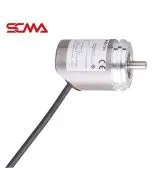
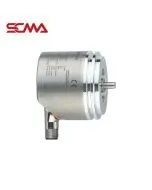
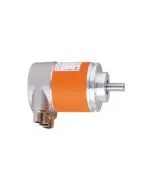
If you are looking for in-depth information about encoders and their industrial applications, you've come to the right place! This article by SCMA will take you on a journey through the world of encoders, from definitions and working principles to various types and techniques for selecting the right one for your specific needs. Let's dive in!
What is an Encoder?

An encoder, or Encoder, is an electronic device used to measure the position, speed, and direction of rotation of objects such as motors, shafts, or rotating axes. It converts this movement data into digital or analog electrical signals for transmission to control systems or other devices. Encoders are crucial components in automation, robotics, machinery, and applications requiring high accuracy and performance.
How Encoders Work
Most encoders consist of a light panel with alternating light slots and opaque barriers, along with a light sensor. When the object connected to the encoder rotates, the light panel rotates accordingly, allowing or blocking light in a predetermined pattern. The light sensor detects these changes and generates electrical pulses that are processed further to calculate position, speed, direction, or angle of rotation. This technology enables encoders to provide precise, fast, and stable movement data.
How to Use an Encoder?
Encoders are widely used in industries ranging from conveyor systems, automatic packaging machines, to high-resolution printers. Examples of their applications include:
- Connecting an Encoder to a motor shaft for speed control, position, and rotation
- Using an Encoder with the rollers of a conveyor belt to measure distance and speed
- Employing Encoders to check robot position feedback for precise operation
- Utilizing Encoders in servo motor systems for complex motion control
Additionally, encoders are used in other applications such as liquid level measurement, lift position checking, or controlling the angle of cameras and sensors.

Factors to Consider When Choosing an Encoder
When selecting the right encoder, consider the following factors:
- Type of Encoder - Choose one that suits your application, such as Incremental or Absolute, linear or rotary.
- Resolution - Select the appropriate pulses per revolution (PPR) to meet your requirements.
- Interface - Choose an output type, such as PNP, that matches the connected equipment.
- Environment - Consider the protection level (IP Rating) and materials suitable for your working environment.
- Shaft size and type - Evaluate shaft size, type, number of revolutions, speed, and torque requirements.
Choosing the right encoder will help your system operate accurately, reliably, and extend its lifespan.
Interested in Encoders? Contact SCMA Today!
If you are looking for encoders or other automation equipment for your work, SCMA offers a wide range of choices. We import high-quality products from global brands and specialize in selecting the right products to meet your needs. Our team of engineers is ready to consult, recommend, and design the best solutions for you, including installation, maintenance services, and training on usage. Contact us through any channel today to find a solution for your work.

Summary
Encoders are essential devices in industrial applications, particularly in automated systems or high-precision applications. Regardless of the industry you're in, understanding how they work, their types, and how to select them will help you design and use your system efficiently. However, if you need assistance, remember that SCMA is ready to serve you with high-quality encoders and expert advice. Contact us today to start your project.
Frequently Asked Questions
How does an Encoder work?
Encoder works by using a sensor to detect the movement of a light shield with alternating slits and opaque sections. When an object connected to the Encoder moves, the light shield changes position, causing the light to be blocked or passed in different ways. The sensor converts these changes into pulse signals, which are then analyzed to obtain accurate data on position, speed, and direction of movement. This method allows the Encoder to track movements in real-time.
How many types of Encoders are there?
Encoders can be divided into two main categories based on their usage, namely:
- Incremental Encoder - provides relative positional change data and is commonly found in industries.
- Absolute Encoder - gives precise digital position values without referencing a starting point, suitable for high-precision applications.
Each type may have subtypes such as linear or rotary, depending on the type of movement being measured.
What are Encoders and what do they do?
An Encoder is a type of sensor used to measure the rotation of an axis or shaft, providing data on degrees, speed, and direction of rotation in electrical signals. It is suitable for use with motors, servos, or rotating equipment. Encoders are often used in machine control, robotics, as well as drive and navigation systems.
How many phases do Encoders have?
Most encoders have three phases, namely:
- Phase A - The main pulse signal indicating the number of revolutions
- Phase B - A pulse signal that is offset from Phase A to indicate the direction of rotation
- Phase Z - One pulse per revolution used as a reference point (Index)
The arrangement and relationship of the three phases are used to analyze and calculate various values related to movement, such as position, speed, direction, and others.
What is Encoding?
Encoding is the process of converting data from one format to another for easier transmission, storage, or processing. For example, converting analog signals into digital ones, encoding text into secure codes for security purposes, or compressing data to reduce file size. In the case of encoders used in industrial applications, encoding refers to the conversion of movement data into electrical signals that can be easily utilized.
SCMA understands that using an encoder may involve complexity and numerous details to consider. However, we are ready to provide consultation and recommendations at every step with our team's expertise and a wide range of products from leading brands. We will help you find the best solution for your work and industry. Do not hesitate to contact us to start this important step in developing efficient and accurate automation systems with reliable encoder technology from SCMA. You are ready to move forward with us.