
SPECIAL PROMOTION — Up to 40% off across many product groups, until 31 December 2026 · Click to see all promotion itemsIFM, Sensor, Automation SystemMeasuring / Testing InstrumentsTemp Indicator, Control, T/C, RTD, TimerHeater, SCR Control, Solid State, Power Supply, Control CabinetField Measuring Instruments, Pressure Gauge, Level Control, Flow MeasurementEMC, Pneumatic, Solenoid ValveInspection Test Lamp, Head Light, Automotive Measuring InstrumentWeighing Scales, Marking Machine, PrintersEducational Training SystemsHot Line Tools & Equipment SPECIAL PROMOTION — Up to 40% off across many product groups, until 31 December 2026 · Click to see all promotion itemsIFM, Sensor, Automation SystemMeasuring / Testing InstrumentsTemp Indicator, Control, T/C, RTD, TimerHeater, SCR Control, Solid State, Power Supply, Control CabinetField Measuring Instruments, Pressure Gauge, Level Control, Flow MeasurementEMC, Pneumatic, Solenoid ValveInspection Test Lamp, Head Light, Automotive Measuring InstrumentWeighing Scales, Marking Machine, PrintersEducational Training SystemsHot Line Tools & Equipment View promotion items View all
Loadcell
What is a Load Cell? A Comprehensive Guide for Engineers and Technicians
In industrial manufacturing, "accuracy" is the heart of the matter. Whether it's weighing ingredients in the food industry, checking pressure on automotive parts, or managing stock in large silos, even minor errors can lead to significant damage. The critical equipment behind this accuracy is a "Load Cell," which acts like sensory organs that detect force and weight for automated systems. This article by SCMA’s engineering team will guide you through understanding this device thoroughly, from its operating principles, various types, to how to select the right one for your specific needs.
Types of Load Cells
- Single Point Load Cells are used in bench scales or electronic balances, supporting weights from as little as 1 kilogram to several hundred kilograms.
- Shear Beam Load Cells are suitable for applications requiring high weight support, such as platform scales, providing balanced weighing in all directions.
- S-Type Load Cells with an S-shaped design are used to measure tensile or compressive forces.
- Compression Load Cells directly measure compressive force, such as in truck scales.
- Tension Load Cells measure tensile forces, such as in crane systems.
- Canister Load Cells with a robust cylindrical shape support heavy weights, such as truck scales or silo tanks.
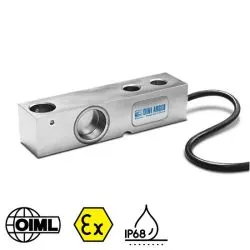 SBX1000-1KL 1000kg Class 3 Loadcell Shear BeamSpecial Price THB 8,480.00 Regular Price THB 10,600.00
What is a Load Cell?
Load Cell (Load Cell) is an electronic sensor that converts "mechanical force" (such as compression, tension, torque, or weight) into an "electrical signal" to display the obtained value or use it for controlling various systems. It is widely used in all types of digital weighing scales, from high-precision laboratory scales to large truck scales, and also in material testing to measure tensile and compressive forces. The key to its accuracy lies in a technology called "strain gauge" (Strain Gauge), which is the main component inside the load cell.
How a Load Cell Works
To understand how a load cell works, we need to look at what happens inside when force is applied. This involves the following key steps:
- Deformation Measurement: The structure of the load cell is usually made from flexible metal (such as aluminum or stainless steel). When weight or force is applied, this metal will deform slightly in a way that may not be visible to the naked eye.
- Resistance Change: On this metallic structure are strain gauges attached, which act as electric resistors sensitive to stretching and contracting. As the metal deforms, the strain gauge stretches or contracts accordingly, causing changes in its internal electrical resistance.
- Electrical Signal Conversion: These changes in resistance are converted into an electrical signal (typically measured in mV/V) through a circuit known as Wheatstone Bridge. This signal is highly precise and directly proportional to the applied force, allowing us to determine the true weight when processed through an Indicator or control system.
The Importance of Load Cells in Industry
Why can't most factories do without load cells? The answer lies in "efficiency and standardization control." In today's industrial world, we don't just use load cells to "weigh" but also to "control the production process" with utmost accuracy.
- Batching Control: In food, chemical, or pharmaceutical industries, ingredient mixing must be precise according to recipes. Load cells help control the release of ingredients into mixing tanks accurately, reducing waste and maintaining consistent product quality.
- Safety: In heavy lifting operations such as cranes (Crane), load cells act as safety devices that shut down operation when overloading occurs, preventing severe accidents.
- Automation: Modern machinery uses data from load cells to make operational decisions. For example, a robotic arm picking up parts can determine if it has gripped firmly enough by measuring the pressure force with this sensor.
What are the Types of Load Cells Used and How Many Kinds Are There?
Based on SCMA's experience in consulting factories nationwide, we find that selecting the right type of load cell for the job is the first step towards success. Choosing the wrong type can affect accuracy and lifespan. The main types include:
1. Single Point Load Cell (for small scales)
- Key Features: Designed to accurately measure weight even when objects are not placed in the center of the tray (Off-center load compensation)
- Usage: Suitable for desktop scales, price computing scales, small conveyor belt scales, and packaging machines
2. Bending Beam & Shear Beam Load Cell (for floor scales, tanks)
- Key Features: High durability, often installed in sets (e.g., 4 units for one platform), excellent at handling compression forces
- Usage: Suitable for floor scales, pallet scales, and medium-sized tank/hopper weighing applications
3. S-Type Load Cell (for tension and compression applications)
- Key Features: Shaped like an "S", designed to be easily suspended for installation
- Usage: Commonly used in hanging hopper scales, material tensile/compression testing machines, and converting mechanical scales into digital ones
4. Compression / Canister Load Cell (for high weight applications such as silos)
- Key Features: Cylindrical shape, robust and durable, capable of handling massive weights (from tons to hundreds of tons), good protection against water and dust
- Usage: Suitable for truck scales, large silos, and storage tanks with heavy materials
How to Choose the Right Load Cell for Your Application
Selecting a load cell is not just about shape; technical specifications must also be considered to achieve optimal results. Our engineers recommend a checklist of 4 points you should consider before purchasing:
1. Choosing the Correct Capacity (Load Rating)
Avoid choosing a capacity that matches your weight exactly! SCMA recommends "over-sizing" by selecting a load cell capacity about 30-50% higher than the total weight (container + product) or using a Safety Factor of 1.5 - 2 times to prevent damage from shock loads or accidental overloading.
2. Environmental Factors (IP Rating, Material, Temperature)
- General areas: Alloy Steel or Aluminum materials can be used
- Damp/food/chemical areas: Stainless Steel is necessary for rust and corrosion prevention, and IP67 or IP68 ratings (waterproof) should be chosen to allow thorough cleaning without damage.
- Hazardous areas: If used in explosive environments (e.g., oil refineries), explosion-proof models must be selected
3. Accuracy and Resolution
Consider the Combined Error or Accuracy Class (such as C3, C6); lower values indicate higher accuracy but also higher cost. For legal for trade weighing applications, load cells certified to international OIML standards are required.
4. Installation Style and Physical Size
Is space limited? What is the direction of force? Choosing a size and mounting point that aligns with existing machinery structures can significantly reduce on-site modification costs.
Applications of Load Cells in Various Industries
Load cells are embedded in almost every stage of production. Some real-world applications we commonly encounter include:
All Types of Scales
From precision scales in laboratories, waterproof scales on food production lines to truck scales weighing up to 80 tons, all rely on load cells as the core component for weight conversion.
Weighing and Inspection Systems (Checkweigher)
In high-speed production lines, checkweighers use fast-response load cells (High Speed) to immediately separate products that are underweight or overweight from the conveyor belt, ensuring every item meets standards.
Force Measurement in Material Testing
Engineers use load cells to measure material strength, such as pulling steel bars until they break or pressing tests on concrete's hardness. The data obtained is analyzed for safety in construction and manufacturing of components.
Tank & Silo Weighing
Rather than using float level sensors which may easily be inaccurate, modern factories prefer to install load cells at the legs of tanks or silos to weigh remaining raw materials accurately. This allows real-time stock monitoring and timely ordering of supplies.
Interested in Load Cells? Buy from SCMA Today!
If you are looking for high-quality load cells or need consultation on designing weighing systems for industrial plants, SCMA is ready to be your technical partner. We do more than just sell equipment; we curate top-tier global brands proven for durability and have a team of expert engineers who provide advice from selection through after-sales service to ensure your system works accurately and offers the best value for investment. You can view all SCMA products and services here.
Summary
A load cell is the heart of weighing, measuring, and automation systems in today's era. Understanding its working principles and selecting the right type not only ensures accurate data but also extends machinery lifespan and reduces long-term maintenance costs. Investing in quality and suitable load cells for your environment is the most worthwhile investment for industrial businesses.
Frequently Asked Questions
How many types of Load Cells are there?
Mainly classified by structural design and force reception, they include:
- Single Point (bench scales)
- Shear Beam/Bending Beam (floor scales/tanks)
- S-Type (suspended/drawn forces) and
- Compression/Canister (high weight capacity/trucks)
How do Load Cells work?
They operate based on the principle of strain gauges attached to a metal structure. When force is applied, the structure deforms slightly, changing electrical resistance which is then converted into an electrical signal representing weight.
How can I check if a load cell is faulty?
Initially, use a multimeter to measure input/output resistance values compared to spec sheets; significant deviations indicate potential damage. Alternatively, check insulation resistance between wires and the housing.
What are Load Cells priced at?
The price varies by type, weight capacity, and material, ranging from hundreds for small models up to tens of thousands or even hundred thousand baht for high-precision or explosion-proof models. It is recommended to contact an expert for a quote tailored to your specific needs.
This website uses cookies
We use cookies to make the site work properly, to understand how it is used, and to show content that is relevant to you. You choose which types to allow; strictly necessary cookies are always on. Privacy Policy
🤖 AI Assistant
Ask about products, specs and replacement models
Hello 👋 Ask us anything — find products, compare specs, or troubleshoot.
🗑 Clear history