
SPECIAL PROMOTION — Up to 40% off across many product groups, until 31 December 2026 · Click to see all promotion itemsIFM, Sensor, Automation SystemMeasuring / Testing InstrumentsTemp Indicator, Control, T/C, RTD, TimerHeater, SCR Control, Solid State, Power Supply, Control CabinetField Measuring Instruments, Pressure Gauge, Level Control, Flow MeasurementEMC, Pneumatic, Solenoid ValveInspection Test Lamp, Head Light, Automotive Measuring InstrumentWeighing Scales, Marking Machine, PrintersEducational Training SystemsHot Line Tools & Equipment SPECIAL PROMOTION — Up to 40% off across many product groups, until 31 December 2026 · Click to see all promotion itemsIFM, Sensor, Automation SystemMeasuring / Testing InstrumentsTemp Indicator, Control, T/C, RTD, TimerHeater, SCR Control, Solid State, Power Supply, Control CabinetField Measuring Instruments, Pressure Gauge, Level Control, Flow MeasurementEMC, Pneumatic, Solenoid ValveInspection Test Lamp, Head Light, Automotive Measuring InstrumentWeighing Scales, Marking Machine, PrintersEducational Training SystemsHot Line Tools & Equipment View promotion items View all
Audio Impedance Testers
Audio Impedance Testers (Speaker Impedance Meters) are what?
Audio Impedance Testers or commonly called Speaker Impedance Meters are electronic measuring tools designed to measure the total resistance in an alternating current (AC Resistance) circuit of a sound system, particularly in speakers and signal cables.
The significant difference is that general meters (Multimeter) will measure DC Resistance but this type of meter measures AC Impedance which changes according to the frequency of the audio signal.
Why measure impedance? In sound systems, especially Public Address Systems or systems with many connected speakers, knowing the impedance value is important for:
- Preventing amp damage: If connecting speakers results in an overall impedance that is too low, it will cause the amplifier to work beyond its capacity and may burn out.
- Power Matching: Helps calculate whether the wattage of all connected speakers matches the power output of the amp.
- Checking for faults: Used to check if any speaker has failed or there's a short circuit in the signal line.
General Usage
-
Public Address System (70V/100V Line) work: Technicians use this device to measure at the end of the signal line before plugging into the amp back to check if the total impedance of all speakers in the building is within a safe range.
-
Car audio installation work: Check whether series or parallel speaker connections match the designed values.
-
Speaker quality check: Check if the speakers have degraded or deviated from factory specifications.
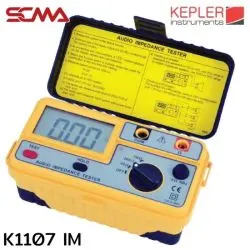 K1107 IM Ranges 0 Ohm~20k Ohm (Audio Impedance Testers)Special Price THB 6,160.00 Regular Price THB 7,700.00
Frequently Asked Questions (FAQs)
-
Q: Why does a general-purpose multimeter (VOM) measure speaker impedance differently from the value indicated on the speaker?
-
A: Because the multimeter measures Resistance (DC), which is direct current resistance. However, speakers operate with alternating current signals. The value indicated on the speaker is Impedance (AC), and an impedance meter would provide a more accurate measurement.
-
-
Q: Is it necessary to disconnect the speaker wires from the amp before measuring?
-
A: Absolutely necessary. Do not measure while the wires are still connected to an active amp as the voltage from the amp can cause damage to the meter and give inaccurate readings due to the internal circuitry of the amp being in parallel with the speaker.
-
-
Q: What happens if measured impedance is "lower" than the amp's specs?
-
A: The amp will be overloaded and overheat, potentially causing the audio amplification circuit to burn out or fail.
-
-
Q: Does impedance change with speaker wire length?
-
A: Yes, the longer and thinner the wire, the higher its resistance will be, increasing overall impedance. This may result in lower volume or reduced sound quality.
-
-
Q: Can an impedance meter check for a "broken speaker coil"?
-
A: Yes, if the meter reads Infinity or an abnormally high value, it indicates a broken voice coil or disconnected wire.
-
-
Q: If measuring multiple speakers in parallel, does impedance increase or decrease?
-
-
A: Decreases. The more speakers connected in parallel, the lower the overall impedance (be cautious not to go below what the amp can handle).
-
-
-
Q: Can an impedance meter measure "microphones"?
-
A: Yes, to check if the microphone is Low Impedance or High Impedance for proper mixer channel selection.
-
-
Q: Can this meter check the "phase (Phase)" of speakers?
-
A: Generally, an impedance meter only measures resistance but does not indicate phase (+/-). To check phase, a separate tool called a Phase Checker is required.
-
This website uses cookies
We use cookies to make the site work properly, to understand how it is used, and to show content that is relevant to you. You choose which types to allow; strictly necessary cookies are always on. Privacy Policy
🤖 AI Assistant
Ask about products, specs and replacement models
Hello 👋 Ask us anything — find products, compare specs, or troubleshoot.
🗑 Clear history