
SPECIAL PROMOTION — Up to 40% off across many product groups, until 31 December 2026 · Click to see all promotion itemsIFM, Sensor, Automation SystemMeasuring / Testing InstrumentsTemp Indicator, Control, T/C, RTD, TimerHeater, SCR Control, Solid State, Power Supply, Control CabinetField Measuring Instruments, Pressure Gauge, Level Control, Flow MeasurementEMC, Pneumatic, Solenoid ValveInspection Test Lamp, Head Light, Automotive Measuring InstrumentWeighing Scales, Marking Machine, PrintersEducational Training SystemsHot Line Tools & Equipment SPECIAL PROMOTION — Up to 40% off across many product groups, until 31 December 2026 · Click to see all promotion itemsIFM, Sensor, Automation SystemMeasuring / Testing InstrumentsTemp Indicator, Control, T/C, RTD, TimerHeater, SCR Control, Solid State, Power Supply, Control CabinetField Measuring Instruments, Pressure Gauge, Level Control, Flow MeasurementEMC, Pneumatic, Solenoid ValveInspection Test Lamp, Head Light, Automotive Measuring InstrumentWeighing Scales, Marking Machine, PrintersEducational Training SystemsHot Line Tools & Equipment View promotion items View all
Emergency Stop
Emergency Stop (E-Stop): Guide to Selecting and Installing for Maximum Safety
In high-risk industrial environments, safety is no joke. A single accident can result in significant loss of life and property. One device that acts as the "frontline" defense against such incidents is the Emergency Stop or E-Stop—a small yet crucial component that immediately cuts off machine operation when an unexpected event occurs. This article by SCMA will take you through essential information that engineers and factory owners need to know, from how it works to selecting the right switch according to international standards.
Important Tips About Emergency Stop
- An E-Stop is not a regular on/off button as it directly connects to the safety circuit.
- Its operation is connected to Safety Relay, Contactor, or PLC circuits.
- Once pressed, the system stops immediately and cannot be used again until it is reset and restarted.
View Emergency Stop Catalogue : Click Here
 MB200EE MB Series Emergency Stop EMASราคาโปรดติดต่อเจ้าหน้าที่
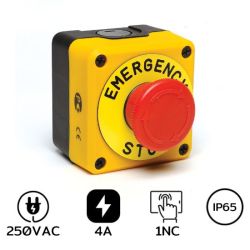 P1EC400E40K Emergency BoxSpecial Price THB 360.00 Regular Price THB 450.00
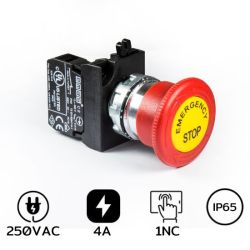 CM200EE Emergency Stop 22mm 1NC With LabelSpecial Price THB 296.00 Regular Price THB 370.00
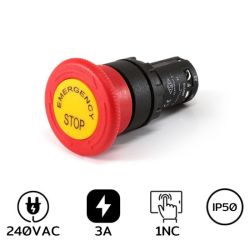 MB200EE Emergency Stop 22mm 1NC With LabelSpecial Price THB 124.00 Regular Price THB 155.00
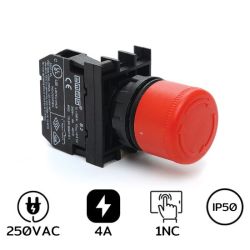 B200E30 1NC Emergency Stop 22mm.Special Price THB 144.00 Regular Price THB 180.00
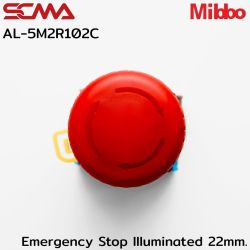 AL-5M2R102C Emergency Stop Illuminated 22mm. 24VAC/DC RedSpecial Price THB 187.50 Regular Price THB 250.00
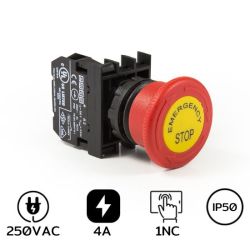 B200EE Emergency Stop 22mm. 1NC With LabelSpecial Price THB 140.00 Regular Price THB 175.00
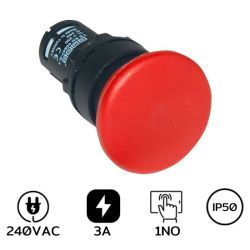 MB100MK Push Button Mushroom Head 22mm. 1NO REDSpecial Price THB 112.00 Regular Price THB 140.00
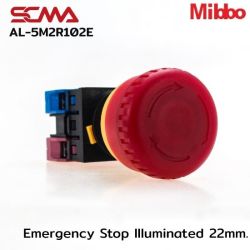 AL-5M2R102E Emergency Stop Illuminated 22mm. 220VAC/DC Red MibboSpecial Price THB 187.50 Regular Price THB 250.00
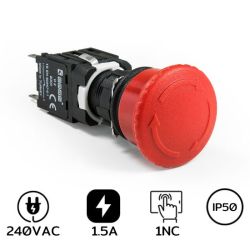 D200YE30K Emergency Stop 16mm. 1NCSpecial Price THB 200.00 Regular Price THB 250.00
What is an Emergency Stop?
Emergency Stop (often abbreviated as E-Stop) or in Thai, the emergency stop button and switch, are safety devices designed to immediately halt the operation of machinery or automated systems when a crisis occurs. This helps protect workers from injury, reduces damage to equipment, and prevents severe accidents from escalating. A distinctive feature of these devices is their easy-to-spot design; international standards mandate that push buttons must be red (Red) against a yellow (Yellow) background, and mushroom head switches are commonly used for quick and easy activation in emergencies.
What's the Difference Between an Emergency Stop and a General Stop Button?
The most common misunderstanding on the job is using emergency stop buttons instead of regular stop buttons, which is incorrect. The key differences include:
- General Stop (Normal Stop): Functions to halt machinery according to normal operational procedures (Process Stop). Systems may gradually slow down or clear workpieces before stopping to prevent damage. It breaks the control circuit.
- Emergency Stop: Directly and immediately cuts power supplied to actuators (Immediate Stop) without regard for whether processes are complete. The goal is to break electrical circuits as quickly as possible to stop danger. E-Stop also has a latching mechanism that locks itself when pressed, requiring manual reset before machinery can resume operation. Unlike general stop buttons which are momentary contact.
Why Are Emergency Stop Buttons Important in Factories?
Based on our experience managing systems for various industrial plants, having high-quality and properly installed emergency stop switches is crucial for five main reasons:
- Immediate Risk Reduction: When machine parts malfunction or workers' clothing gets entangled with a conveyor belt, pressing this button immediately stops the machinery to mitigate risks.
- Rapid Response: Designed for ease of use, anyone can press it upon seeing an incident without needing special skills or aiming.
- Loss Reduction: Stopping machines in time reduces damage to expensive equipment and production downtime costs.
- Legal Compliance: Required by safety laws and industrial standards.
- Built Confidence: Workers feel more secure knowing reliable safety systems are available.
How Does an Emergency Stop Switch Work?
To ensure 100% functionality during emergencies, emergency stops have special mechanisms beyond regular switches.
Failsafe Circuit Break Mechanism
The core of E-Stop is the failsafe principle: if any switch or wiring errors occur (such as broken wires or loose connections), the system must "stop" for safety, not continue operating.
No and NC Contact States
According to safety standards, emergency stop switches must always be wired in an NC (Normally Closed) configuration. In normal conditions, current flows through; when pressed or if wires break, circuits open, stopping machinery instantly. Unlike regular NO (Normally Open) switches where broken wires prevent pressing.
Latching Mechanism Operation
When the E-Stop button is pressed, it mechanically locks in the "off" position and does not automatically reset until manually unlocked to restart machinery after issues are resolved.
Get to Know Various Types of Emergency Stops Used
Selecting the right type for specific applications is crucial. Here are common types found in industries:
1. Push-Pull Type
A standard type, used by pressing down to stop and pulling up to reset (Release). Suitable for control panel installations.
2. Twist-to-Release Type
Very popular today; press to stop and twist the mushroom head along arrows to release. Prevents accidental releases better than push-pull types.
3. Pull-Cord/Rope-Pull Type
A long cord runs alongside machinery like conveyors, allowing pulling at any point to halt operations. Ideal for long machines.
4. Foot-Operated Type
Used when both hands are occupied or in areas where pressing buttons is impractical; foot-operated switches provide quick emergency stops.
5. Key-Operated Type
A key must be used to unlock and restart machinery after pressing the stop button, suitable for large dangerous machines needing supervisor approval before restarting.
How to Choose an Emergency Stop That's Appropriate and Safe?
Purchasing emergency stops based solely on price may not suffice as they are life-saving devices. Here’s advice from our SCMA experts:
Type of Machinery and Usage
If it's general machinery, twist-to-release types usually suffice; for long conveyors, rope-pull types are better; high-vibration machines need vibration-resistant switches.
Mushroom Head Size Selection
Standard size is 40mm but larger sizes like 60mm may be needed in thick-gloved areas or where visibility is crucial for ease of pressing.
Safety Standards Compliance (ISO 13850, IEC 60947)
Always check if products meet international standards such as ISO 13850 and IEC 60947-5-5 to ensure proper emergency function.
Durability in Environmental Conditions (IP Rating)
In food production lines with water washing or dusty environments, choose switches with high IP ratings like IP65/IP67 for protection against dust and water damage.
Installation and Usage Precautions
Proper Installation Positioning
The key principle is "easy accessibility" (Easy Accessibility). Install at appropriate heights (0.6 - 1.7 meters) without obstructions, ensuring emergency stops are placed in all risky machine areas.
Maintenance and Regular Testing of Systems
Emergency Stops rarely get pressed; thus regular PM plans to test functionality every 3-6 months are essential.
Frequent Usage Errors
- Installing switches out of reach or obstructed by objects.
- Miswiring using NO contacts instead of NC.
- Selecting non-industry standard switches or modifying regular ones for emergency use.
If you need more information on global safety mechanisms, visit Kill switch - Wikipedia for an overview of emergency shutdown systems.
If Interested in Emergency Stops, SCMA is Ready to Serve!
Safety isn't something to wait on. If you're looking for high-quality emergency stops meeting international standards or need safety system design consultations, SCMA is your trusted technical partner. We offer leading global brands with precision and durability, plus expert engineers providing advice from selection to installation for maximum efficiency and safety in production lines. Learn more about our services and solutions at Our Services.
Summary
Emergency stops are indispensable safety devices in industrial plants. Properly selecting and installing them according to standards not only complies with laws but also invests in protecting your most valuable assets: "worker lives" and "machinery." Paying attention to these details distinguishes ordinary factories from internationally-standardized ones.
Frequently Asked Questions
How Many Types of Emergency Stops Are There?
Varieties include push-pull, twist-to-release, rope pull, and foot-operated types. The most popular for control panels is the twist-to-release mushroom head red button.
How Does an Emergency Stop Work?
It works by immediately cutting power through NC contacts when pressed; mechanisms lock to prevent machinery from restarting until manually reset.
What Are the Prices of Waterproof Enclosed Emergency Stops?
Pricing varies based on brand, materials, and IP ratings. High-standard waterproof models (IP65/67) cost more than regular ones. For accurate quotes for specific specs, contact SCMA directly.
This website uses cookies
We use cookies to make the site work properly, to understand how it is used, and to show content that is relevant to you. You choose which types to allow; strictly necessary cookies are always on. Privacy Policy
🤖 AI Assistant
Ask about products, specs and replacement models
Hello 👋 Ask us anything — find products, compare specs, or troubleshoot.
🗑 Clear history