
SPECIAL PROMOTION — Up to 40% off across many product groups, until 31 December 2026 · Click to see all promotion itemsIFM, Sensor, Automation SystemMeasuring / Testing InstrumentsTemp Indicator, Control, T/C, RTD, TimerHeater, SCR Control, Solid State, Power Supply, Control CabinetField Measuring Instruments, Pressure Gauge, Level Control, Flow MeasurementEMC, Pneumatic, Solenoid ValveInspection Test Lamp, Head Light, Automotive Measuring InstrumentWeighing Scales, Marking Machine, PrintersEducational Training SystemsHot Line Tools & Equipment SPECIAL PROMOTION — Up to 40% off across many product groups, until 31 December 2026 · Click to see all promotion itemsIFM, Sensor, Automation SystemMeasuring / Testing InstrumentsTemp Indicator, Control, T/C, RTD, TimerHeater, SCR Control, Solid State, Power Supply, Control CabinetField Measuring Instruments, Pressure Gauge, Level Control, Flow MeasurementEMC, Pneumatic, Solenoid ValveInspection Test Lamp, Head Light, Automotive Measuring InstrumentWeighing Scales, Marking Machine, PrintersEducational Training SystemsHot Line Tools & Equipment View promotion items View all
Bobbin heater
What is a Bobbin Heater? How to Choose the Right One for Heating Chemicals
In industrial manufacturing processes, especially in metal plating or chemical preparation work, engineers and maintenance teams often face the problem of "corrosion damage to heaters," which leads to production line downtime and escalating repair costs. Choosing the right equipment is crucial. A Bobbin Heater, designed specifically for heating liquids and chemicals, provides a solution with its unique features. This article delves into the structure, operation, and techniques for selecting the most cost-effective and safe chemical heater.
Features of Bobbin Heaters
Stainless Type
- Suitable for heating or boiling viscous liquids that do not react with SUS316.
- Tube material is stainless steel SUS316.
- Tube diameter ø50 mm.
- Initial length is 625 mm.
- Power rating 3000W 220V (single phase) / 3000W (three-phase).
- Top immersion installation.
Quartz Type
- Suitable for heating or boiling liquids and all types of chemical solutions.
- Tube diameter ø34 mm.
Benefits of Using Bobbin Heaters
- The stainless type is suitable for heating or boiling viscous and sticky liquids that do not react with SUS316 tubes, such as asphalt and adhesives.
- The quartz type is ideal for heating or boiling chemical solutions.
View the Bobbin Heater Catalog Click Here
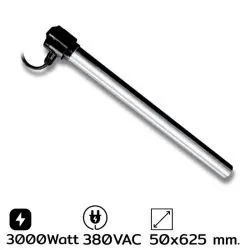 Custom Order Only Stainless Steel Chemical Fluid Heating Element (BOBBIN HEATER) Model SS-6303 50 x 625 mm. 3000W 380 VAC SANGISpecial Price THB 6,821.00 Regular Price THB 9,095.00
Delivery: 30 ต.ค. 2569
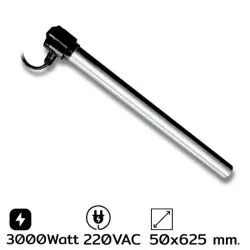 Custom Order Only Stainless Steel Chemical Fluid Heating Element (BOBBIN HEATER) Model SS-6302 50 x 625 mm. 3000W 220 VAC SANGISpecial Price THB 6,821.00 Regular Price THB 9,095.00
Delivery: 30 ต.ค. 2569
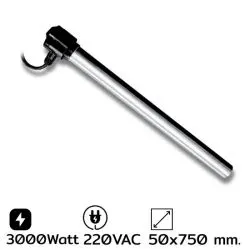 Custom Order Only Stainless Steel Chemical Fluid Heating Element (BOBBIN HEATER) Model SS-7302 50 x 750 mm 3000W 220 VAC SANGISpecial Price THB 7,303.00 Regular Price THB 9,737.00
Delivery: 30 ต.ค. 2569
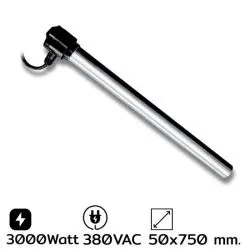 Custom Order Only Stainless Steel Chemical Fluid Heating Element (BOBBIN HEATER) Model SS-7303 50 x 750 mm 3000W 380 VAC SANGISpecial Price THB 7,303.00 Regular Price THB 9,737.00
Delivery: 30 ต.ค. 2569
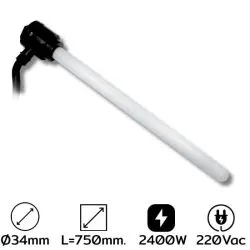 SQ-5242-S Dia 34x500 mm 2400w 220v 1 PhaseSpecial Price THB 5,352.00 Regular Price THB 6,690.00
Delivery: 30 ต.ค. 2569
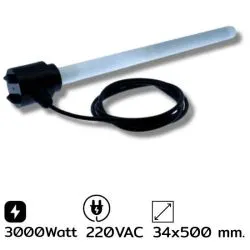 Custom Made Quartz Heater (BOBBIN HEATER) Model SQ-5302 34 x 500 mm. 3000W 220 VAC SANGISpecial Price THB 6,000.00 Regular Price THB 8,000.00
Delivery: 30 ต.ค. 2569
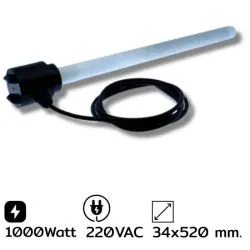 Custom Made Quartz Heater (BOBBIN HEATER) Model SQ-5102 34 x 520 mm. 1000W 220 VAC SANGISpecial Price THB 6,150.00 Regular Price THB 8,200.00
Delivery: 30 ต.ค. 2569
What is a Bobbin Heater: How it Works and Its Structure
A Bobbin Heater (bobbin heater) belongs to the category of immersion heaters designed intelligently to address maintenance issues. The main structure consists of "heating elements" wound around a ceramic core (Bobbin), inserted into a protective sheath, which is the only part that comes in contact with liquids. Its working principle involves passing an electric current through resistance wire to generate heat, then transferring it through the sheath to the liquid. What sets Bobbin Heaters apart from regular rod heaters is that if the heating element breaks, you can pull out and replace just the inner core without emptying the tank, significantly reducing downtime, aligning with SCMA's goal of minimizing production stoppages.
Definition and Meaning of a Bobbin Heater in Engineering Terms
In engineering terms, a Bobbin Heater is defined as an immersion heat exchanger that emphasizes high safety and durability. It consists of resistance wire wound around a high-temperature ceramic core, housed within a material tube chosen according to the acidity or alkalinity of the application site. Whether it's SUS316L for general use or other special materials, this design helps distribute heat evenly and prevents direct contact between the coil and chemicals, reducing risks of short circuits and explosions due to corrosion. You can learn more about why Bobbin Heaters are the best choice for liquids and gases from Tempsens Engineering Article.
Applications of Bobbin Heaters in Various Industries
The flexibility in selecting sheath materials makes Bobbin Heaters a star in various industries, from boiling water to concentrated chemicals.
Using and Boiling Chemicals: Suitable Types of Liquids
Selecting the right Bobbin Heater for chemicals starts with identifying the type of liquid. If it's mildly corrosive or neutral, high-grade stainless steel can be used; however, highly concentrated acids require special materials. Choosing incorrect materials not only damages the heater but may also contaminate the chemical in the tank due to corrosion.
Applications in Metal Plating and Wastewater Treatment Industries
The metal plating industry (such as chromium, nickel, or zinc plating) requires constant temperature control for quality. Chemical heating immersion heaters are most commonly used here, often choosing titanium or quartz sheaths to withstand the corrosion of acids and bases in plating tanks, including wastewater treatment systems with fluctuating pH levels.
Applications with High Viscosity Liquids
For high viscosity liquids such as boiler oil, glue, or asphalt, using a Bobbin heater requires caution regarding "Watt Density" (watts per area). If the wattage is too high, liquid around the tube will carbonize and form thick scale, causing the heater to overheat and fail eventually. For heating oils or viscous liquids, consulting an expert for proper load calculation is recommended.
Precautions When Using with Various Chemicals
Safety is paramount when working with chemicals and electricity. Liquid level: Install a liquid level switch to ensure the tank is always full of liquid. Allowing the heater to operate in air (dry firing) can cause glass or tubes to explode immediately. Scale buildup: In plating or boiling hard water, regularly clean scale deposits on the tube as they act as thermal insulation, causing overheating and coil failure. For more information about heaters for general boiling applications, read our Water Heater Knowledge Article.
Technical Specifications: How to Choose a Bobbin Heater Appropriately
To achieve maximum efficiency and longevity, selecting specifications requires careful engineering considerations as follows:
Selecting Materials: Comparing Stainless Steel SUS304 vs. SUS316L
The sheath material is the front line against chemicals; choosing incorrectly can be a disaster.
| Material | Prominent Features | Appropriate Use | Cautions |
| SUS304 | Durable, cost-effective | Clean water, vegetable oil, air | Not resistant to acids and bases or saltwater |
| SUS316L | High corrosion resistance, suitable for harsh environments | General use, wastewater treatment, chemical processing | Higher cost than SUS304 |
| Quartz | Excellent chemical resistance, high temperature tolerance | Highly corrosive environments, concentrated acids | Fragile and expensive to replace if broken |
| Titanium | High corrosion resistance, lightweight | Seawater, highly corrosive chemicals, plating tanks | Most expensive option |
Calculating Required Wattage (Watt)
Accurate watt calculation saves energy and achieves the desired temperature. The basic formula is:
$$kW = \frac{Volume (Liters) \times \Delta T (Desired Temp - Initial Temp)}{860 \times Time (Hours) \times Efficiency (0.8-0.9)}$$ where 860 is a constant for unit conversion.
This calculation requires precision; underestimating can cause the heater to work continuously, shortening its lifespan, while overestimating may lead to overshoot and wasted energy.
Selecting Tubing Size and Length in Relation to Container
Tubing size must match container dimensions, leaving at least 5-10 cm clearance from the bottom and walls for liquid circulation. Installing immersion heaters too close to walls can damage plastic or fiberglass tanks due to heat accumulation.
Voltage (Voltage) and Electrical System Connection
Thai factories use 220V (single phase) and 380V (three-phase). Incorrect wiring, such as connecting a 220V heater to 380V or vice versa, can cause immediate failure. Always check the nameplate before installation.
If You're Interested in Bobbin Heaters, SCMA Has Them Available Today!
At SCMA, we position ourselves as technical partners who understand real factory issues. We offer high-quality and premium-grade materials like SUS316L and Quartz for maximum durability, along with a team of expert engineers providing consultation from watt calculation to system design tailored to each chemical type. Enjoy fast and comprehensive after-sales service in major areas such as EEC and the North, ensuring smooth and cost-effective production processes.
Summary
Selecting a Bobbin Heater for chemical heating isn't just about choosing wattage but also considering "material" that can withstand chemical corrosion and "design" that ensures user safety. Investing in high-quality heaters and accurate calculations will reduce hidden costs from maintenance and production downtime risks. Remember, expertise in selecting equipment is the first step to success in manufacturing processes.
Frequently Asked Questions
How does a Bobbin Heater differ from a Screw Plug Immersion Heater?
A Bobbin Heater is a subset of immersion heaters but has the advantage of being able to replace heating elements without unscrewing them, eliminating the need to empty liquids. This makes maintenance more convenient compared to screw plug types that are permanently fixed.
Should I choose Quartz or Titanium for plating applications?
This depends on the type of plating solution; highly corrosive acids can be better handled by quartz at a lower cost, but it's fragile and may break easily. For risk-prone environments with potential impacts, titanium is safer and more economical in the long run.
Why do heaters fail often even when wattage is correct?
The main reasons are:
1. Incorrect material selection causing sheath failure and chemical contact with coils
2. Thick scale buildup preventing heat dissipation
3. Liquid level dropping (dry firing) can cause immediate heater failure; always install a liquid level sensor.
This website uses cookies
We use cookies to make the site work properly, to understand how it is used, and to show content that is relevant to you. You choose which types to allow; strictly necessary cookies are always on. Privacy Policy
🤖 AI Assistant
Ask about products, specs and replacement models
Hello 👋 Ask us anything — find products, compare specs, or troubleshoot.
🗑 Clear history