
SPECIAL PROMOTION — Up to 40% off across many product groups, until 31 December 2026 · Click to see all promotion itemsIFM, Sensor, Automation SystemMeasuring / Testing InstrumentsTemp Indicator, Control, T/C, RTD, TimerHeater, SCR Control, Solid State, Power Supply, Control CabinetField Measuring Instruments, Pressure Gauge, Level Control, Flow MeasurementEMC, Pneumatic, Solenoid ValveInspection Test Lamp, Head Light, Automotive Measuring InstrumentWeighing Scales, Marking Machine, PrintersEducational Training SystemsHot Line Tools & Equipment SPECIAL PROMOTION — Up to 40% off across many product groups, until 31 December 2026 · Click to see all promotion itemsIFM, Sensor, Automation SystemMeasuring / Testing InstrumentsTemp Indicator, Control, T/C, RTD, TimerHeater, SCR Control, Solid State, Power Supply, Control CabinetField Measuring Instruments, Pressure Gauge, Level Control, Flow MeasurementEMC, Pneumatic, Solenoid ValveInspection Test Lamp, Head Light, Automotive Measuring InstrumentWeighing Scales, Marking Machine, PrintersEducational Training SystemsHot Line Tools & Equipment View promotion items View all
RTD
What is RTD?
RTD stands for Resistance Thermometers and is one of the types of temperature sensors or temperature probes that convert analog voltage signals to digital signals in relation to temperature. The other two types are Thermocouples (thermocouple) and Thermistor (thermistor), which are also temperature sensors.
Benefits of RTD
- RTDs or Resistance Thermometers offer high accuracy and reliability.
- They do not degrade easily, ensuring stability and long-term use.
- They can respond to subtle temperature changes.
- Made from durable materials that withstand various environments.
- Easy to calculate temperature values.
- Suitable for use in a wide range of industries.
The most commonly used type is PT100 (Platinum 100), which means it is made from platinum and has a resistance of 100 Ω (ohms) at temperatures not exceeding 85 °C.
View RTD Catalog Click here
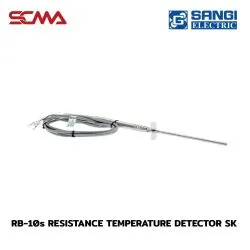 RB-10S RESISTANCE TEMPERATURE DETECTOR SKราคาโปรดติดต่อเจ้าหน้าที่
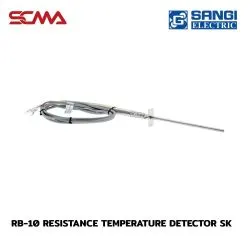 RB-10 RESISTANCE TEMPERATURE DETECTOR SKราคาโปรดติดต่อเจ้าหน้าที่
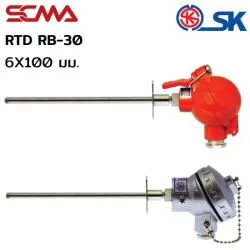 RB-30 6X100mm PT-100 RTDSpecial Price THB 928.00 Regular Price THB 1,160.00
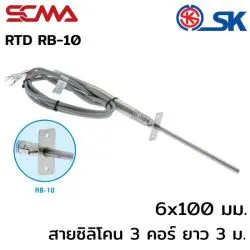 RB-10 6x100mm RTD Silicone 3 Core 3M PT-100Special Price THB 896.00 Regular Price THB 1,120.00
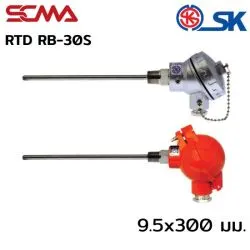 RB-30S 9.5X300mm RTD Thread 1/2" NPT PT-100Special Price THB 1,424.00 Regular Price THB 1,780.00
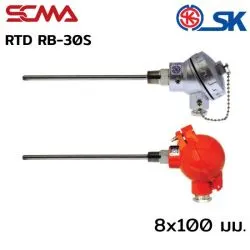 RB-30S 8X100mm RTD 1/2" NPT PT-100Special Price THB 1,328.00 Regular Price THB 1,660.00
Delivery: 30 ต.ค. 2569
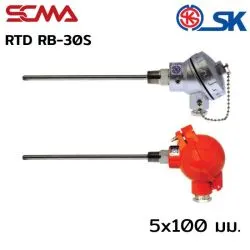 RB-30S 5X100mm RTD Thread 3/8" NPT PT-100Special Price THB 1,056.00 Regular Price THB 1,320.00
Delivery: 30 ต.ค. 2569
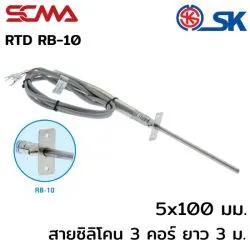 RB-10 5x100mm RTD Silicone 3 Core 3M PT-100Special Price THB 896.00 Regular Price THB 1,120.00
Delivery: 30 ต.ค. 2569
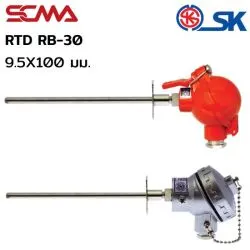 RB-30 9.5X100mm PT-100 RTDSpecial Price THB 880.00 Regular Price THB 1,100.00
Delivery: 30 ต.ค. 2569
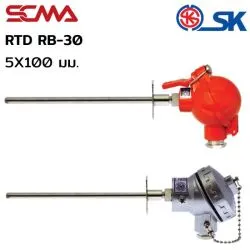
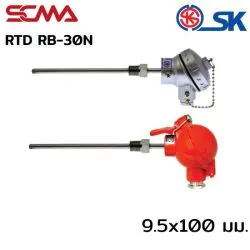 RB-30N 9.5X100mm SK RTD 3/8" NPT PT-100Special Price THB 1,360.00 Regular Price THB 1,700.00
Delivery: 30 ต.ค. 2569
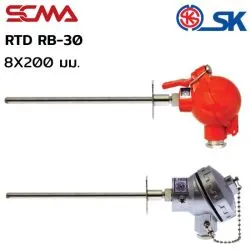 RB-30 8X200mm PT-100 RTDSpecial Price THB 1,080.00 Regular Price THB 1,350.00
Delivery: 30 ต.ค. 2569
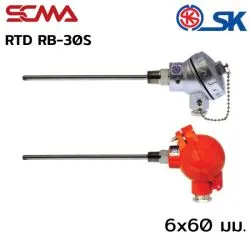 RB-30S 6X60mm RTD 3/8" NPT PT-100Special Price THB 1,120.00 Regular Price THB 1,400.00
Delivery: 30 ต.ค. 2569
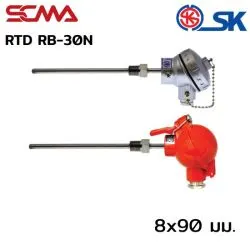 RB-30N 8X90mm RTD 1/2" NPT PT-100Special Price THB 1,120.00 Regular Price THB 1,400.00
Delivery: 30 ต.ค. 2569
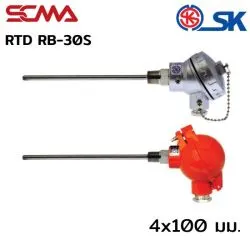 RB-30S 4X100mm RTD Thread 1/2" NPT PT-100Special Price THB 1,200.00 Regular Price THB 1,500.00
Delivery: 30 ต.ค. 2569
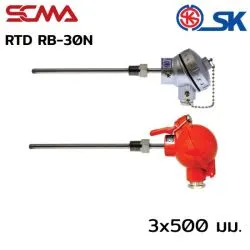 RB-30N 3X500mm RTD Thread 1/2" NPT PT-100Special Price THB 1,280.00 Regular Price THB 1,600.00
Delivery: 30 ต.ค. 2569
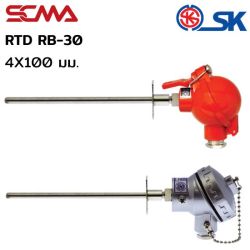 RB-30 4X100mm PT-100 RTDSpecial Price THB 1,120.00 Regular Price THB 1,400.00
Delivery: 30 ต.ค. 2569
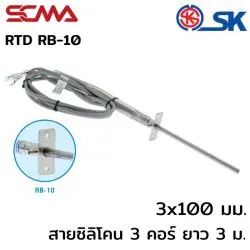 RB-10 3x100mm RTD Silicone 3 Core 3M PT-100Special Price THB 923.00 Regular Price THB 1,230.00
Delivery: 30 ต.ค. 2569
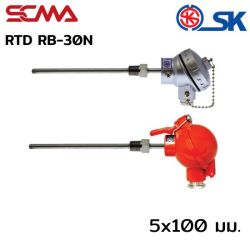 RB-30N 5X100mm RTD Thread 1/2" NPT PT-100Special Price THB 1,080.00 Regular Price THB 1,350.00
Delivery: 30 ต.ค. 2569
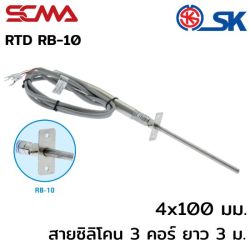 RB-10 4x100mm RTD Silicone 3 Core 3M PT-100Special Price THB 880.00 Regular Price THB 1,100.00
Delivery: 30 ต.ค. 2569
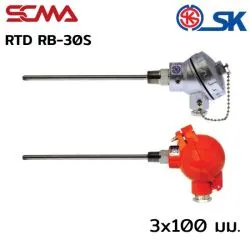 RB-30S 3X100mm RTD Thread 1/2" PT PT-100Special Price THB 1,240.00 Regular Price THB 1,550.00
Delivery: 30 ต.ค. 2569
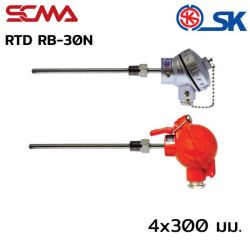 RB-30N 4X300mm RTD Thread 1/2" NPT PT-100Special Price THB 1,224.00 Regular Price THB 1,530.00
Delivery: 30 ต.ค. 2569
What is RTD? Working Principle, Types and Applications
Are you wondering what an RTD is and how it differs from other temperature sensors? An RTD (Resistance Temperature Detector) is one of the most accurate temperature measuring devices used in industrial plants. This article will take a deep dive into RTD sensors, covering everything from their working principle to various types and selecting them for optimal process control to achieve the most precise measurements. If you need an engineering team on-site or require urgent advice, click here to view our services for free consultation.
What is RTD?
RTD stands for Resistance Temperature Detector, also known as resistance thermometers in academic terms. It is a temperature sensor that operates based on the electrical properties of metals, meaning "electrical resistance changes with temperature." The material most commonly used to make RTDs is platinum (Pt) due to its high stability and excellent linearity, making it highly popular for applications requiring high precision.
Definition of RTD (Resistance Temperature Detector)
RTD is a type of transducer that converts physical temperature into electrical resistance (Ohm) before passing it on to a thermometer or controller for conversion back into temperature readings. If you want to learn more about sensors, read further at What is a Temperature Sensor?
Working Principle of RTD
RTD (Resistance Temperature Detector) works based on the fact that
the electrical resistance of metals changes with temperature.
Below is a step-by-step explanation of how RTD converts “resistance” into “temperature.”
RTDs are made from pure metal (most commonly platinum).
When temperature increases → resistance increases.
When temperature decreases → resistance decreases.
This relationship is quite linear and stable, making it ideal for accurate temperature measurement.
Common Examples:
Pt100 → Resistance = 100 Ω at 0°C
Pt1000 → Resistance = 1000 Ω at 0°C
Relationship between resistance and temperature
The RTD relationship graph is more linear than other types of sensors, resulting in minimal error when reading values. This is especially true for the -200°C to 600°C range which covers almost all processes in a plant. Read more about how RTD works
Types of RTD to Know About
Choosing the right type of RTD wire is crucial because the number of wires directly affects measurement accuracy, especially when the measurement point is far from the control panel.
Two-Wire Configuration (2-Wire)
This is the most cost-effective option but has the lowest accuracy because the readout device includes the resistance of the wires, leading to a higher temperature reading than actual. Not recommended for applications requiring precision.
Three-Wire Configuration (3-Wire)
This is an industry standard; the third wire compensates for the resistance of the wires (Lead wire compensation), resulting in highly accurate readings. It is most commonly used in general industrial settings.
Four-Wire Configuration (4-Wire)
Provides the highest accuracy by completely eliminating the effect of wire resistance. Often used in calibration labs or where multi-digit precision is required.
Clear Comparison: What's the Difference Between RTD and Thermocouple?
Many people are confused about what a thermocouple is and how it differs from an RTD? A thermocouple works on the principle of voltage (Voltage) generated by two different metals, whereas an RTD operates based on resistance. If asked what a thermocouple is in terms of usage, it's a choice for "high-temperature" applications and is "cost-effective."
Comparison Table (Accuracy, Temperature Range, Price, Response)
|
Comparison Topic |
RTD (Pt100) |
Thermocouple (Type K) |
|
Principle of Operation |
Measures resistance (Ohm) |
Measures voltage (mV) |
|
Accuracy |
Very high (Class A, AA) |
Moderate |
|
Temperature Range |
-200°C to +850°C |
-200°C to +1250°C (or higher) |
|
Response Time |
Slightly slower |
Fast (Fast Response) |
|
Price |
Higher |
Lower |
Pros and Cons of RTD
- Pros: Very stable, highly accurate, less prone to drift
- Cons: More expensive, measures lower temperatures than thermocouples, more fragile (be careful with vibrations)
Pros and Cons of Thermocouple
- Pros: Durable, measures up to 1000°C+, cost-effective, small probe size
- Cons: Less accurate, more susceptible to noise interference
Applications of RTD in Various Industries
Due to its stability, RTD is the go-to choice in industries that cannot tolerate temperature measurement errors.
Food and Pharmaceutical Industry
Sterilization or pasteurization requires precise temperatures for consumer safety. Sanitary RTDs are chosen because they provide reliable readings.
Chemical and Petrochemical Processes
In distillation columns or reactors where chemical reactions are highly sensitive to temperature, even a deviation of 1-2 degrees can mean product damage or danger. RTDs are the first choice.
Laboratory and Research Work
Experiments requiring repeatable results need sensors with no drift over time, which is a key feature of platinum in RTDs.
If you are looking for high-quality RTD, think SCMA!
At SCMA, we understand that temperature is a critical variable affecting product quality. We offer top-tier RTD sensors and thermometers from leading global brands, accurate and durable, along with expert engineering teams to consult on specifications or design installation points tailored to your needs. View all our Temperature Sensor products here or send us a photo of your old nameplate to find suitable replacements.
Summary
In summary, choose RTD when you need "accuracy" and the operating temperature does not exceed 600°C (e.g., food, pharmaceuticals, refrigeration work). However, if your job exceeds 1000°C or has heavy vibrations, use a thermocouple instead. Choosing the wrong sensor type may lead to frequent calibration or substandard products. For confidence in selection, contact SCMA immediately We are ready to be your Technical Partner, closely managing your measurement and control systems.
Frequently Asked Questions
What is Pt100? How does it differ from Pt1000?
Pt100 is an RTD made of platinum with a resistance of 100 ohms at 0°C, while Pt1000 has 1000 ohms. Pt1000 uses less power and is more accurate over long distances.
Does Thermocouple Type K work like RTD?
No, a thermocouple type K works by using different metals (Chromel/Alumel) to generate voltage based on temperature changes. In contrast, RTDs measure resistance changes.
How long can an RTD cable be?
If it's a three-wire or four-wire type, it can run for hundreds of meters with minimal error. However, if it’s two-wire, keep the length as short as possible.
For more detailed information on RTD standards, refer to TE Connectivity Resources
This website uses cookies
We use cookies to make the site work properly, to understand how it is used, and to show content that is relevant to you. You choose which types to allow; strictly necessary cookies are always on. Privacy Policy
🤖 AI Assistant
Ask about products, specs and replacement models
Hello 👋 Ask us anything — find products, compare specs, or troubleshoot.
🗑 Clear history