
SPECIAL PROMOTION — Up to 40% off across many product groups, until 31 December 2026 · Click to see all promotion itemsIFM, Sensor, Automation SystemMeasuring / Testing InstrumentsTemp Indicator, Control, T/C, RTD, TimerHeater, SCR Control, Solid State, Power Supply, Control CabinetField Measuring Instruments, Pressure Gauge, Level Control, Flow MeasurementEMC, Pneumatic, Solenoid ValveInspection Test Lamp, Head Light, Automotive Measuring InstrumentWeighing Scales, Marking Machine, PrintersEducational Training SystemsHot Line Tools & Equipment SPECIAL PROMOTION — Up to 40% off across many product groups, until 31 December 2026 · Click to see all promotion itemsIFM, Sensor, Automation SystemMeasuring / Testing InstrumentsTemp Indicator, Control, T/C, RTD, TimerHeater, SCR Control, Solid State, Power Supply, Control CabinetField Measuring Instruments, Pressure Gauge, Level Control, Flow MeasurementEMC, Pneumatic, Solenoid ValveInspection Test Lamp, Head Light, Automotive Measuring InstrumentWeighing Scales, Marking Machine, PrintersEducational Training SystemsHot Line Tools & Equipment View promotion items View all
Potentiometer
Potentiometer (Pot)
The pot, or potentiometer, is a crucial control device in electronic and industrial systems. It allows for precise adjustment of voltage values and parameter control. With its adjustable voltage divider mechanism, it is suitable for applications ranging from volume control to position measurement in automated systems. At SCMA, we offer high-quality potentiometers from leading brands, along with a team of expert engineers ready to provide consultation and help you choose the right equipment.
Key Features of Potentiometer
At SCMA, we select potentiometers with standout features:
- High Precision - Accurate measurement and adjustment for reliable results
- Durability - Capable of millions of cycles, suitable for industrial environments
- Variety of Ranges - Options ranging from a few ohms to several megohms
- Easy Installation - Convenient integration into control systems
- High Resolution - Plastic and multi-turn models offer fine adjustment capabilities
- Stability - Cermet models have low temperature coefficients
View Potentiometer Catalog: Click Here
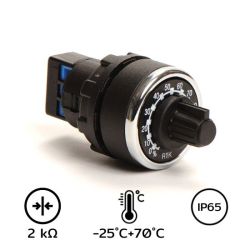 BPR02K 2K Potentiometer 22mm.Special Price THB 736.00 Regular Price THB 920.00
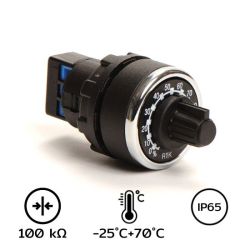 BPR100K 100K Potentiometer 22mm.Special Price THB 736.00 Regular Price THB 920.00
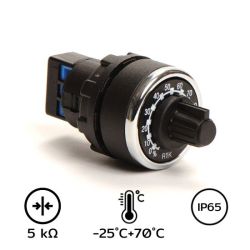 BPR05K 5K Potentiometer 22mm.Special Price THB 736.00 Regular Price THB 920.00
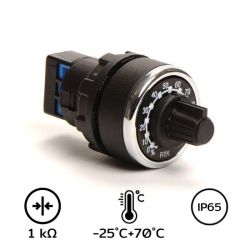 BPR01K 1K Potentiometer 22mm.Special Price THB 736.00 Regular Price THB 920.00
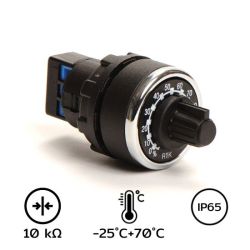 BPR10K 10K Potentiometer 22mm.Special Price THB 736.00 Regular Price THB 920.00
What is a Potentiometer?
A potentiometer, or pot for short, is a variable resistor with three terminals that changes resistance through mechanical movement of a wiper along the resistive element. Adjusting the position of the wiper alters the resistance, allowing precise control over voltage output to circuits. This fine-tuning capability makes potentiometers essential components in modern industrial systems. SCMA supplies potentiometers for all industries, from automatic control jobs to high-precision measurement and inspection.
Types of Potentiometer by Operation Mode
To meet diverse applications, SCMA offers various types of potentiometers:
Rotary Potentiometer
The most common type of potentiometer uses rotational shaft movement to adjust resistance. Suitable for precise and easy-to-use control tasks.
Types of rotary potentiometers include:
- Single-turn - rotates approximately 270 degrees, suitable for general control applications
- Multiturn - rotates 5-20 turns, providing high precision for detailed work
- Dual gang - two potentiometers on the same shaft to control two channels simultaneously
- Servo - controlled by a servo motor both manually and automatically
Linear Potentiometer
This type uses linear slider movement along a straight line to adjust resistance. Linear potentiometers provide a direct relationship between position and resistance.
Popular types of linear potentiometers:
- Slide pot - single-slider control suitable for individual channel or distance measurement
- Dual slide - controls two channels simultaneously, used in professional audio mixers
- Motorized fader - motor-controlled for automatic studio systems
Digital Potentiometer
A digital potentiometer is electronically controlled instead of mechanically. It uses small resistive elements connected in series and can be controlled via I²C or SPI protocols.
Special Types of Potentiometers
In addition to the main types, there are special designs for specific applications:
Trimmer Potentiometer (Trim Pot)
A small device mounted on a printed circuit board used for calibration and adjustment during production. It remains in its final set position.
Servo Potentiometer
A potentiometer integrated with a servo motor, accurately detecting and controlling position. Suitable for robotics and automation systems.
Concentric Potentiometer
Two potentiometers stacked concentrically on the same shaft, allowing independent adjustment. Ideal for simultaneous control of volume and tone levels.
Potentiometer Materials and Taper Types
Selecting an appropriate potentiometer involves considering both materials used and taper types:
Commonly Used Materials
- Potentiometers are made from various materials based on application needs:
- Carbon Composition - cost-effective, suitable for general use
- Wirewound - high power handling, long lifespan, high precision
- Conductive Plastic - smooth touch, highest resolution, millions of cycles usable
- Cermet - high stability, good temperature resistance, ideal for trim pots
Taper Types
The taper type of a potentiometer refers to the relationship between position and resistance. There are two main types: linear taper (linear) where changes occur proportionally, and logarithmic taper (logarithmic) mimicking human hearing response.
Applications of Potentiometers in Industry
Potentiometers can be used extensively across all industries:
- Automatic control systems - adjusting motor speed, controlling position, setting parameters, and working with pneumatic valves to regulate pressure and flow.
- Stereo equipment - volume control, tone adjustment, mixing.
- Metering and testing systems - part of measuring and calibration devices.
- Automotive industry - used in accelerators, air control systems, and instrument panels.
- Industrial machinery - adjusting conveyor belt speed, controlling hydraulic systems.
- Food production - regulating temperature and speed in production lines.
- HVAC systems - adjusting fan speeds and controlling temperatures.
- Robots - used as position sensors and control movement devices.
Comprehensive Potentiometer System Services by SCMA
At SCMA, we are not just potentiometer suppliers but also technical partners accompanying you throughout the process. With over 40 years of experience in automation systems, we understand that selecting the right potentiometer impacts overall system performance. Our team of expert engineers is ready to provide comprehensive services from equipment selection and system design to installation and maintenance, ensuring your system operates efficiently and reliably over time.
Summary
Selecting the right potentiometer or pot is crucial for control system performance. SCMA Company Limited is a reliable partner at every step, from consulting on potentiometer selection that meets requirements, designing appropriate systems, to close post-sales support. With our team of experts and representation of leading brands worldwide, we are confident in delivering solutions that meet your needs and elevate your industry standards globally. Contact us today for free consultation and discover why SCMA is the technical partner you're looking for.
Frequently Asked Questions
What's the difference between a Potentiometer and a Rheostat?
A potentiometer is a three-terminal device used to control voltage, capable of dividing voltage. A rheostat is a two-terminal device used for controlling current, often large wire-wound types that handle high power. However, a potentiometer can be wired as a rheostat by connecting the wiper and one end terminal together.
How do I choose the right type of Potentiometer?
Selecting a potentiometer involves considering factors such as required resistance value, taper type, power usage, environment, and installation mode. For audio control tasks, logarithmic pots are recommended; for position measurement, linear types should be used. SCMA's expert team can provide advice to help you choose the best equipment.
How do I maintain a Potentiometer?
To extend potentiometer lifespan, regularly inspect and clean the wiper area, avoid dusty or overly humid environments, check resistance values periodically for abnormalities, and don't exceed specified power ratings. For high-precision work, calibrate potentiometers as recommended by manufacturers.
This website uses cookies
We use cookies to make the site work properly, to understand how it is used, and to show content that is relevant to you. You choose which types to allow; strictly necessary cookies are always on. Privacy Policy
🤖 AI Assistant
Ask about products, specs and replacement models
Hello 👋 Ask us anything — find products, compare specs, or troubleshoot.
🗑 Clear history