
SPECIAL PROMOTION — Up to 40% off across many product groups, until 31 December 2026 · Click to see all promotion itemsIFM, Sensor, Automation SystemMeasuring / Testing InstrumentsTemp Indicator, Control, T/C, RTD, TimerHeater, SCR Control, Solid State, Power Supply, Control CabinetField Measuring Instruments, Pressure Gauge, Level Control, Flow MeasurementEMC, Pneumatic, Solenoid ValveInspection Test Lamp, Head Light, Automotive Measuring InstrumentWeighing Scales, Marking Machine, PrintersEducational Training SystemsHot Line Tools & Equipment SPECIAL PROMOTION — Up to 40% off across many product groups, until 31 December 2026 · Click to see all promotion itemsIFM, Sensor, Automation SystemMeasuring / Testing InstrumentsTemp Indicator, Control, T/C, RTD, TimerHeater, SCR Control, Solid State, Power Supply, Control CabinetField Measuring Instruments, Pressure Gauge, Level Control, Flow MeasurementEMC, Pneumatic, Solenoid ValveInspection Test Lamp, Head Light, Automotive Measuring InstrumentWeighing Scales, Marking Machine, PrintersEducational Training SystemsHot Line Tools & Equipment View promotion items View all
Milliohm Meters
What are Milliohm Meters?
Milliohm Meters are instruments used to measure resistance in the milliohm range (equal to 0.001 ohm) of various materials or devices. These tools are highly sensitive and accurate for measuring very small values, working by using electrical current to test material resistance through voltage measurement across the material and calculating resistance according to Ohm's law.
Types of Milliohm Meters
- Portable Milliohm Meters suitable for carrying around in various locations. They are compact and easy to use.
- Benchtop Milliohm Meters which are installed on a desk or workbench, ideal for tasks requiring precision and fast testing.
Uses of Milliohm Meters
- To test and control the resistance values of electronic circuits to ensure they meet standards.
- To test the resistance of wires or components during production and maintenance of machinery.
- In research for measuring the resistance of new materials or various experiments requiring accuracy.
Famous Brands of Milliohm Meters
- Fluke a brand known for quality and expertise in manufacturing electrical testing tools including Milliohm Meters.
- Hioki a manufacturer of advanced technology and high-quality testing equipment.
- KEPLER INSTRUMENTS with a wide range of products, high quality, and reliability.
- Megger a leading brand offering testing and measuring instruments for electricity, including
- Milliohm Meters recognized in the industry.
View Milliohm Meters Catalog: click here
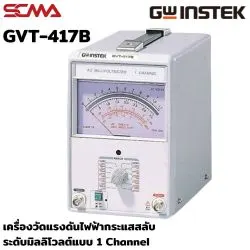 GVT-417B (1 Channel) AC MILLIVOLT METER GW INSTEKSpecial Price THB 8,250.00 Regular Price THB 11,000.00
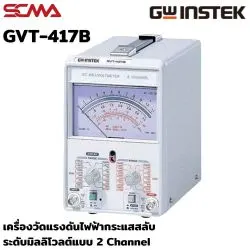 GVT-427B (2 Channel) AC MILLIVOLT METER GW INSTEKSpecial Price THB 20,850.00 Regular Price THB 27,800.00
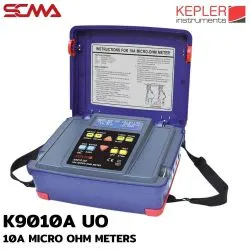 K9010A UO 10A MICRO OHM METERS KEPLERSpecial Price THB 42,600.00 Regular Price THB 56,800.00
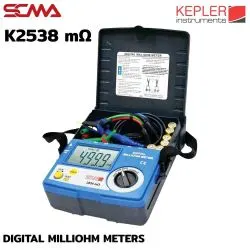 K2538 mO DIGITAL MILLIOHM METERS KEPLERSpecial Price THB 10,275.00 Regular Price THB 13,700.00
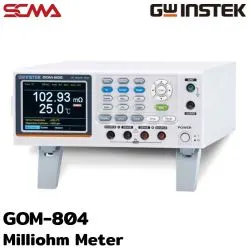 GOM-804 GW Instek DC Milli-Ohm MeterSpecial Price THB 27,360.00 Regular Price THB 34,200.00
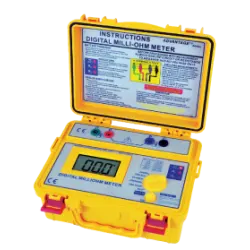 K4137 mO KEPLER Digital Milliohm MeterSpecial Price THB 17,600.00 Regular Price THB 22,000.00
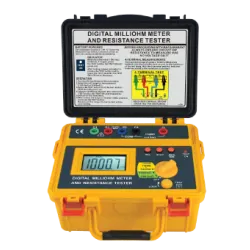 K4338 mO KEPLER Digital Milliohm Meter And Resistance TestersSpecial Price THB 11,760.00 Regular Price THB 14,700.00
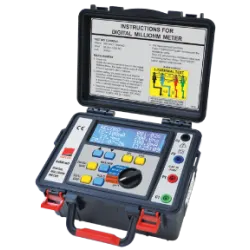 K4538 mO KEPLER Digital Milliohm MeterSpecial Price THB 18,000.00 Regular Price THB 22,500.00
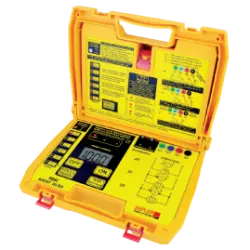 K6237 DLRO KEPLER Digital Low Resistance Ohm MeterSpecial Price THB 32,400.00 Regular Price THB 40,500.00
Delivery: 30 ต.ค. 2569
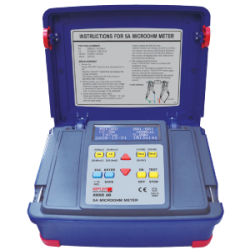 K9005 UO KEPLER Digital Microhmmeter (5A Micro Ohm Meters)Special Price THB 28,800.00 Regular Price THB 38,400.00
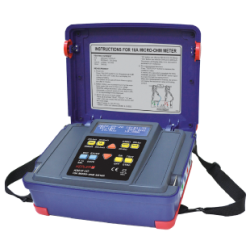 K9010 UO KEPLER 10A Micro Ohm MetersSpecial Price THB 39,600.00 Regular Price THB 49,500.00
What is a Milliohm Meter? A Guide for Technicians and Engineers
Delve into the milliohm meter, a high-precision instrument designed to measure extremely low resistance values that exceed the capabilities of standard ohmmeters. Understand what an ohmmeter is and how it differs from regular ohm meters. Learn how to choose the right one for maintenance and electrical system testing tasks. For technical consultation or immediate measurement solutions, contact our expert engineering teamhere
What is a Milliohm Meter?
A milliohm meter, or milli-ohmmeter, is an electrical measuring instrument specifically designed for measuring very low resistance values in the range of milliohms (mΩ) or microohms (µΩ). Standard ohmmeters cannot read these values accurately enough or have high measurement errors due to their own lead resistance. Using this type of tool is crucial for preventive maintenance tasks, such as checking contact resistance on circuit breakers, bus bars, or measuring winding resistance in large transformers and motors to identify overheating points or loose connections. Learn morehere
The Importance of Low Resistance Measurement
A slight increase in resistance at high current electrical connections can cause massive heat buildup according to Joule's law ($I^2R$), leading to equipment failure or fires. Using a standard ohmmeter may read zero ohms, but there could be an underlying resistance of 0.05 ohms, which is enough to create problems in systems with hundreds of amps flowing through them.
The Principle of Four-Wire (Kelvin Probe) Measurement
The main problem with using a standard ohmmeter for measuring low resistance is that the resistance of the test leads gets included in the measurement, leading to inaccurate readings. A milliohm meter solves this by employing four-wire (4-Wire Measurement) or Kelvin Double Bridge methods, separating current-carrying and voltage-sensing leads. This method eliminates lead resistance from calculations, providing accurate device resistance measurements. Read more about measuring techniqueshere
How It Works
The device applies a constant test current through the current leads to the component and uses potential leads to measure voltage drop across the component. Ohm's law ($R=V/I$) is used for calculation within the meter, displaying highly precise digital results.
Differences Between Milliohm Meters and General Multimeters
A common misconception is that a multimeter ohmmeter can measure everything. While basic ammeter, voltmeter, and ohmmeter functions are combined in one unit, their measurement ranges and precision differ significantly. General multimeters use very low test currents (microamps) suitable for measuring kiloohm or megaohm resistance levels, whereas milliohm meters apply higher test currents (from 100mA to 10A or more) to generate sufficient voltage drops across components with low resistance.
Usage Comparison Table
Distinguishing between measuring tools is crucial. A milliammeter measures electrical current flowing in a circuit, while a milliohm meter measures object resistance. Misusing them can lead to equipment damage or incorrect analysis.
Applications of Milliohm Meters in Maintenance
Engineers and technicians use milliohm meters for various tasks to confirm the condition of machinery and electrical systems.
- Motor winding and transformer testing: Measure DC resistance of each phase winding to check for imbalance. If values differ beyond standards, it may indicate turn-to-turn shorts or loose internal connections.
- Contact Resistance Measurement: Check breaker contacts, magnetic contactors, and knife switches. High resistance values indicate dirty or worn-out contacts.
- Ground Bonding Testing: Verify electrical continuity between machinery frames and ground systems for safety and reduced interference.
- Fuse and Conductor Testing: Check large fuses and crimp lugs to ensure they are tight and conduct electricity well.
Factors for Selecting a Cost-Effective Milliohm Meter
When choosing a milliohm meter, consider specifications that match your actual job requirements to achieve accurate results and cost-effective investment.
- Measurement Range and Resolution: Must cover the lowest values needed, such as $1 \mu\Omega$ for bus bars.
- Test Current: Higher test currents yield better accuracy in low ranges but must not exceed the device's rating.
- Portability: For field maintenance, choose battery-powered models that are compact and durable against impacts.
- Additional Features: Such as data logging, temperature compensation, and appropriate lead length.
Find High-Quality Milliohm Meters at SCMA
If your factory or maintenance team is looking for highly accurate, reliable milliohm meters with assured after-sales service, SCMA is ready to provide technical consultation. We curate leading measurement tools tailored for industrial applications and offer a knowledgeable engineering team to guide you in selecting the right specifications. Browse our full range of measuring instrumentshere
Summary
Low resistance measurement with a milliohm meter is crucial for maintaining electrical systems and preventing severe damage. Understanding how it works and using the right tool improves plant efficiency and safety. If you want to elevate your inspection and maintenance standards, SCMA offers consultation and supply of internationally certified measuring instruments. Contact ushere
Frequently Asked Questions
Why Use a Four-Wire Measurement Method?
Four-wire measurement eliminates lead resistance from readings, allowing accurate and precise measurements of extremely low resistances that standard ohmmeters cannot achieve. Learn morehere
How Often Should Calibration Be Done?
Calibration should be done at least once a year or as per ISO quality system requirements to ensure measurement accuracy, considering electronic components may degrade over time and use.
Can Milliohm Meters Measure Ground Loops?
Milliohm meters are designed for object resistance (bonding) measurements. For earth resistance testing of ground rods, a dedicated Earth Tester is recommended. However, milliohm meters excel in continuity/bonding tests between grounding wires and machinery frames.
This website uses cookies
We use cookies to make the site work properly, to understand how it is used, and to show content that is relevant to you. You choose which types to allow; strictly necessary cookies are always on. Privacy Policy
🤖 AI Assistant
Ask about products, specs and replacement models
Hello 👋 Ask us anything — find products, compare specs, or troubleshoot.
🗑 Clear history