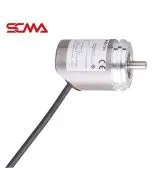
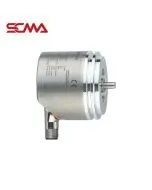
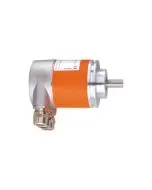
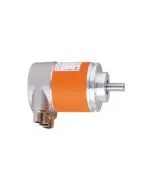
Encoder, or encoder, is a crucial component in the automatic control system that converts mechanical movement into electrical signals or digital signals, allowing the control system to accurately detect position, speed, and direction of motion. Currently, Encoders play a significant role in manufacturing industries, robotics, and various automatic systems.
What is an Encoder?

Encoder is a type of sensor that measures rotation to determine desired values such as rotational speed, distance, and direction. This device plays an important role in manufacturing industries, measuring tools, and medical equipment requiring high precision. The encoder converts mechanical movement into electrical signals or digital codes (Binary or Gray code), which can be processed into accurate data for controlling various automatic systems.
How does an Encoder Work?

An encoder works by converting mechanical motion into electrical signals using light detection technology. When the shaft rotates, the code disk spins accordingly, allowing LED light to pass through transparent slots in a rhythmic pattern and is detected by photodetectors. The system converts the reception of light into digital pulse signals, generating data that can be further processed. This technology bridges hardware connectivity, software data, and intelligence within modern automated systems.
- Shaft - The component that connects to the rotating object such as a motor, wheel, or machine shaft
- Code or Pulse Disc - A disc with patterns of transparent and opaque slots arranged in tracks or grooves that serve as the medium for signal formation
- Light Source - High-quality LEDs providing consistent brightness to pass through the disc
- Photodetector or Photodiode - A device that receives light and converts it into electrical signals, which are then processed as digital data in the next step
Encoder Usage

Encoders operate through a system of six phases, namely Phase A, B, Z and their inverted counterparts A-, B-, Z-. These signals provide different output signals. Phases A and B are offset by 90 degrees, allowing the direction of rotation to be determined. Meanwhile, phase Z releases a signal upon completing one full revolution, adding versatility in usage. With these features, encoders are applied to motors, couplings, or conveyor belt systems for measuring revolutions, distance, rotational direction, and position, making them an essential component in modern automation systems.
What Should Be Considered When Selecting Encoders?

Selecting an encoder must be appropriate for the nature of work to ensure maximum efficiency. IFM products offer both Incremental and Absolute types for different applications. Factors need to be considered in line with system requirements to achieve accurate and stable measurement results.
Key factors in selecting encoders:
- Signal cable length - Affects the quality of signals sent to the control system.
- Maximum RPM - Must be selected to accommodate the operating speed of the system.
- Pulses per Revolution (PPR) - Directly impacts measurement resolution.
- Output type - PNP must be selected to match the control system used.
Contact SCMA today for Encoder inquiries!
Upgradeyour automation systemwith high-quality Encoders from SCMA, a trusted partner for industrial sensor solutions! We offer a wide range of Encoder models selected from leading brands and provide consultation to help you choose the best fit for your specific needs, including both Incremental and Absolute Encoders that support all applications.
Our expert team is ready to support you from planning through maintenance to ensure your system operates at peak efficiency. Contact SCMA today to receive special offers and tailored solutions for your business!
Summary
An encoder, or an encodder, is a crucial component in automatic systems and control mechanisms. It functions to convert mechanical movement into electrical signals that the control system can process. There are various types such as Incremental and Absolute, rotary and linear, operating on principles of light or magnetic fields.
The importance of encoders lies in their ability to provide accurate position, speed, and direction data, which is essential for systems requiring precise and reliable control, whether it be in industrial plants, automotive, or medical equipment.
Selecting the appropriate encoder involves considering several factors such as type, resolution, environmental conditions, and budget. SCMA is ready to provide consultation and services with high-quality products that meet every customer's needs.
Whether your business is in manufacturing, processing, or developing new products, SCMA offers suitable and efficient encoder solutions along with a team of experts providing support throughout the product lifecycle. Contact SCMA today to elevate your business's automation and control systems to the next level!
Frequently Asked Questions
Common questions about encoders that customers ask, we have compiled clear and easy-to-understand answers to help you better understand the product.
What is the function of an encoder?
An encoder converts mechanical motion such as rotation or linear movement into electrical signals that a control system or computer can read and process, allowing for precise tracking and control of position, speed, and direction. Encoders are therefore crucial components in high-precision automatic systems and feedback control (Feedback Control) systems.
How many phases does an encoder have?
Generally, Incremental Encoder Connection has 2-3 phases:
- Phase A: Main pulse signal
- Phase B: Pulse signal that is offset by 90 degrees from Phase A (to indicate the direction of rotation)
- Phase Z or Index: Pulse signal that occurs once per revolution (for reference point)
Having two phases (A and B) offset by 90 degrees allows for detection of the direction of rotation because when rotating in one direction, Phase A leads Phase B, but when rotating in another direction, Phase B leads Phase A.
Absolute Encoders may have multiple phases depending on the number of bits used to encode position, for example, a 10-bit Encoder will have 10 phases with each phase representing one bit in the position code.
What type of encoding does a Rotary Encoder use?
A Rotary Encoder is a device that converts rotation into electrical signals, with the main encoding methods being:
- Incremental - Creates pulses when rotated; the number of pulses indicates distance traveled, and the phase relationship between Phase A and Phase B indicates direction.
- Absolute - Uses a unique code for each position in rotation, such as Binary Code, Gray Code, or Single-track Code, allowing the exact position to be known without referencing a starting point.
Additionally, they are categorized by technology used, including Optical Rotary Encoders that use light for detection and Magnetic Rotary Encoders that use magnetic fields for detection.
What is an Absolute Encoder?
An Absolute Encoder provides a unique position value for each position in the rotation cycle using specific codes (such as Binary or Gray code), allowing the system to know the true position immediately upon startup without having to rotate back to a reference point, even after power loss or system shutdown. This differs from Incremental Encoders which must count pulses from a new reference point every time.