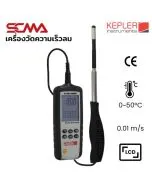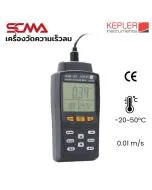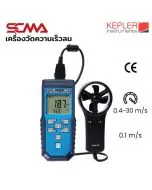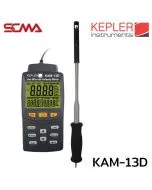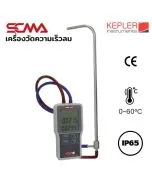

Anemometer or Air Velocity Meter is a crucial device in various industries.SCMA Company, the leader in measurement tools and automation systems, specializes in providing and advising on Anemometers that meet your business needs. This article will explain the functions, benefits, and usage of an Anemometer to help you understand and use it effectively.
What is an Anemometer?

An Anemometer is a device used to measure wind speed and direction. Typically, an Anemometer reports wind speed in various units such as meters per second (m/s), kilometers per hour (km/h), miles per hour (mph), or knots, and air flow rate in cubic meters per minute (CMM) or cubic feet per minute (CFM). The Anemometer plays a vital role in weather monitoring, aviation, maritime activities, and various industries that rely on wind speed data for their operations.
How an Anemometer Works
Most Anemometers work by utilizing the force of the wind acting upon a surface such as cups or blades, or using high-frequency sound waves. When wind blows across the moving part, it causes that part to spin or move, and an internal system calculates and displays the wind speed in various units such as meters per second, kilometers per hour, miles per hour, and knots.
What are the benefits of an Anemometer, and who can benefit from it?
An anemometer is useful for anyone interested in weather data as follows:
- Pilots use it to assess wind speed before taking off, preventing accidents.
- Engineers and physicists use laser anemometers in experiments measuring the speed of cars, airplanes, and spacecraft to improve aerodynamics.
- Boat owners use it to assess wave height.
- Meteorologists use anemometers to measure weather changes and forecast incoming storms.
- Building engineers use it to design buildings that can withstand wind forces.
- Environmental engineers use wind speed to assess the dispersion of air pollutants.
- Engineers use it in measuring wind speeds inside industrial plants.

Types of Wind Speed Meters
Wind speed meters come in various types, each with its own advantages and disadvantages as follows:
1. Cup Anemometer
A cup anemometer consists of a vertical pole and 3-4 arms attached to cups at the end of each arm. When wind blows, it causes the cups and arms to rotate around the pole. However, cup anemometers have more friction compared to other types, which can lead to greater measurement inaccuracies.
2. Windmill Anemometer
A windmill anemometer or windmill anemometer resembles a wind turbine with blades rotating in the horizontal plane. To use this type of anemometer, you must align the blades parallel to the direction of the wind and then count the number of rotations within a specified time period, which is used to calculate wind speed.
3. Hot Wire Anemometer
A hot wire anemometer or hot wire anemometer works on the principle that air cools a heated object as it passes over it. This type of anemometer uses thin wires heated to a higher temperature than the surrounding air. As wind blows across the wire, the system calculates wind speed based on the energy required to maintain the wire at its constant high temperature; more powerful winds require more energy to compensate for cooling effects. Hot wire anemometers provide accurate readings but are fragile.
4. Ultrasonic Anemometer
An ultrasonic anemometer or ultrasonic anemometer uses high-frequency sound waves to measure wind speed by measuring the time it takes for sound waves to travel between transmitters and receivers. This measurement can provide wind speed in one, two, or three dimensions with very high precision. Because there are no moving parts, this type of anemometer is ideal for long-term use, such as at weather stations or on buoys measuring atmospheric conditions where environmental factors may affect other types of anemometers.

How to Use a Wind Speed Meter
Using a wind speed meter correctly involves the following guidelines:
- Select an Anemometer type that is suitable for the environment you are measuring
- Install the tool according to the manual securely, choosing a suitable position and avoiding obstacles in the wind direction
- Turn on the device and wait for it to start up
- Place the device parallel to the wind direction, waiting for the meter to measure the wind speed
- Record the readings and compare them with standards
- Clean the tool regularly according to proper methods
- Send the device for calibration at specified intervals
- Store the tool in an appropriate place when not in use
Contact SCMA to inquire about wind speed meters today!
SCMA Products offer a wide range of models to choose from, including affordable Anemometers for beginners and advanced Digital Anemometers for professionals. Our team of experts is ready to consult you to find the wind speed meter that best meets your needs. Additionally,SCMA Services cover everything from installation advice to training on how to use and maintain the Anemometer properly, ensuring you get the most out of your chosen device.
Summary
An anemometer, or wind speed meter, is a necessary tool for measuring and recording wind speed data. It is highly useful in various industries, whether you are a meteorologist, engineer, pilot, or need to measure any kind of airspeed. SCMA is ready to provide you with the best measurement tools along with reliable after-sales products and services. Contact us at SCMA to consult about Anemometer and receive the best solutions for your business.

Frequently Asked Questions
What is the function of an Anemometer?
Anemometers are used to measure wind speed and direction, with various types that operate on different principles such as cup rotation, propeller, thermal, and ultrasonic. Data from an Anemometer is reported in units of speed and is highly useful for weather forecasting, navigation at sea or in the air, and numerous other industries.
What are wind speed meters used for?
Wind speed meters are used to measure wind speed and direction. This information can be utilized in various ways, from weather forecasting to deciding whether conditions are suitable for air or sea operations, assessing wind energy production potential, industrial ventilation, and engineering research on airflow.
What is the wind speed measuring device called in an HVAC system?
The wind speed measuring device in an HVAC system is also called an Anemometer. However, it may be smaller and more accurate for specific HVAC applications. The Anemometer helps measure the air velocity coming out of vents or ducts to ensure proper airflow circulation, resulting in efficient cooling and comfort within a building.
What are wind speed measuring tools and wind direction measuring tools called respectively?
Wind speed measuring tools are called Anemometers or Air Velocity Meters, while wind direction measuring tools are called Wind Vanes. Often, an Anemometer and a Wind Vane are installed together to provide both wind speed and direction data, which is crucial for maximizing the utility of this information.