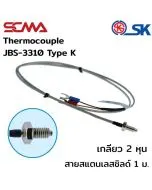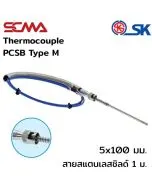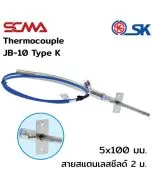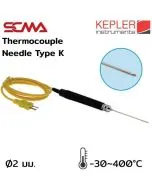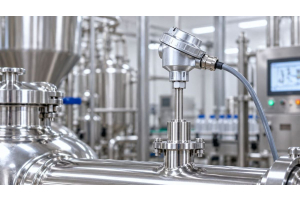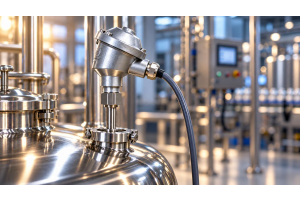

Thermocouples are widely popular temperature sensors in industrial applications due to their durability, wide temperature range, and affordability.SCMA Company Limited, a leading provider of measurement tools and automation solutions in the industry, offers a variety of thermocouples along with a team of experts to provide consultation to meet customer needs across all industries.
What is a Thermocouple?

A thermocouple, or Thermocouple, is a type of temperature measuring device that consists of two different metal wires joined at one end. When the jointed end is heated, there will be an electrical potential difference change at the other end which can be converted into a temperature value.
Thermocouples are widely used to measure temperatures in industrial applications ranging from as low as -200 degrees Celsius to over 1,600 degrees Celsius. This is due to their wide temperature range capability, durability under environmental or vibration conditions, and relatively low cost compared to other types of temperature sensors.
How does a Thermocouple Work?
The operation of a thermocouple (Thermocouple) relies on the Seebeck effect. When two different metal wires are joined and one end is heated while the other remains at a reference temperature (usually room temperature), an electric current flows in the circuit, generating an electrical potential difference at the other end.
The resulting electrical potential difference (typically measured in millivolts) varies directly with the temperature of the hot junction and the type of metal pair used to make the thermocouple. This can be converted into the desired temperature measurement, usually by referencing a table that correlates electrical potential differences with temperatures for each type of thermocouple.
Features of a Thermocouple
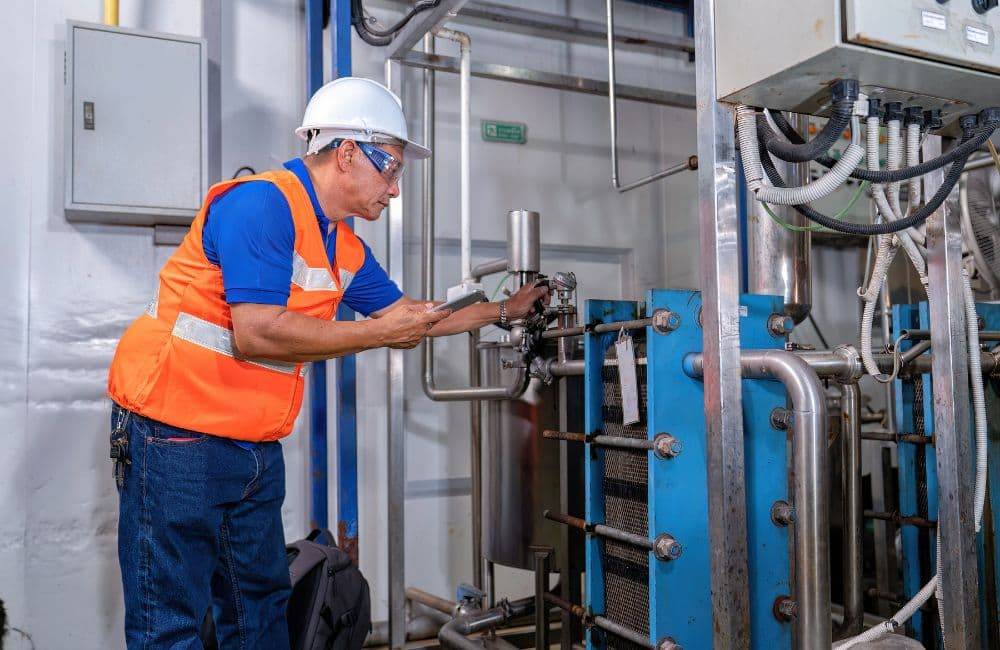
A thermocouple has the following important features:
- Can measure temperature over a wide range from -200 to 1,600 degrees Celsius depending on the type of thermocouple
- Is durable in harsh environments such as vibration, impact, high temperatures, and corrosion resistance
- Responds quickly to temperature changes
- Has an accuracy range of ±0.5°C to ±2°C in measurement
- Is small, easy to install and use, suitable for various types of equipment
- Is relatively inexpensive compared to other temperature sensors
- Does not require external power supply for operation
These features make the thermocouple a popular choice for temperature measurement in various industrial applications such as food, petrochemicals, plastics, metals, ceramics, glass, automotive, and aerospace industries.
How many types of thermocouples are there?
Thermocouples can be divided into two main groups based on the type of metal used, namely "Base Metal Thermocouples" and "Noble Metal Thermocouples". The common types of "Base Metal Thermocouples" are J, K, T, E, N, while "Noble Metal Thermocouples" include R, S, B. Noble Metal Thermocouples can withstand higher temperatures but are more expensive. Each type has different properties and suitability for various applications.
Type E (Type E)
- Suitable for measuring low temperatures due to its highest accuracy in the low-temperature range.
- Measures temperature from -270 to 870 °C.
- Has a sensitivity of approximately 68 µV/°C.
- Consists of a wire made from Nickel-Chromium alloy and Constantan (Copper-Nickel).
Type J (Type J)
- Suitable for oxidizing or reducing conditions.
- Measures temperature from -210 to 1,200 °C.
- Has a sensitivity of approximately 55 µV/°C.
- Consists of a wire made from Iron and Constantan (Copper-Nickel).
Type K
- It is the most widely used thermocouple, suitable for general applications at an affordable price.
- Measures temperatures in the range of -270 to 1,260 °C
- Has a sensitivity of approximately 41 µV/°C
- The wire is an alloy of Nickel-Chromium with Nickel-Aluminium
Type N
- Has good resistance to oxidation.
- Measures temperatures in the range of -270 to 1,300 °C
- Has a sensitivity of approximately 39 µV/°C
- The wire is an alloy of Nicrosil (Ni-Cr-Si) with Nisil (Ni-Si-Mn)
Type T
- Suitable for measuring temperatures below 350 °C.
- More accurate than other types in low temperature ranges.
- Measures temperatures in the range of -270 to 400 °C
- Has a sensitivity of approximately 43 µV/°C
- The wire is an alloy of Copper and Constantan (Copper-Nickel)
Type M
- It is a special type suitable for measuring very high temperatures.
- Can measure up to 1,400 °C.
- Currently not as popular as other types.
- The wire is a Nickel-Molybdenum alloy with Nickel-Cobalt.
Benefits of Using Thermocouples

Thermocouples offer numerous benefits in industrial applications, including:
- Measuring and controlling temperatures in ovens, furnaces, or various machinery.
- Used in research and product development to accurately determine heat levels.
- Measuring the temperature of liquids or gases within pipe systems or tanks.
- Monitoring combustion conditions in engines or boilers.
- Controlling production processes that require constant temperature control, such as curing, baking, and casting.
- Installed in safety systems to monitor abnormal temperature conditions.
- Used for calibration to check the accuracy of other temperature measuring instruments.
With their versatile capabilities and various types available, thermocouples are highly beneficial for temperature measurement in industrial and engineering applications.
What Should Be Considered When Selecting a Thermocouple?
When selecting a thermocouple for your application, the following important factors should be considered:
- The temperature range you need to measure. Choose the type of Thermocouple that matches the measurement range.
- Working environment conditions, considering corrosion resistance, oxidation, vibration, and impact.
- Required accuracy and precision. For high-precision measurements, premium quality thermocouples may be necessary.
- Installation methods and space constraints such as size limitations, narrow spaces, or difficult-to-reach installation points.
- Compatibility with other equipment, such as compatibility with standard connectors, connection ports, or existing measuring tools.
- Price and budget that aligns with the requirements of use and desired quality.
Selecting a thermocouple requires comprehensive consideration from both technical properties, suitability for work, as well as cost-effectiveness to ensure efficient operation, meet needs, and provide long-term value.
Interested in Thermocouples? You can now purchase from SCMA!
SCMA Company Limited is a leading provider of measurement tools and automation systems in the industry. We offer various types and styles of Thermocouples, including Type K, Type J, and Type E, to meet your specific needs.
In addition, we also provide comprehensive smart factory design and installation services that enhance production efficiency and reduce long-term costs by applying thermocouples in various points to control temperature appropriately.
If you are looking for reliable temperature measurement solutions today, consult our professional team at SCMA. With expertise, experience, and dedication to service, we are ready to be a part of your industrial success journey. Contact us now for quotations or additional information.
Summary
Thermocouples are widely popular temperature sensors with outstanding performance in terms of wide temperature measurement range, durability under harsh conditions, high accuracy, compact size, and reasonable pricing. They are extensively used across various industries and engineering applications.
As a leading provider of measurement tools and automation systems in Thailand, SCMA Company Limited is committed to delivering high-quality thermocouples and providing consultation for selection and installation tailored to your actual needs. We are ready to contribute to the modernization of industries with advanced temperature measurement solutions at every production stage.
Frequently Asked Questions
What is the difference between RTD and Thermocouple?
RTD (Resistance Temperature Detector) and Thermocouple are both temperature sensors, but they operate on different principles. RTDs work by measuring changes in electrical resistance of a metal as temperatures change, while thermocouples rely on the thermoelectric effect. RTDs offer better accuracy and stability at low temperatures but are not suitable for high-temperature measurements since their maximum range is 650°C, whereas thermocouples can measure up to 1,600°C. In terms of cost, RTDs tend to be significantly more expensive than thermocouples.
What is a Thermocouple Wire?
Thermocouple wire is the cable used to connect from the temperature measurement point (Hot Junction) to the reference point (Cold Junction), transmitting voltage signals according to thermocouple principles. The wires are made of the same two types of metal as the measuring junction, ensuring accurate and precise measurements. There are various types such as Type K, J, T, which can be selected based on specific application needs. Wires come in insulated, non-insulated, shielded, or flexible varieties that can be run through conduits or installed in tight spaces.
What is a Thermocouple Transducer?
A thermocouple transducer is an instrument used to convert voltage signals from a thermocouple into standard industrial signals such as 4-20 mA, 0-5V, or 0-10V. This makes it easier for further processing and display. The transducer compensates for the cold junction temperature (Cold Junction Compensation), which affects the output voltage of the thermocouple to a signal format suitable for processing. Transducers are available in panel mount and field mount versions with high protection levels for use in hazardous areas.
What is Thermocouple RTD?
Thermocouple RTD actually does not refer to any specific device; it's a misnomer. RTDs and thermocouples are different types of temperature measuring devices, with RTD standing for Resistance Temperature Detector that measures changes in resistance according to temperature using technology distinct from the thermoelectric effect used by thermocouples. Therefore, "thermocouple RTD" is an incorrect term and should not be used together to avoid confusion.