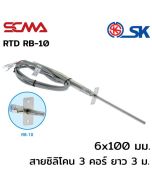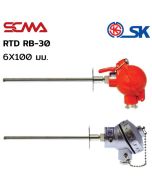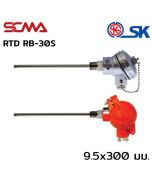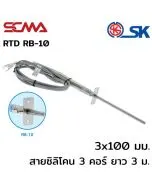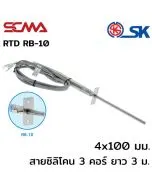

RTD (Resistance Temperature Detector) is a temperature sensor commonly used in today's industries. BySCMA Company, the leader in measurement tools and automation systems, offers a wide range of high-quality RTDs to meet various needs. These RTDs are accurate, durable, suitable for different environments, and most importantly, they provide precise temperature measurements which help improve production efficiency.
What is an RTD?

An RTD (Resistance Temperature Detector) is a type of temperature sensor that relies on the relationship between temperature and electrical resistance in certain metals, such as copper, nickel, or platinum. Platinum is commonly used due to its stability and consistent accuracy over time.
RTDs are passive sensors, meaning they require an external power source. When the temperature changes, so does the resistance of the RTD, allowing for a relationship between temperature and resistance to be determined. By connecting the RTD to appropriate circuits and meters, temperature measurements can be made and displayed.
How RTD Works
RTD (Resistance Temperature Detector) works based on the principle of metal resistance changing with temperature. That is, as temperature increases, the resistance of the metal used in RTDs also increases accordingly. Conversely, when temperature decreases, resistance also decreases.
The change in RTD resistance can indicate temperature values because the relationship between resistance and temperature for metals is linear within a specified range. Therefore, we can measure the resistance of an RTD and convert it to temperature by referencing standard graphs or known linear equations.
What are the Benefits of RTDs?

RTDs offer high accuracy in temperature measurement, especially the platinum type, which provides reliable long-term measurements that can be repeated without changing over time. They are therefore preferred for applications requiring precision, such as laboratory operations.
Moreover, RTDs have high stability, environmental durability, and a long service life. They support extended measurement wiring without affecting accuracy and can quickly respond to temperature changes, making them suitable for industrial process temperature measurement and control applications.
Types of RTDs
RTDs are primarily classified into two types based on their structural characteristics, namely:
- Thin-film RTD - This type of RTD is coated with a thin film of metal such as platinum onto a ceramic substrate and then connected to terminals for resistance measurement. Its advantages include small size, impact and vibration resistance, but it offers less accuracy compared to the wire-wound type.
- Wire-wound RTD - This type of RTD uses thin metal wires such as platinum wound around a ceramic or glass core and then connected to terminals at both ends. Typically, two, three, or four strands are used, providing higher accuracy than the thin-film type but being more fragile and expensive.
Additionally, there are special types of RTDs such as wireless RTD which transmits data wirelessly, and flat surface RTD for measuring contact surfaces, among others.
Accuracy of RTD

RTD (Resistance Temperature Detector) is a highly accurate and precise temperature sensor, especially the platinum RTD with 100 ohm resistance (PT100), which is the most commonly used type. RTDs typically specify accuracy or class according to DIN IEC 751 standards as follows:
- Class B: Deviation ±(0.3 + 0.005|t|)°C
- Class A: Deviation ±(0.15 + 0.002|t|)°C
- Class AA: Deviation ±(0.1 + 0.0017|t|)°C
- Class 1/10 DIN: Deviation ±(0.03 + 0.0005|t|)°C
Therefore, the higher the RTD class, the better its temperature measurement accuracy will be. Additionally, selecting a wire-wound type RTD with four or more wires helps compensate for signal lead resistance, reducing measurement errors compared to two or three wire types.
What is the difference between RTD and Thermocouple?
RTD (Resistance Temperature Detector) and thermocouple are both commonly used temperature sensors in industry, but they operate differently. Specifically,
RTD
- Works by changing the electrical resistance of metal according to temperature.
- Has a high linear relationship between resistance value and temperature.
- Mostly made of platinum, offering high stability.
- Provides higher accuracy and precision than thermocouples.
- Responds to temperature changes more slowly.
- More expensive.
- Measures a narrower range of temperatures.
Thermocouple
- Works by generating an electric voltage when the junctions of different metal wires are heated.
- The relationship between voltage and temperature is non-linear.
- Made of various types of metal alloy wires.
- Less accurate and precise than RTDs.
- Responds to temperature changes more quickly.
- Cheaper.
- Measures higher temperatures.
Therefore, the choice between RTD and thermocouple depends on suitability for each specific application. RTDs are suitable for applications requiring high accuracy at moderate temperatures, while thermocouples are better suited for tasks that do not require precision but need to measure higher temperatures quickly and within a limited budget.
Interested in RTD? You can now purchase from SCMA.
If you are looking for RTD (Resistance Temperature Detector) with high quality, accuracy, and long-term reliability, SCMA, the leader in industrial sensor and automation systems, is ready to be your choice. With a variety of RTDs from leading global brands such as PT100, PT1000 thin film, wire-wound, or special order types, our team of expert engineers at SCMA is available to provide consultation and recommendations for selecting the right RTD that suits your application, from purchasing through installation and maintenance, ensuring optimal performance of equipment throughout its lifespan.
Moreover, SCMA also offers comprehensive temperature control system design and installation services by integrating RTDs with other equipment to create automation systems that enhance production efficiency and reduce costs for your business.
Summary
RTD (Resistance Temperature Detector) is a temperature sensor known for its accuracy, stability, and long lifespan, making it ideal for applications requiring high precision. SCMA has extensive expertise in providing various types of high-quality RTDs along with consultation and installation services for customized temperature measurement systems according to customer needs. Therefore, if you are looking for an expert in RTD and temperature measurement systems, you can contact SCMA today to ensure your business is well-prepared for the future.
Frequently Asked Questions
What is an RTD and how does it work?
RTD, or Resistance Temperature Detector, is a temperature sensor that relies on the change in electrical resistance of metals such as platinum according to temperature. As the temperature increases, the resistance of the RTD also increases linearly, allowing for measurement of the resistance and conversion into a temperature value.
How many types of PT100 are there?
PT100, which is an RTD made from platinum with a resistance of 100 ohms at 0°C, comes in several varieties such as thin film (Thin Film), two-wire, three-wire, or four-wire types. Additionally, they are categorized by probe styles like straight rod, spring type, flat head, and so on.
What electrical circuit principle is used for RTD operation?
The measurement of RTD resistance typically uses a Wheatstone Bridge circuit due to its high accuracy in measuring low resistances. The principle involves comparing the resistance of the RTD with that of a standard resistor, then adjusting variable resistance until the circuit is balanced (Balance), which allows for determination of the RTD's resistance.
How does an RTD temperature sensor work?
An RTD temperature sensor works by utilizing the property of certain metals to change their electrical resistance according to temperature, commonly using platinum as the sensing element. When environmental temperatures change, the resistance of the RTD changes in a constant rate. Then, when the RTD is connected to a resistance measurement circuit such as a Wheatstone Bridge, it allows for determining the temperature by referencing the measured resistance against the standard resistance-temperature relationship graph of that particular RTD.