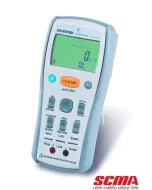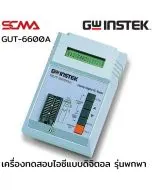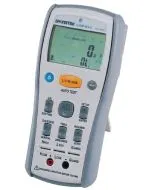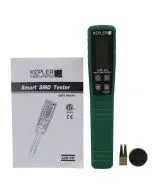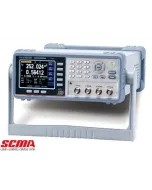

LCR Meters are highly important electronic measuring instruments in the electronics industry and maintenance work. They enable engineers and technicians to accurately test the properties of electronic devices. Let's get better acquainted with this efficient tool.
What is an LCR Meter?

LCR Meters, or LCR meters, are tools used directly in electrical and electronic work that must be present to measure the circuits inside various devices. They can measure all three main components in an electronic circuit, namely Inductance (L), Capacitance (C), and Resistance (R). This tool is essential for repair technicians or engineers who need to inspect, analyze, and troubleshoot problems within electronic device circuits to accurately identify faulty or deteriorated parts.
Using an LCR Meter

To use an LCR meter effectively, it is necessary to understand the correct method of measuring each type of component. An LCR meter can measure three main types of components: resistance (Resistance), capacitance (Capacitance), and inductance (Inductance). Each type has similar measurement steps but differs in mode selection and reading values.
Measuring Resistance (R)
- Turn on the meter and select the resistance measurement mode
- Connect the resistor to the test leads
- Select a test frequency (1 kHz/120 Hz)
- Read the resistance value from the display (unit Ω)
Measuring Capacitance (C)
- Turn on the meter and select the capacitance measurement mode
- Connect the capacitor to the test leads
- Select an appropriate test frequency
- Read the capacitance value and Dissipation Factor (D)
Measuring Inductance (L)
- Turn on the meter and select the inductance measurement mode
- Connect the inductor to the test leads
- Select an appropriate test frequency
- Read the inductance value and Quality Factor (Q)
Features and Benefits of LCR Meters
An LCR meter is a tool used directly in electrical and electronic work that must be present to measure the circuits within various devices. With its ability to measure inductance (L), capacitance (C), and resistance (R), technicians and engineers can accurately diagnose problems and test the performance of electronic circuits, leading to highly efficient maintenance and product development.
Types of LCR Meters
LCR meters are categorized based on their usage characteristics and measurement accuracy. The two main types commonly used in electronics work are portable and benchtop models, each with advantages and features suited to different tasks.
Portable LCR Meter
A portable LCR meter stands out for its compact size, lightweight design, and ease of use in field work. It can be carried conveniently to various locations, making it suitable for general maintenance tasks that do not require extremely high accuracy. It operates within a frequency range up to 100 kHz with an accuracy of approximately 0.1-2%, offering good value at a reasonable price point accessible to most technicians.
Benchtop LCR Meter
A benchtop LCR meter is larger and heavier than its portable counterpart, designed for use in laboratories or factories requiring high accuracy. It can operate at frequencies above 100 kHz up to megahertz levels with measurement accuracy as high as 0.01%. It offers a wider range of functions and often connects to computers for in-depth data analysis, making it ideal for research, product development, or quality control tasks that require high precision.
What are the differences between an LCR meter and a multimeter?

When it comes to electrical and electronic measuring tools, LCR meters and multimeters differ in terms of design, measurement capabilities, and application. Each type has its own strengths and limitations, making them suitable for different tasks.
LCR Meter
An LCR meter is a specialized tool designed specifically for measuring the properties of passive electronic components. Its main advantage lies in its high accuracy when measuring inductance (L), capacitance (C), and resistance (R). Additionally, it can measure other related parameters such as Q-factor, dissipation factor, and impedance. Although LCR meters are generally more expensive and harder to use than multimeters, they provide deeper insights into the components being measured.
Multimeter
A multimeter is a versatile measuring tool capable of performing various basic electrical measurements such as voltage, current, and resistance. Currently available in many brands and models, they are primarily divided into two types: analog and digital multimeters. Digital multimeters display numerical readings on a digital screen, while analog ones do not show numbers but use a scale to indicate changes in the measured values. Multimeters tend to be cheaper and easier to use than LCR meters, although some models may have additional special functions such as temperature or frequency measurement. However, their accuracy in measuring L and C is usually much lower compared to an LCR meter.
Interested in Motion Sensors? You Can Buy Them from SCMA Today!
In addition to the important LC meter for electronic work, we also offer high-quality Motion Sensors! Motion Sensors are crucial components in modern automation and security systems.
At SCMA, we provide a variety of motion detection sensors including PIR, Microwave, Ultrasonic, and Dual Technology types that offer the highest detection efficiency. We also offer professional consultation and installation services.
Whether you need Motion Sensors for automatic lighting systems, security systems, or factory automation control systems, we have solutions tailored to every requirement.
Summary
An LCR Meter is an essential electronic measuring instrument for tasks requiring precise measurement of passive electronic component properties. It can accurately measure inductance (L), capacitance (C), resistance (R), and related parameters.
LCR Meters come in two main types: portable models that are convenient for field work, and benchtop models with high precision suitable for laboratories and industrial plants. Unlike general multimeters which offer versatility but lower accuracy in measuring L and C values.
In addition to LCR Meters, SCMA also offers a range of high-quality products such as various types of Motion Sensors that meet needs for both safety and automation systems. We provide professional consultation and installation services to ensure the best user experience.
If you are looking for high-quality resistance measuring tools or efficient electronic devices, SCMA is your best choice. Contact us today to get more information and special offers!
Frequently Asked Questions
What is Motion Detection?
Motion Detection, or movement detection, is a technology used to detect the movement of objects or people in designated areas using various types of sensors such as PIR (Passive Infrared) sensors, ultrasonic sensors, or microwave sensors. Each type operates differently but has the same purpose of detecting motion and sending alerts or triggering other systems.
What is a Motion Sensor?
A Motion Sensor, also known as a movement sensor, is an electronic device designed to detect movement in the area where it is installed. There are several types that vary based on the technology used, such as PIR (Passive Infrared) sensors which detect changes in infrared radiation within an area, microwave sensors which emit microwaves and measure reflections, ultrasonic sensors which use high-frequency sound waves, and dual-technology sensors which combine multiple technologies to reduce false alarms.
Which type of Motion Sensor is best?
Choosing the right Motion Sensor depends on the usage scenario and environment:
- PIR Sensor: Suitable for indoor use, energy-efficient, affordable, but may have limitations in detecting objects with temperatures close to the environment.
- Microwave Sensor: Can penetrate certain materials and is suitable for areas with obstructions, but it is more expensive and may detect movement outside the desired area.
- Ultrasonic Sensor: Suitable for high-precision areas such as automatic door systems.
- Dual Technology Sensor: Reduces false alarms and is suitable for security systems requiring high reliability, but it is more expensive.
At SCMA, we have experts ready to advise you on selecting the right Motion Sensor that meets your specific needs.
How does a PIR sensor work?
A PIR (Passive Infrared) sensor works by detecting changes in infrared radiation within its coverage area. Every object with a temperature above absolute zero (-273°C or 0 Kelvin) emits infrared radiation. The human body has an average temperature of about 37°C, which releases infrared radiation at wavelengths around 9.4 micrometers.
When a person walks in front of a PIR sensor, there is a change in the infrared radiation that the sensor detects. The sensor has special lenses that divide the detection area into zones (Zones). When movement passes through these zones, it causes changes in signals that the internal electronic circuitry can detect and send out to control other devices such as turning on lights or sending an alarm signal.
PIR sensors have advantages like low power consumption, affordable pricing, and durability. However, they have limitations in detecting movements directly towards or away from the sensor compared to lateral movement, and may be disturbed by other heat sources such as direct sunlight or heaters.