The common issue that maintenance technicians face on the job site is a drop in suction power, causing parts to fall off during robotic arm movement, resulting in an increase in defects (Defects) and forcing production lines to halt. SCMA offers high-performance vacuum generation equipment solutions. You can easily purchase vacuum generator through our online system here. The SCMA engineering team will assist with specifications comparison before purchasing to prevent ordering the wrong spare parts, which would otherwise waste time modifying machinery.
What is a vacuum generator and why do engineers choose it for automation systems?
The most frequently asked question from on-site technicians is what vacuum generator is. This piece of equipment converts compressed air (Compressed Air) from the factory's air compressor into a vacuum state for use in automation systems. The standout feature of this type of equipment is that it has no moving parts inside, making its structure lightweight and compact. Engineers can install vacuum generators directly at the end of robot arms without adding load to the robot's drive shaft.
In-depth look at how ejector-type vacuum generator works
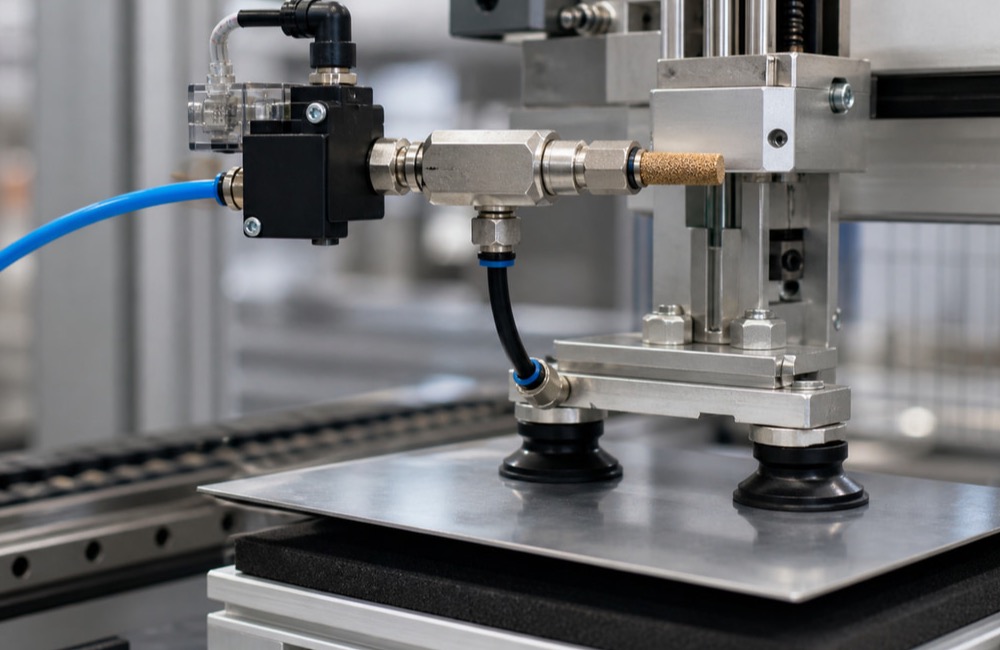
The principle of operation for the ejector-type vacuum generator relies on physics known as the Venturi Effect. When compressed air is released through a narrow nozzle (Nozzle), its speed increases dramatically. This acceleration causes the pressure in that area to drop rapidly below atmospheric pressure. This negative pressure then acts to draw air from outside into the vacuum port (Vacuum Port). This process creates immense suction power for accurately picking up parts.
Types of Vacuum Generators That Meet Industrial Needs
Each work site requires different specifications for Vacuum Generators. Engineers can classify the types of Vacuum Generators based on their working structure into 3 main groups as follows:
Single-stage Ejector Type
This model has a simple and uncomplicated design. The mechanism can quickly achieve deep vacuum levels (High Vacuum). A single-stage vacuum generator is suitable for picking up smooth surface workpieces without porous holes, making it ideal for technicians to use in handling plastic or metal parts.
Multi-stage Ejector Type
This system uses multiple nozzles arranged sequentially to increase efficiency. The mechanism can achieve a very high vacuum flow rate (Suction Flow Rate) while conserving compressed air from the factory. This type of Vacuum Generator is suitable for workpieces with porous holes, where air leaks easily, such as lifting boxes of packaging materials.
Integrated Ejector Type (with Valve and Sensor)
This model integrates directional control valves (Solenoid Valve) and vacuum switches into one unit. The integration helps save installation space on robotic arms, allowing robots to quickly send signals for picking up and releasing workpieces. This type of ejector vacuum generator is suitable for electronic assembly lines that require high sensitivity.
How to Evaluate Vacuum Generators Specifications for Secure Workpiece Handling
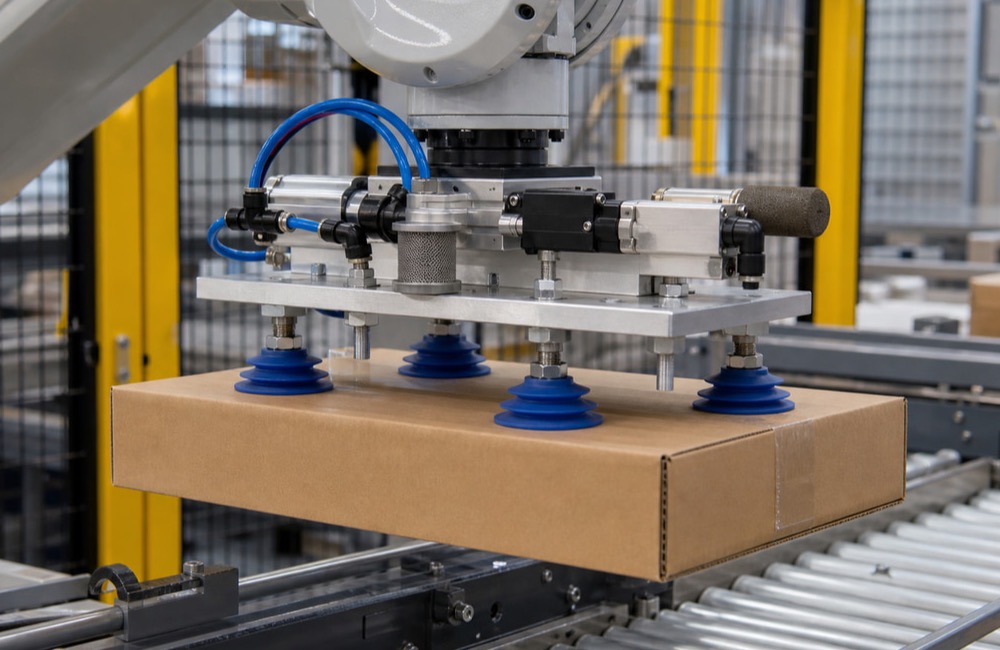
Incorrect spare part sizing can cause Vacuum Generators to fail in lifting workpieces. Maintenance teams should evaluate specifications according to the following engineering steps:
- Calculate the total weight of the workpiece to determine the required lifting force (Lifting Force)
- Check if the suction pad's contact area is proportional to the weight of the object
- Evaluate a safety factor for sudden pulling forces when robotic arms move at high speeds
- Select the appropriate nozzle diameter (Nozzle Diameter) of the Vacuum Generator based on all calculated values
- If the selected nozzle is too small, suction force will be insufficient; if it's too large, factory compressed air will be wasted unnecessarily
Clogged Vacuum Generators and On-Site Solutions
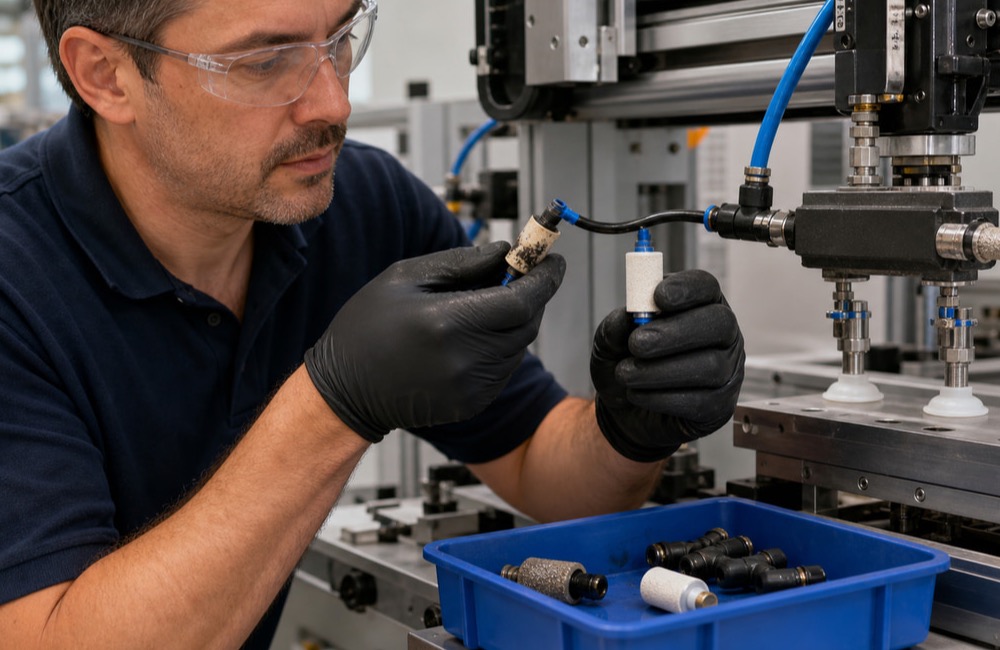
Maintenance technicians must be prepared to handle sudden drops in suction force from Vacuum Generators. We can analyze and resolve the issue as follows:
- Observe machine symptoms, workpieces frequently drop even when air pressure settings remain unchanged
- The cause is often dust particles on the workpiece being drawn into and clogging the nozzle (Nozzle) of the vacuum generator
- In some cases, the silencer on the exhaust side becomes clogged, preventing proper airflow release
- The correct solution involves installing a filter (Vacuum Filter) between the suction pad and the generator
- The filter will trap dust particles to prevent them from damaging internal narrow passages
- Technicians must remove and clean the filter according to PM (Preventive Maintenance) schedules strictly
Noise Management from Exhaust Air on Machinery Fronts
The operation of ejectors requires the continuous release of compressed air into the atmosphere. This process inevitably creates loud bang noises that disturb workers at the production line front. On-site technicians must always install a silencer (Silencer) at the exhaust port of the vacuum generator type ejector. Controlling noise levels helps maintain safety standards (OSHA) and protects the hearing health of team members.
Piping System Layout to Maintain Stable Vacuum Levels
A common mistake is that on-site technicians lay out vacuum lines too long. Using smaller diameter tubing than the port results in a Pressure Drop along the way, causing massive loss of suction at the end point. The engineering rule is to install Vacuum Generators as close to the pickup points as possible. Shortening the length of air lines helps improve the system's vacuum generator response time, making part handling more accurate and less delayed.
Summary
Vacuum Generators are a crucial power source for automatic part handling. Choosing the right ejector type vacuum generator helps reduce production line waste issues. SCMA is ready to provide engineering consultation for you. Order vacuum generators from us and get fast delivery, no need to wait.
If you want to buy, SCMA is available today!
SCMA offers the highest convenience to factory customers. You simply take a photo of the nameplate of your old model and send weight data of the workpiece via our Line OA immediately. The SCMA engineering team will calculate flow rates and compare specifications for vacuum generators from leading brands free of charge. We have stock vacuum generator ready for fast delivery nationwide. You can install them into your machinery and use them immediately, eliminating downtime issues.
Frequently Asked Questions (FAQ) About Vacuum Generator Usage
Q1: How does a Vacuum Generator differ from a Vacuum Pump?
A vacuum pump is driven by an electric motor and has mechanical components inside, suitable for creating a vacuum in large areas. A vacuum generator, on the other hand, uses compressed air to operate, is lightweight, requires no maintenance of mechanical parts, and is ideal for spot holding tasks.
Q2: Do ejector-type vacuum generators consume a lot of factory air?
This depends on the size of the Nozzle and the duration it's in use. Currently, there are ejector-type vacuum generators with an installed Vacuum Switch that has an Energy Saving function to cut off compressed air immediately when reaching set values, saving more than 50% of air consumption.
Q3: What causes workpieces to fall during robot arm movement?
Mechanics should evaluate three main points: bent air hose, worn-out rubber suction pads, or dust clogging inside the vacuum generator, which reduces flow rate and suction force.
Q4: Can SCMA compare specifications for discontinued vacuum generator models?
SCMA can compare specifications of Vacuum Generators from all brands. The engineering team will request air specifications and the weight of workpieces to calculate an equivalent new model, ensuring that the mounting points (Mounting) match those of the original.
Q5: How can I be confident about specifications when purchasing equipment online with SCMA?
We operate with a 100% Technical Support system. Customers don't have to risk ordering on their own; our engineering team will conduct in-depth parameter evaluations of vacuum generators via Line OA, confirming the correct specifications before providing quotes every time.