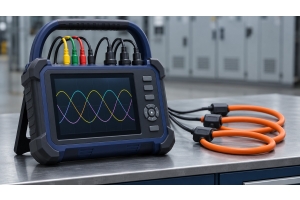
Are you facing issues with measurement inaccuracies in your industrial electrical measurements? This article will take you deep into what True RMS is, as well as help you understand what RMS is, so that you can choose the right True RMS Multimeter. The engineering team from SCMA, the provider of complete measurement tool solutions with integrated automation systems, has summarized key information that you will learn from the basic principles of operation all the way to a practical checklist for purchasing
What is True RMS?
True RMS (True Root Mean Square) is a technology for measuring the actual energy value of an alternating current (AC) electrical signal. The system mathematically calculates the actual waveform to achieve the highest level of accuracy, even if the electrical waveform is distorted or deviates from a perfect sine wave
Principle of True RMS Operation
Understanding the principle of operation of this technology starts with finding the answer to what RMS is. In electrical engineering, this term is an abbreviation for Root Mean Square, or the square root of the mean square.

Conversion of Electrical Signals
The system converts alternating current (AC) electrical signals into equivalent energy quantities of direct current (DC). This process helps technicians accurately assess the heat generated in the system. Choosing a True RMS Multimeter therefore meets the needs of real energy analysis.
Limitations of General Meters
General average-responding meters measure the average and then multiply by a constant, assuming the wave is a perfect sine wave. If the electrical system involves electronic devices or inverters, the wave will distort from the original (Non-sinusoidal wave), resulting in the original meter reading inaccurately.
Accuracy of Real Waveform Calculation
The True RMS technology records and calculates from every actual waveform passing through the circuit. This method provides accurate results, effectively reflecting the real electrical power. Understanding the meaning of True RMS deeply helps prevent equipment damage from overloading problems.
Importance to Problem Analysis Systems
From the experience of SCMA engineers who manage systems for customers in the Eastern Economic Corridor (EEC), Chonburi, as well as northern industrial estates, Lampoon, we have found that measuring values that reflect real thermal energy is the core of proactive maintenance. Using high-quality True RMS Multimeters helps quickly identify the causes of accumulated heat in wiring, preventing unexpected machine shutdown problems.
How many types of True RMS are there?
The measurement system in electrical instruments is divided according to the principle of signal processing or the calculation method inside the instrument. If considered according to technology, it can be divided into 2 main types as follows
Analog (Analog / Thermal True RMS)
This technology uses the principle of heat by converting electrical signals into equivalent heat, and then measuring that heat to obtain the actual RMS value. This system is an old technology with high complexity. A major limitation is its relatively limited frequency response compared to new technologies
Digital (Digital / Mathematical True RMS)
This system uses a processing chip (DSP or Microcontroller) to sample the signal, square the mathematical values, find the average, and take the root according to the formula. True RMS Multimeters in the current era widely use this system because it provides high accuracy
True RMS Maintenance
Maintaining the True RMS Multimeter ensures long-term use with high accuracy. The following strict basic steps should be performed:
Proper Cleaning
Clean the device and screen only with a dry soft cloth or a slightly damp cloth. Never use corrosive chemicals or solvents. Technicians must check the test leads (Test Leads) to ensure no rust accumulates to maintain the accuracy of True RMS.
Storage Environment
The instrument must be stored in a dry place, avoiding high humidity. Prevent the device from being exposed to direct sunlight or located in areas with extremely high temperatures. The device should be kept away from high-voltage electromagnetic fields that may interfere with the internal circuitry.
Battery Power Management
If the device is not used for a long period, the battery should be removed each time to prevent acid leakage that may corrode the circuit board. For portable True RMS Multimeters, the battery should be charged or replaced regularly as scheduled.
Transportation and Calibration
Transportation must be done carefully to avoid shocks, especially for desktop models, which should be placed in shock-proof boxes each time. The most important thing is to send the device for regular calibration (Calibration) against standard values. SCMA offers calibration services to ensure your instrument meets the highest standards.

True RMS Usage in Industry
The use of measuring instruments that support this technology in industry is to measure the actual electrical energy of alternating current (AC) signals, even if the electrical waveform is distorted or has frequencies skewed from various electronic systems.
Measuring Non-Sinusoidal Signals
Modern industrial factories are full of electronic devices, such as inverters (VFDs), power converters, which cause the electrical waveform to distort from the original sine wave. Therefore, using a True RMS Multimeter is essential for analyzing these electrical systems to obtain accurate values.
Preventing Reading Errors
Ordinary meters calculate values based on a complete sine wave, causing measured values to be inaccurate when encountering distorted waves. Underestimating current can lead to equipment damage. If the operator understands what RMS is, they will realize the importance of using the correct tool.
Accuracy in Analysis for Maintenance
Accurate data helps technicians analyze overloading issues or accumulated heat in wiring precisely. Proactive problem-solving using data from True RMS can reduce production downtime by at least 15% in a short period of time.
Advantages of True RMS
The main advantage of this technology is its ability to accurately measure voltage along with alternating current (AC) in all signal waveforms, no matter how much the wave is distorted from the original.
Maximum Accuracy in All Waveforms
This system differs from general meters that can only read accurately for pure sine waves. True RMS meters calculate based on the actual signal shape passing through the circuit, resulting in accurate results even when encountering distorted waves in the production system.
Supports Modern Electrical Equipment
This technology is designed to support measurements in circuits with modern equipment, such as variable speed drives (Inverter), uninterruptible power supply (UPS). Using a True RMS Multimeter therefore meets the needs of industrial environments with a large number of harmonic disturbances.
Reflects Real Thermal Energy
The measured value reflects the actual thermal energy generated in the load equivalent to direct current (DC). Understanding what True RMS is, in terms of energy, helps engineers analyze electrical problems accurately, preventing fuse blowouts without knowing the cause.

How to Choose True RMS
Purchasing a True RMS Multimeter that is cost-effective and suitable for industrial applications should consider several important factors to obtain a tool that maximizes downtime reduction
- Analyze the nature of the work with interference signals: If working with solar cell systems or inverters, only True RMS should be selected to solve the problem of distorted frequency readings
- Check the type of electrical current: Check the current range (Ampere) to see whether AC or DC voltage needs to be measured to cover actual usage
- Pay attention to the safety level (CAT Rating): Choose a model with safety standards such as CAT III or CAT IV according to the voltage level being measured to prevent accidents
- Select an accepted brand: Consider leading brands in the industrial group such as KYORITSU which are durable and have accurate calibration
- Consider necessary additional functions: Choose a model with an overload protection system and complete basic measurement functions such as resistance, diode, capacitor
- Display screen: The screen should have a backlight for dark areas and a data hold function to facilitate reading values on-site
Applications of True RMS Multimeter in Industrial Work
Applying True RMS Multimeter in real industrial environments plays an important role in quality control and maintaining the stability of the electrical system. Understanding what RMS is helps to fully utilize the various functions effectively.
- Analysis of Industrial Motor Load: Used to check the current flowing into the motor through the Inverter to detect abnormalities and prevent motor burning.
- Checking the Cooling System: Accurately measure the varying current of the compressor using the True RMS system.
- Evaluating Electrical Quality in IT Systems: Correctly analyze the current in the data center (Data Center) and complex waveform UPS systems.
- Maintenance of Electronic Circuit Boards: Inspect small electrical components with sensitive measurement functions.
- Troubleshooting Voltage Drop or Overvoltage: Rely on actual energy values to find points of high resistance in the system.
Summary
Understanding what True RMS is and its benefits is a crucial foundation for effectively selecting measuring instruments. If you are looking for high-quality True RMS Multimeters to reduce production downtime, the engineering team from SCMA is ready to be your technical partner, offering advice, recommending suitable products, as well as providing international standard calibration services for measuring instruments.
Interested in purchasing or consulting via LINE Official: @SCMA
If you want to buy True RMS, you can buy it from SCMA today!
Investing in accurate measuring instruments is an investment in the stability of the production line. If you are considering which True RMS Multimeter to choose, SCMA, as a technically proficient partner, offers leading global brand measuring instruments for sale, such as Digital Multimeter model GDM-360 Multimeter model KDM-18A, along with professional engineering team solutions design and after-sales service.
Frequently Asked Questions
How is True RMS different from a regular meter?
A regular meter measures only a complete sine wave, but the True RMS system calculates from the actual distorted waveform, resulting in more accurate readings in industrial environments.
What is RMS in electrical terms?
RMS stands for Root Mean Square, which is a conversion of alternating current (AC) electrical signal values to display equivalent thermal energy quantities of direct current (DC).
Is it always necessary to use a True RMS multimeter?
If measuring household electricity, a regular meter is sufficient. However, in factories with inverters or a large number of electronic devices, it is recommended to use a measuring tool that supports this technology.
Can this type of measuring tool measure direct current (DC)?
Currently high-quality measuring tools fully support the measurement of both alternating current (AC) and direct current (DC), along with comprehensive functions for various applications.
How often should measuring tools be calibrated?
To maintain maximum accuracy, it is recommended to send the device for standard calibration at least once a year. Calibration services can be directly obtained from SCMA.