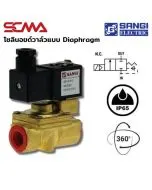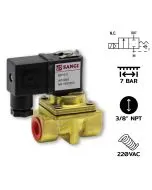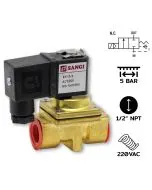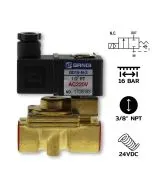

Solenoids are crucial components in today's industrial applications, whether it involves controlling the flow of liquids, mixing substances, or distributing various materials. Solenoids play a vital role in ensuring that production systems operate efficiently. SCMA, as experts in measurement tools, automation systems, and industrial solutions, wishes to provide information about what solenoids are, their benefits, and how they work through this article to enhance readers' understanding of solenoids.
What is a Solenoid Valve?

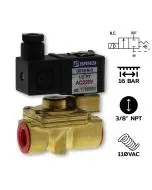
A solenoid valve, or Solenoid Valve, is a directional control valve used to regulate the flow of liquids, gases, or air. The operation of a solenoid valve relies on the principle of a solenoid, which consists of an electric coil wound around a magnetic core that opens or closes the valve to control the flow. When electrical current passes through the coil, it generates a magnetic field and pulls the plunger to open or close the fluid path.
What are the Benefits of Solenoid Valves?
Solenoid valves offer numerous benefits in industrial applications as they can be used with liquids, gases, and air. They provide precise control for opening, closing, mixing, or diverting fluid flow as needed, have quick response times, long service life, and are available in various types to suit a wide range of uses, from household appliances and automobiles to food, chemical, and medical industries.
Solenoid Valve How does it work?
The operation of a solenoid valve relies on two main components: the solenoid, which is a coil of wire wound around an iron core, and the valve body that consists of a plunger and seal to open or close the flow path. Solenoid valves can be either normally open or normally closed. When electrical current passes through the coil, it generates a magnetic field that can pull or push the plunger to move and thus open or close the valve.
Solenoid valves have three main operating types:
- Direct acting - The plunger is directly connected to the core of the coil. When energized, it lifts or lowers the plunger to open or close the passage. Suitable for low pressure and moderate flow rates.
- Indirect/pilot - Uses a differential in pressure to move a diaphragm to open or close the valve. The solenoid is separate and acts as a pilot valve, suitable for high pressure and high flow rates.
- Semi-direct - Combines both methods by using force from the coil and differential in pressure. Suitable for applications requiring opening or closing at zero pressure.

Solenoid Valve Circuit Functions
Solenoid valves have different circuit designs based on their intended use, specifying the number of ports for connecting pipes or air lines and the valve's open/close characteristics in each operating state. The main circuit functions of solenoid valves are as follows:
2/2 Way Solenoid Valve
A 2/2 way solenoid valve has only one inlet and one outlet port each, suitable for applications requiring simple on/off flow control such as safety valves or emergency shut-off. This is the simplest form of a solenoid valve but it effectively controls unidirectional flow.
3/2 Way Solenoid Valve
A 3/2 way solenoid valve has three ports for connecting pipes or lines and operates in two modes which can be switched between. It is suitable for directing fluid flow to change direction between two positions, such as diverting the main inlet flow to one of two outlets, or mixing flows from two inlets into a single outlet. The 3/2 way solenoid valve thus offers greater flexibility in use.
4/2 Way Solenoid Valve
A 4/2 way solenoid valve has four connection ports designed specifically to control the air or gas flow into and out of a cylinder. Note that the exhaust rate from both sides of the cylinder is controlled by the common port, meaning the exhaust airflow rates are equal on both ends of the cylinder. This may limit the ability to adjust different speeds or forces in two directions.
5/2 Way Solenoid Valve
A 5/2 way solenoid valve is similar to a 4/2 but adds the fifth port for separate exhaust of air or emissions from both sides of the cylinder. It allows independent control over the release from each side of the cylinder, making it easier and more precise to adjust airflow rates for different speeds or forces. This makes it an excellent choice for work requiring detailed and flexible control of cylinder operation.

What types of Solenoid Valves are there?
In addition to being classified by circuit function, solenoid valves can also be categorized based on their initial open or closed state when no power is supplied to the coil.
- Normally Closed Solenoid Valve (NC) : In normal conditions, it remains closed. Without electrical power to the coil, a spring forces the plunger to close the valve and prevent flow.
- Normally Open Solenoid Valve (NO) : In normal conditions, it remains open and allows fluid to flow through. When power is supplied, a magnetic force pulls the plunger to close off the outlet seal. This type is suitable for applications where the valve needs to be open longer than closed as it conserves energy.
- Bi-stable Solenoid Valve : This is a locking solenoid valve that uses only brief bursts of power to change the valve's position and lock it there without continuous power, reducing spring stress and energy consumption.
How do different seal materials differ?
Choosing the right seal material is crucial for solenoid valves as it must be compatible with the type of fluid and operating conditions. Common seal materials include NBR, which is resistant to water and glycol; EPDM, which withstands heat and UV radiation and has a wide range of applications; FKM or Viton, which are highly chemical-resistant; and PTFE, which excels in both chemical resistance and high temperatures.
What factors should be considered when selecting a solenoid valve?
Selecting a solenoid valve involves considering several factors such as the type of valve (2-way, 3-way, 4-way, or 5-way), housing and seal materials suitable for the media used, AC or DC power source, required pressure and maximum flow rate, operating temperature range, valve response time, and specific certifications like UL, CE for safety, or NSF, ACS standards for drinking water.
Usage of Solenoid Valves
The application of solenoid valves is widespread, ranging from household use to process control in industrial plants. For example, they are used to open and close the flow of refrigerant or air conditioning fluids, adjust airflow into pneumatic cylinders, operate washing machines and dishwashers for water filling and drainage, control solutions in medical equipment, as well as dispense cleaning chemicals in industrial cleaning tools.
Before Using Solenoid Valves, Consult SCMA Today!
When using solenoid valves, selecting the right model and proper installation is crucial. SCMA Company, an expert in measurement tools and automation systems, provides consultation on choosing suitable solenoid valves for your needs, from requirement analysis to system design, installation, and maintenance. SCMA has a professional team of engineers ready to offer comprehensive services with quality assurance.High-quality products and services

Summary
Solenoid valves play a crucial role in controlling fluid flow in modern industrial applications. They come in various types based on usage, materials used, and properties of the fluids being managed. Therefore, selecting appropriate solenoid valves is very important to ensure that systems work as intended, are highly efficient, and have long-lasting durability. For more information or advice, you can contact SCMA's expert team anytime. The company is pleased to provide comprehensive consultation and services in measurement tools and automation systems to meet the needs of all industrial sectors.
Frequently Asked Questions
What is the function of a Solenoid Valve?
Solenoid serves as the driving force to open and close valves by utilizing a magnetic field from an electric coil wrapped around a metal core, causing a plunger to move and either block or allow fluid flow.
What causes a solenoid to fail?
Common issues with solenoids include valves not closing tightly, leaking, making loud noises, or coil burnout. These problems may arise from dirt buildup, improper pressure, leaks, excessive heat, or coil damage, which might require cleaning, seal replacement, or new coil installation.
What is the function of a gas stove solenoid?
The solenoid in a gas stove or combustion equipment acts as a safety valve to cut off gas flow if there's an electrical leak or backdraft flame, preventing explosion hazards.
How many types of Solenoids are there?
Solenoid valves can be categorized into various types based on their usage, such as water solenoid valves, air solenoid valves, gas solenoid valves, hydraulic solenoid valves, or by the number of ports like two-way, three-way, four-way, and five-way. Additionally, they are classified according to initial state NC (Normally Closed) or NO (Normally Open). Consultation with an expert is recommended for optimal selection.