Air Cylinder is an essential actuator in the industry. If the old cylinder deteriorates or the seal leaks, it will immediately cause a malfunction in the machine rhythm. SCMA offers high-quality pneumatic cylinders that are exceptionally impact-resistant. We have a team of engineers to provide consultation and review specifications for air pneumatic cylinders before you order online. This helps eliminate the problem of waiting for external technicians to assess on-site, allowing you to requisition spare parts for cylinders with precise specifications and fast delivery nationwide.
What is a Pneumatic Air Cylinder? Why is it Important in Automation Systems?
Many new technical graduates may wonder what a pneumatic air cylinder is. This piece of equipment is the main actuator (Actuator) that converts compressed air energy into linear or rotational movement. The air cylinder plays a crucial role in pushing, pulling, lifting, or sliding workpieces in automated production lines. Assembly line and packaging industries cannot function without these mechanisms. Choosing a robust pneumatic cylinder will help achieve quick and accurate control of the workpiece.
In-depth Engineering Principles of How Cylinders Work
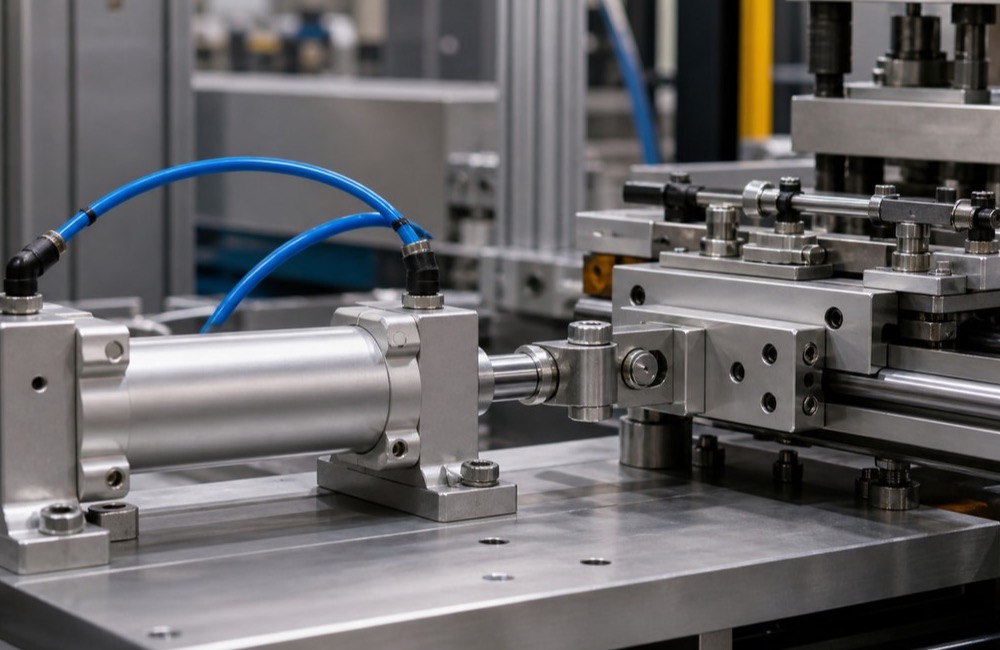
The internal mechanism of the cylinder begins to work when compressed air is supplied into the control chamber (Chamber). The high-pressure air pushes the piston inside to move in the direction programmed by the engineer. The speed and force (Force) of the air cylinder depend on the size of the piston bore (Bore Size). This pushing value varies directly with the level of compressed air pressure supplied from the upstream pneumatic air system. On-site technicians must control the operating pressure to be stable to prevent jerking when the machine is running at full capacity.
Types of Pneumatic Cylinders That Maintenance Technicians Should Know About
Maintenance technicians encounter a variety of mechanisms in machinery. Understanding the types of pneumatic cylinders will help them replace parts correctly according to their intended use.
Single-acting cylinder
This type has only one air inlet port, relying on an internal spring to pull the piston rod back to its starting position. A pneumatic cylinder of this kind is suitable for short-stroke pushing or light part sorting work on conveyor belts. It's important to note that the upstream air pressure must overcome the resistance of the spring completely to prevent the air piston from getting stuck in mid-stroke.
Double-acting cylinder
This mechanism uses compressed air to push the piston rod both forward and backward. Technicians can control the working cycle more accurately than with a spring-return type. Pneumatic cylinders of this kind cover most industrial applications, supporting heavy-duty work that requires high pulling force. When connecting air lines, make sure to check the symbols carefully to prevent the pneumatic cylinder from working in reverse direction.
Selecting the Correct Size for Pneumatic Cylinders and Stroke Length to Match Original Specifications
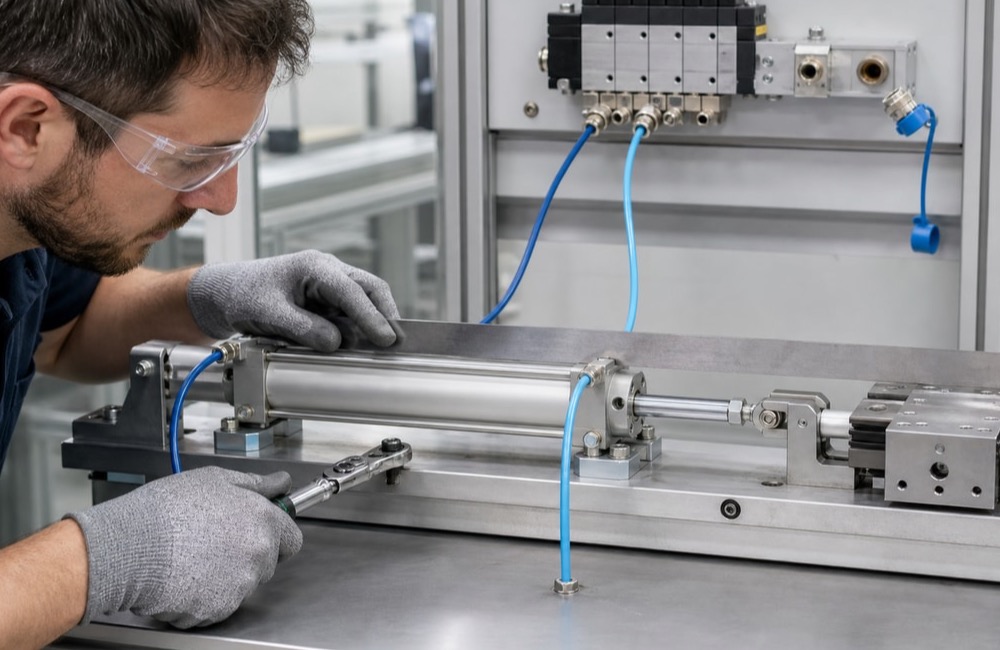
Misselecting the specification by even a small margin may cause severe damage to machinery. Engineers must recalculate the air cylinder specifications every time there is structural modification.
Evaluating Load Weight and Bore Size
Engineers need to evaluate the weight of the workpiece along with the total weight of the end-of-rod mounting assembly, in order to calculate an appropriate bore size. Selecting a pneumatic cylinder must generate sufficient force without overworking the machinery. Adding a safety factor (Safety Factor) of 20-30% helps reduce the risk that the cylinder will not have enough lifting power.
Accurately Measuring Stroke Length
The maximum extension length of the rod (Stroke) must fit the actual working position in front of the machinery. Maintenance technicians need to use a vernier caliper to measure the stroke length of the pneumatic cylinder precisely. Evaluating the stroke specification incorrectly by just a few millimeters can cause machine mechanisms to collide and deform immediately.
Mating Style (Mounting Style) to Match Original Flange
The on-site technician must check the installation characteristics of the old cylinder before ordering spare parts. There are several mounting styles, such as flange type (Flange), clevis type (Clevis), or foot mount type (Foot). Selecting an incorrect mating style makes it impossible to fit into the original machine structure. The SCMA engineering team is ready to match your pitch hole dimensions 100% with your work site requirements.
Accuracy Enhancing Accessories: Air Limit Switches and Sensors
The operation of automation systems relies on precise detection devices. Installing air limit switches greatly enhances the accuracy of production circuits.
- Currently, engineers prefer to use magnetic Auto Switch models instead of the old-fashioned mechanical plunger-type air limit switches.
- Sensors work in conjunction with embedded magnetic rings around the pneumatic cylinder rod inside the barrel.
- When the magnet moves into position opposite the sensor, a feedback signal (Feedback Signal) is immediately sent to the PLC.
- The PLC receives this data and commands the next pneumatic cylinder in sequence to operate seamlessly.
Piston Rod Issues with Pneumatic Cylinders Sticking and On-Site Solutions
Problems such as piston rod jerking or stick-slip cause parts to be ejected from the conveyor belt. Maintenance technicians can address pneumatic cylinder issues following these steps:
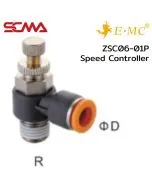
- Check if the air flow control valve (Speed Controller) settings are proportional to the volume of the cylinder barrel.
- Inspect the lubricator set; a common cause of piston rod stiffness is insufficient internal lubrication.
- Examine the dust seal at the cylinder flange end. If it's torn, dust can enter and accumulate on the piston rod.
- Dust particles that harden will scratch the inner rubber seals, causing an pneumatic cylinder to develop internal leakage (Internal Leak).
- If the piston rod has deep scratches, it must be removed for cleaning, with a new piston rod and seal kit installed immediately.
Preventive Maintenance Standards for Air Cylinders
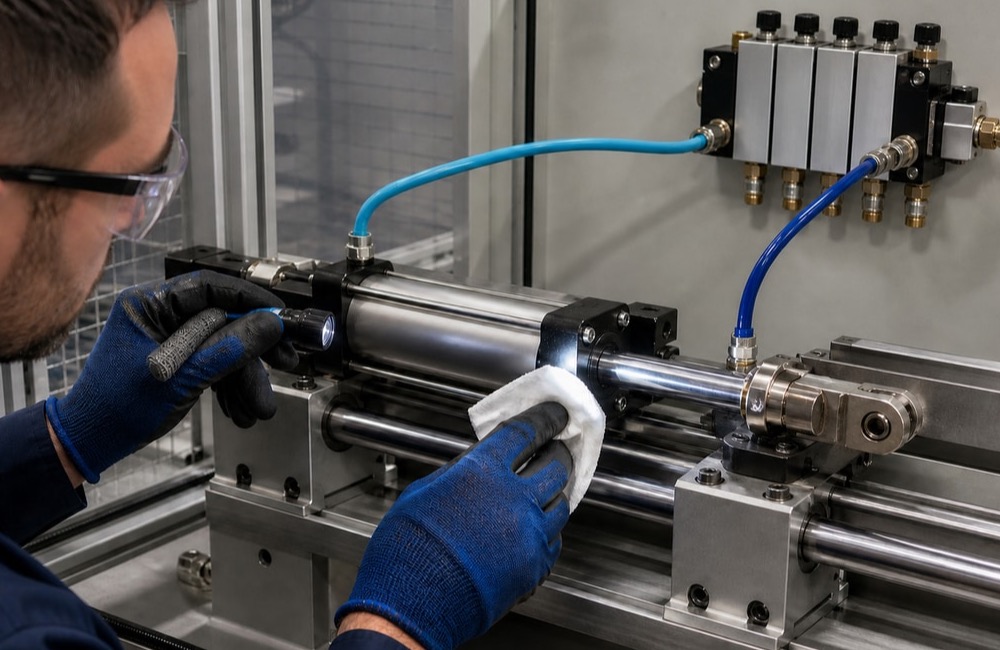
The maintenance team must regularly check the quality of air from the upstream pump. The air used must pass through an FRL unit to capture moisture and dust, preventing scratches inside the air cylinder. It is crucial to check the alignment (Alignment) of the piston rod with the target workpiece. Installing a structure that is not perpendicular will cause side loads (Side Load), which can lead to premature wear and tear of the bearings and piston rod in the pneumatic cylinder.
Summary
Calculating and selecting the correct specifications for an air cylinder helps maintain smooth production flow. Engineers should install air limit switches alongside maintaining the quality of upstream air to extend the lifespan of the pneumatic cylinder. If you need replacement parts, SCMA offers online specification matching services with express delivery straight to your factory.
If you want to purchase, you can buy from SCMA today!
SCMA provides a 100% online service. Customers only need to take a photo of the Nameplate of the original piston cylinder model and send it via Line OA of our company. Our engineering team will promptly compare specifications for popular brands such as air cylinder smc or cylinder smc, free of charge. We provide either the exact specification model or a replacement brand with equivalent quality, delivered quickly to solve your Downtime issues.
Frequently Asked Questions (FAQ) About Pneumatic Cylinders
Q1: What is a pneumatic cylinder? How does it differ from a hydraulic cylinder? Pneumatic cylinders use compressed air as the driving force, suitable for high-speed applications that require cleanliness and safety. They are also easy to maintain. A pneumatic cylinder is a solution different from hydraulic systems which use oil, better suited for heavy machinery requiring immense pressure.
Q2: Why does my pneumatic cylinder jerk during operation? Have the technician check if the flow control valve adjustment on the pneumatic cylinder is too tight. If the valve is normal, it indicates that the internal seals of the pneumatic cylinder are deteriorating due to lack of lubrication.
Q3: What type of sensor should be used to detect the position of a pneumatic piston? Currently, air limit switches such as Reed Switch or Solid State Auto Switch are commonly installed directly into the groove of the cylinder sleeve. These devices react with the magnet inside the pneumatic piston, providing higher accuracy than mechanical lever switches.
Q4: Does SCMA offer specification comparisons for SMC air cylinders that have been discontinued or phased out? We provide specification comparisons for all models of cylinder smc and air cylinder smc. Our engineering team is skilled at reading technical manuals, calculating Bore/Stroke to find new models that fit seamlessly with the existing pneumatic air system.
Q5: How can I be confident about specifications when ordering pneumatic cylinders online? SCMA works closely with our engineering support team to ensure customers do not purchase pneumatic cylinders that are incorrect. We will request information on the pitch of the end shaft threads and mounting bracket type to confirm accuracy before providing a quote for every air cylinder.