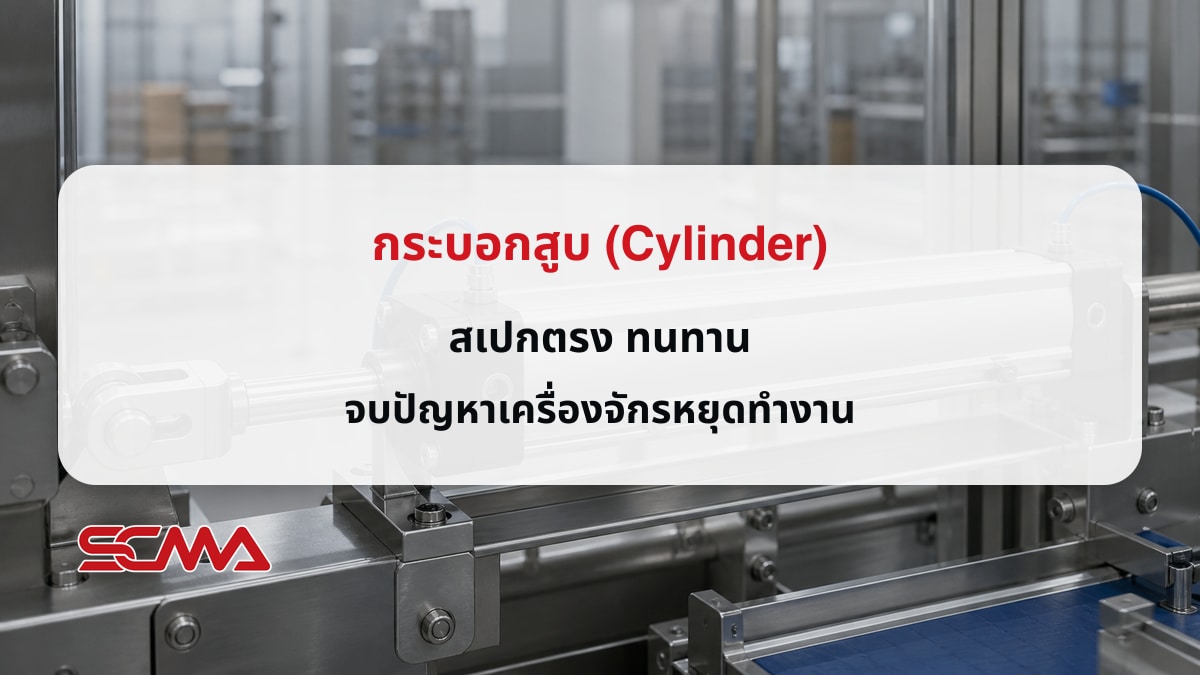
Cylinder deterioration, piston sticking, or seal failure is the cause that leads to machine timing errors resulting in production line downtime (SCMA) offers high-quality pneumatic cylinder and hydraulic cylinder solutions. You can easily order a pneumatic cylinder through our online system, our engineering team is ready to assist with specifications comparison before purchase, preventing errors by 100%
What is a Cylinder? Explanation in an Engineer's Perspective
A field technician may wonder what is a cylinder?. According to the dictionary, cylinder means cylindrical shape. In mechanical engineering, cylinder means a type of actuator that is indispensable in factories. The basic principle of operation of this device is to convert fluid energy into mechanical energy. The fluid used may be compressed air or oil. Internal mechanisms create linear motion (Linear Motion) to push other machine parts forward.
What is a cylinder used for in automated manufacturing (Automation)?
Recent engineering graduates may wonder what a cylinder is used for. The cylinder plays a crucial role in generating force to push, pull, lift, slide, or press workpieces on the automated production line.
Electronic assembly work
The mechanism of a pneumatic cylinder is fast and precise, meeting the needs of electronic component assembly industries that require cleanliness. Technicians apply it to pick up or slide circuit boards into soldering stations. The rapid operation significantly reduces Cycle Time.
Packaging and packaging work
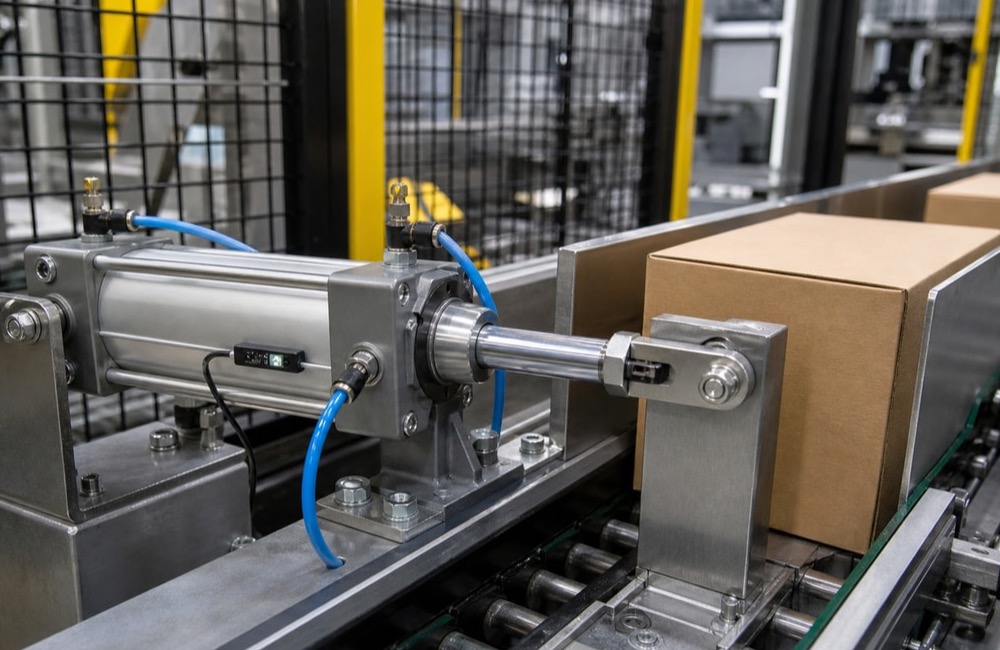
The packaging line requires repetitive movement throughout the day. A pneumatic cylinder plays a role in pushing boxes onto conveyor belts or arranging products on pallets. Engineers must calculate the stroke length to ensure that workpieces do not get damaged due to impact during transportation.
Industrial metal stamping presses
Automotive parts manufacturing plants require metal stamping machines with immense pressing force. A hydraulic cylinder is the solution for such tasks. Its robust and durable structure ensures consistent part forming, essential for modern industrial factories.
Comparing Pneumatic Cylinders with Hydraulic Cylinders
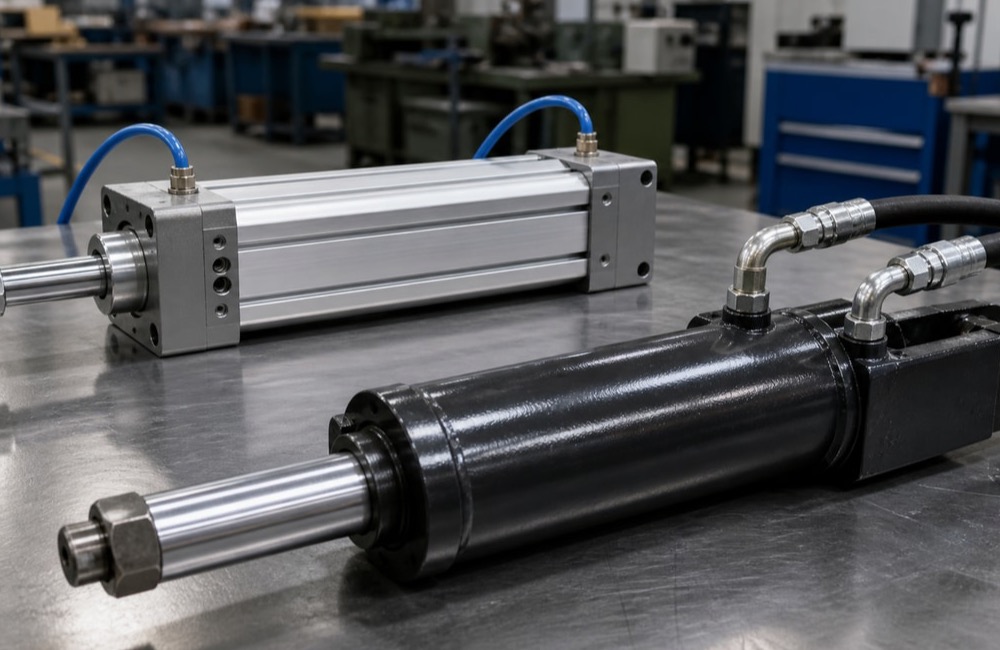
Selecting the wrong type of cylinders can cause machinery to malfunction. Engineers must understand the differences between both drive systems clearly before ordering spare parts.
Pneumatic Cylinder (Air-driven)
A pneumatic cylinder uses compressed air from an air compressor as its primary driving force. This system offers high speed, cleanliness, safety, and easy maintenance. Field technicians prefer it for tasks requiring fast cycle times without the need to bear heavy loads.
Hydraulic Cylinder (Oil-driven)
A hydraulic cylinder uses hydraulic oil as a medium for power transmission. This system can generate high pressure, making it suitable for heavy machinery that must withstand high loads. Movement is slower than air systems but offers excellent stability.
Dive Deep into Cylinder Components Affecting Lifespan
Diagnosing cylinder failures starts with understanding the internal components. Maintenance technicians should understand cylinder components to assess lifespan.
- Tube (Bore): Must be made from high-pressure resistant material, serving as a chamber for compressed air or oil to push internal mechanisms.
- Piston Rod: The part that extends out to work. It must undergo hard chrome plating to resist scratches from dust particles.
- Seal Kit: A crucial component preventing air leakage between chambers. If the seal deteriorates, a pneumatic cylinder will lose its pushing force immediately.
- Cushioning Rubber: Helps reduce impact when the piston rod reaches full stroke, protecting structural components from breaking.
- Magnet Ring: Embedded inside the piston to send magnetic signals for sensors to detect working position.
The Relationship Between Force, Pressure in the Cylinder, and Bore Size
Engineers must understand basic engineering calculation formulas to design machinery. The force exerted by pressure in the cylinder is directly proportional to the product of pressure and the cross-sectional area of the piston (Bore Size). Accurate assessment of the load weight is necessary to determine an appropriate size. Engineers must always account for a safety factor (Safety Factor) in their calculations, which helps prevent issues where the cylinder lacks sufficient force to move the workpiece, causing production lines to halt.
The Way to Select Pneumatic Cylinders That Match Original Specifications 100%
Mis-specifying spare parts causes maintenance teams to waste time modifying machinery. The correct way of selecting pneumatic cylinders can solve this problem decisively.
- Start by reading the Nameplate of the original pneumatic cylinder model to gather detailed information from the manufacturer's manual.
- Check the piston bore size (Bore) to ensure that the same pushing force is maintained without reduction.
- Measure the full extension length of the rod (Stroke) accurately. A misaligned stroke can cause mechanisms to collide and break down.
- Note the mounting type, such as floor mount (Foot), flange mount (Flange), or clevis mount (Clevis). All points must be identical to avoid modifying machinery.
Seal Leakage, Shaft Sticking Issues and Emergency On-Site Solutions
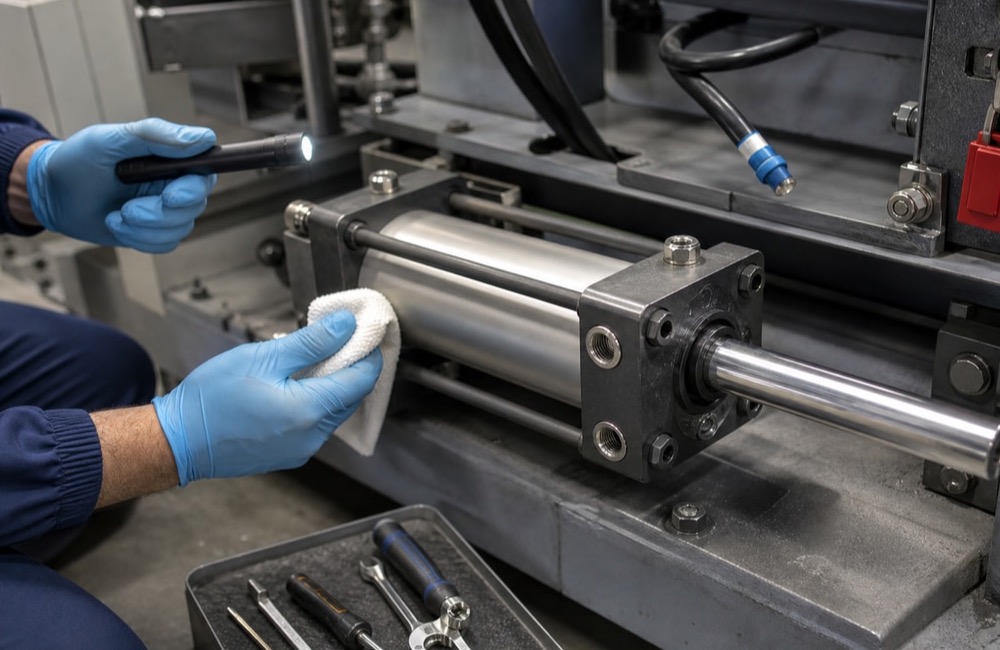
Heavy-duty machinery inevitably wears down over time. Maintenance technicians must know how to handle emergency cylinder damage.
- The shaft jerking or moving hesitantly is caused by the speed controller valve being too narrow.
- If the valve setting is correct, the stiffness may come from the lubricant inside the pneumatic cylinder drying up and causing friction.
- A whistling sound at the end of the piston rod indicates a damaged Rod Seal, with dust or water droplets from the air compressor entering and damaging the shaft surface.
- When deep scratches are found on the piston rod, it must be disassembled for cleaning immediately and replace the repair kit (Seal Kit) to maintain pressure.
Summary
The cylinder is a crucial component in driving automation systems in factories. Understanding cylinder components, along with how to choose pneumatic cylinders, helps extend the lifespan of machinery. SCMA is ready to provide consultation for both pneumatic cylinder and hydraulic cylinder work. We offer online specification comparisons and quick delivery of the exact model to your site.
If you want to buy, SCMA is available now!
Order driving equipment from SCMA for greater convenience. Customers only need to take a picture of the Nameplate of the cylinder, measure the mounting hole distance and send it directly to our website. Our engineering support team will provide free brand comparisons, checking every technical parameter of the pneumatic cylinder in detail. SCMA delivers quickly so you can fit the parts perfectly into your machinery.
Frequently Asked Questions (FAQ) About Selecting and Using Cylinders
Q1: What is a cylinder? Can it be repaired when it malfunctions? A cylinder
is a device that converts energy into linear motion. If the piston rod or barrel sleeve does not have deep scratches, maintenance personnel can purchase and install a seal kit (Seal Kit) themselves to save factory budget significantly.
Q2: What is the maximum operating temperature for pneumatic cylinders?
The standard specifications of pneumatic cylinder typically withstand heat up to 60-70 degrees Celsius. If the installation area is near an oven or a high-heat accumulation zone, special orders must be made with internal seals changed to Viton material for heat resistance up to 150 degrees Celsius.
Q3: What causes sudden pressure drops in cylinders?
The maintenance team should check for air fitting leaks, broken air lines, or internal piston seal damage (Internal Leak) in the cylinder. This issue may arise from directional control valves (Solenoid Valve) not supplying full system air pressure or water accumulation in main air pipes.
Q4: Can non-magnetic pneumatic cylinders be fitted with sensors?
No, sir. Sensors or Auto Switches rely on detecting magnetic fields. If the pneumatic cylinder does not come with embedded magnets from the factory, the sensor will not function. You must specify this requirement to the seller every time before purchasing.
Q5: Can I buy online equipment from SCMA without an engineer on-site and risk buying the wrong model?
No worries about buying the wrong cylinder model, sir. SCMA uses real engineers for consultation and specification comparison through online channels. We request detailed information such as pitch thread length, flange pattern, stroke length to confirm engineering accuracy before purchase.