Is the 5/2 air valve an equipment you are considering to control your factory's pneumatic system? As a designer and maintenance technician of automatic systems, you must be well aware that selecting the right 5/2 solenoid valve directly impacts the accuracy and stability of production. This article will delve into everything from how the 5/2 directional air valve works, reading symbols, to choosing specifications that solve specific problems. If you are looking for experts to help design or evaluate your system, you can consult SCMA's services immediately.
What is a 5/2 air valve?
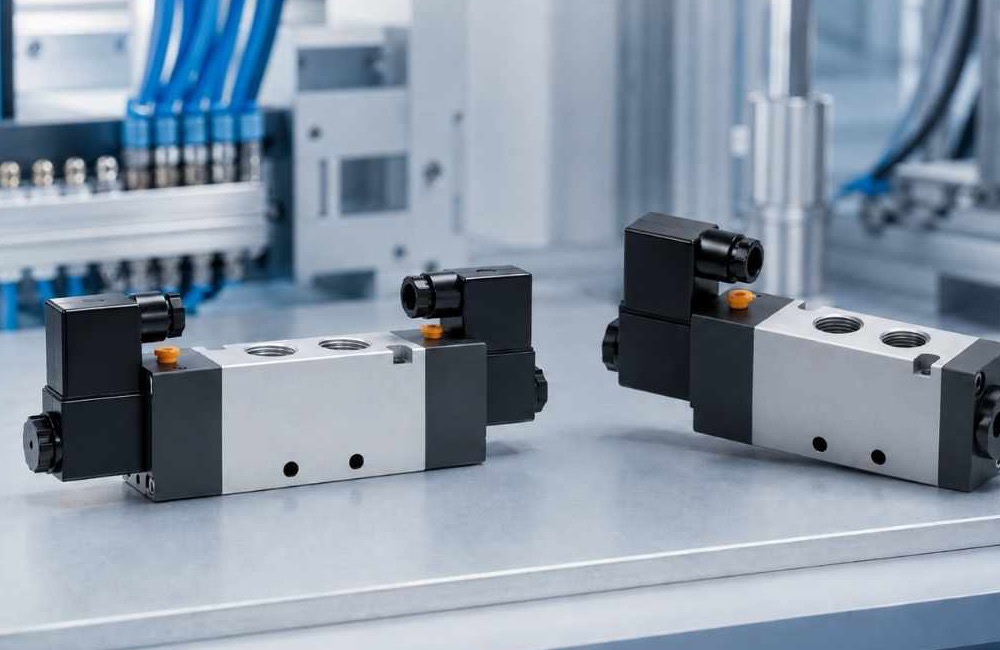
Based on SCMA's team of engineers' experience, a 5/2 air valve is the primary equipment for controlling the direction of compressed air flow. The number "5" refers to the number of ports (air holes), which includes an intake port (P), two working ports (A, B), and two exhaust ports (R, S). The number "2" indicates that there are 2 operating positions. This design structure allows the 5/2 valve to control the in-and-out movement of pneumatic cylinders perfectly with compressed air. In summary, this type of valve acts as an on-off switch and switches the direction of airflow to command various mechanical systems in production lines according to a set rhythm.
How does a 5/2 solenoid valve work?
In terms of how a 5/2 valve works, it starts from its normal position (Normal Position). Air from port P flows to port A to push the cylinder into its starting position. Meanwhile, any remaining compressed air is vented through port S. When power is supplied or an action command is given (Actuated Position), the internal spool of the 5/2 solenoid valve shifts positions. As a result, air from port P changes direction and flows out through port B to push the cylinder into operation. At the same time, air from port A is vented through port R. This switching back-and-forth mechanism of the 5/2 air valve allows various mechanisms to move accurately according to production cycles. You can learn more about what a pneumatic system is for a better overall understanding.
How to Read 5/2 Pneumatic Valve Symbols Easily
Understanding the symbols of a 5/2 pneumatic valve is considered a fundamental skill that every engineer and maintenance technician must have. These symbols are an international language that describes air flow without having to open up the internal circuit.
Components in Pneumatic Symbols
The basic structure of a 5/2 valve symbol is drawn as two adjacent rectangular channels. Each channel represents a working position (Position), and arrows within the channels indicate the direction of compressed air flow. Perpendicular lines (T-shaped) represent ports that are blocked from airflow in that particular state.
Differences in Normally Open (NO) 5/2 Valve Symbols
When looking at a normally open (NO) 5/2 valve symbol, in the normal position channel (the one pushed by the spring), air from port P connects directly to the working side port that extends the cylinder immediately without needing power. This type of valve is relatively rare in general industrial work.
Differences in Normally Closed (NC) 5/2 Valve Symbols
For a normally closed (NC) 5/2 valve symbol, in the normal state air from port P is sent to the side that causes the cylinder to retract. The valve waits until power is supplied before switching direction and pushing to extend the cylinder into operation. This is the safest standard and most commonly used.
Example of Reading Actual Symbols
In real work, when an SCMA engineer sees a symbol with two rectangular channels, with a solenoid coil drawn on the left side along with a spring image on the right side, we immediately know this is a single solenoid actuated valve. When power is cut off, the spring will pull the valve shaft back to its initial position.
How do a Single Solenoid and Double Solenoid 5/2 Valve Differ?
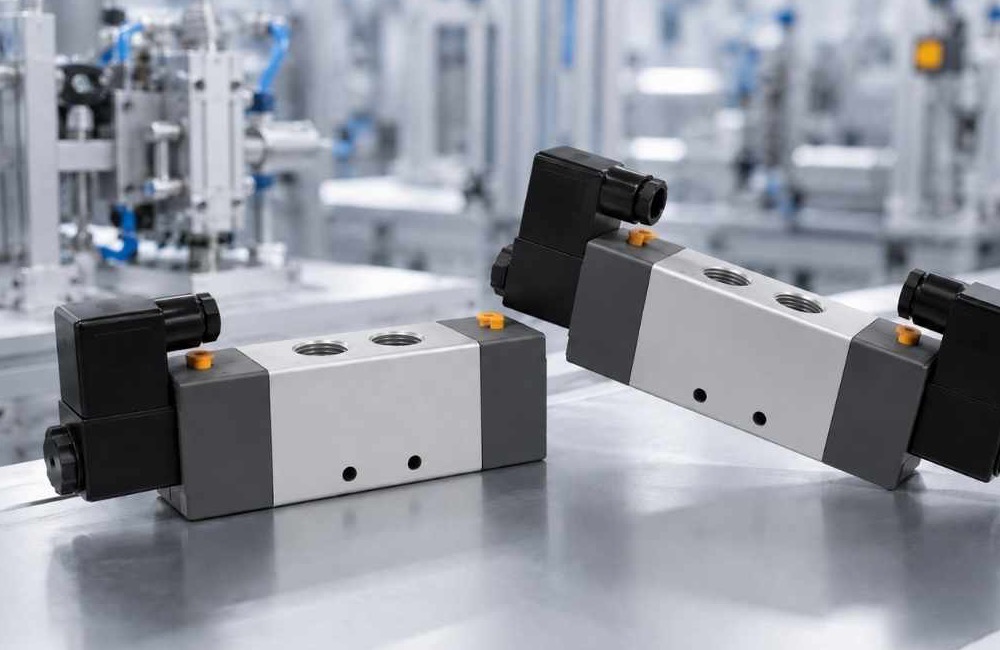
Choosing between a single coil and double coil is a question we often advise our customers on. Both types of 5/2 solenoid valves are engineered to meet different requirements.
The Working Principle of Single Coil Valve (Mono-stable) and Spring Return Mechanism
A single coil valve operates by receiving electrical signals from one side only, pushing the spool to change position. When power is cut off, an internal spring mechanism immediately pushes the spool back to its initial position. This system is ideal for circuits that require machinery to return to a safe point when there's a power outage.
The Working Principle of Double Coil Valve (Bi-stable) and Position Holding
A double coil valve has two sets of solenoid coils on both sides. Operation uses short electrical pulse signals to switch positions back and forth. When the signal is cut off, the valve shaft remains in its latest position (Memory function). The advantage here is that it saves energy as there's no need for continuous power supply.
Advantages, Disadvantages, and Suitable Applications of Each Type
A single coil is cheaper and easier to wire but may get hot if continuously powered. A double coil significantly reduces heat accumulation issues and is suitable for circuits that require the cylinder to hold a position locking in place even during power failure. However, designing control circuitry becomes more complex as well.
Checklist for Selecting the Right 5/2 Air Valve for Your Job
Selecting the correct air valve type 5/2 helps prevent machinery malfunctions or loss of system pressure. The SCMA engineering team has summarized 5 key factors to guide you in specifying a precise directional control air valve 5/2.
- Port Size: Choose the size that matches the volume of air required by the cylinder, such as 1/8", 1/4" or 1/2". If the port is too small, the cylinder will move slowly and not achieve full power.
- Operating Pressure: Check the pressure range specifications of the solenoid valve type 5/2 to match the air compressor capacity in your factory to prevent internal seals from rupturing due to excessive pressure.
- Type and Size of Voltage Used for Control: Verify whether the control system is direct current (DC) or alternating current (AC), such as 24VDC, 220VAC. This prevents damage when connecting to a circuit.
- Air Flow Rate: This variable indicates how many liters per minute the valve can vent air. Always calculate for the highest system machinery requirements.
- Installation Environment: If the installation point is outdoors with dust, humidity or high temperatures, choose models with sufficient IP (Ingress Protection) levels to suit those conditions.
Comparing 5/2 Valves with Other Common Valve Types
In the world of pneumatic solenoid valves, we are not limited to just 5/2 air valves. Understanding the differences between each valve model helps engineers design circuits in the most cost-effective way.
Differences Between 5/2 Valves and 3/2 Valves
The 3/2 valve has only one working port, suitable for controlling single-acting cylinders (spring-return type). On the other hand, the 5/2 valve has two working ports, making it capable of efficiently controlling double-acting cylinders. You can read detailed comparison information about valves from foreign experts for more details.
Differences Between 5/2 Valves and 5/3 Valves
The 5/3 valve is an advanced version of the 5/2 model, with the addition of a "center" position. This center position allows us to command the cylinder to stop in mid-stroke without having to move all the way to the end of the stroke, which meets the needs of work that requires precise positioning.
Summary Table for Usage of Each Valve Type
To make it clear, the SCMA team would like to present a basic specification comparison table so you can save and use it as a reference guide in your work.
| Valve Type | Number of Working Ports | Cylinder Types Supported | Main Features |
|---|---|---|---|
| 3/2 Valve | 1 port (A) | Single-acting cylinder | Simpler system, space-saving |
| 5/2 Valve | 2 ports (A, B) | Double-acting cylinder | Independent control of extension and retraction with compressed air |
| 5/3 Valve | 2 ports (A, B) | Double-acting cylinder | Middle position allows stopping the cylinder in mid-stroke |
Examples of Using a 5/2 Way Pneumatic Valve in Industry
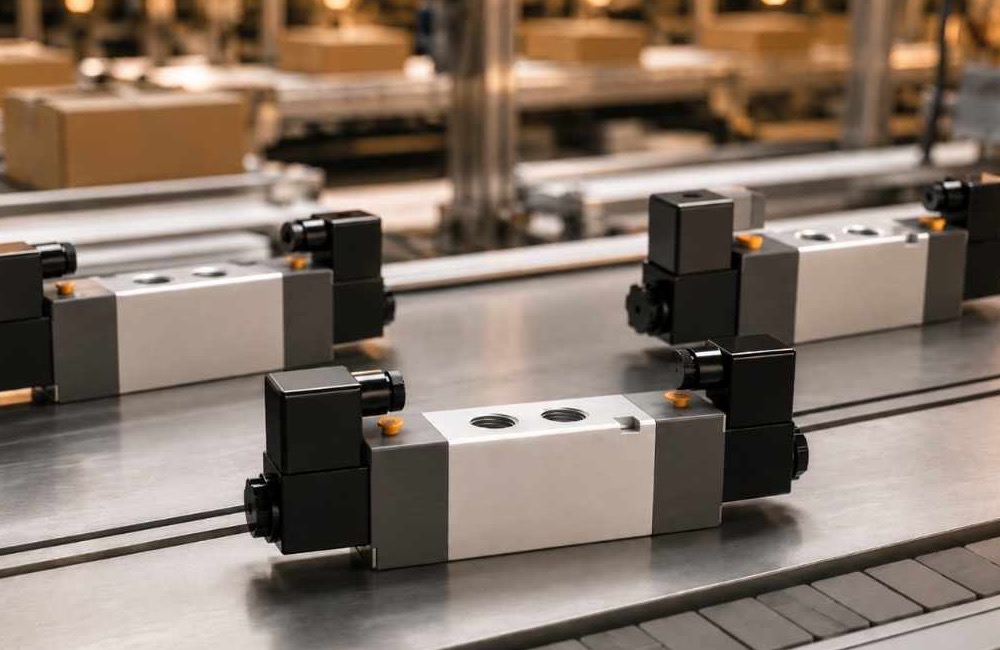
Based on SCMA's long experience in providing solutions for automation systems, we have found that controlling double-acting cylinders with 5/2 way pneumatic valves is widely applied across all levels of manufacturing plants.
Controlling Double-Acting Pneumatic Cylinders
This is the most straightforward primary function. The valve alternates air supply to the head and tail ports of the cylinder, creating force to push workpieces, operate machinery, or quickly secure parts during assembly line operations.
Usage in Conveyor Systems
In product conveyance lines or conveyor systems, valves are used to control stoppers or rejectors. The speed at which the valve switches positions directly impacts the accuracy and speed of sorting products.
Application in Packaging Machinery
Packaging machines rely on extremely high precision. This valve controls mechanisms such as bag sealing, foil cutting, or box folding. Choosing high-quality equipment helps prevent defects caused by timing discrepancies during operation.
Summary
In summary, a 5/2 way pneumatic valve is crucial for controlling two-way mechanisms. Understanding its working principles and how to read the symbols of a 5/2 way pneumatic valve will help you purchase valves that meet your specifications, preventing machinery downtime sustainably. As experts in measurement tools and automation solutions, SCMA is ready to be your trusted advisor for your business.
If you want to buy, you can purchase from SCMA today!
Selecting from a partner with engineering knowledge ensures that your two-way cylinder control work using 5/2 air valves will run smoothly. If you are looking for replacement equipment or planning to design a new system, you can browse all of our products. The SCMA engineering team is ready to help you specify 5/2 air valves and leading brand 5/2 solenoid valves to propel your industry forward with confidence.
Frequently Asked Questions
What does a 5/2 air valve mean?
The number 5 refers to the number of ports (1 inlet, 2 working, and 2 exhaust), while the number 2 indicates the operating states (left-right switching) for controlling two-way cylinders.
How do you know if a single coil or double coil valve is needed?
A single coil should be used if you want the cylinder to return to a safe position immediately when power fails, whereas a double coil should be used if you need the cylinder to hold its last position even during a power outage to lock down workpieces.
What are ports R and S in a 5/2 valve for?
The R and S ports serve as outlets for exhausting compressed air remaining inside the cylinder into the atmosphere, reducing resistance and allowing the cylinder to move in the opposite direction more easily.
How long does a solenoid air valve last?
Average lifespan is 10-30 million cycles (Cycles), depending on the quality of compressed air. If the air contains dust or moisture, it will cause internal seals to deteriorate faster.
Can a 5/2 valve be used to control a single-direction cylinder?
This is possible by plugging one working port (A or B) that is not in use with an air plug. The operation would then be equivalent to a 3/2 valve, but this approach is more costly.