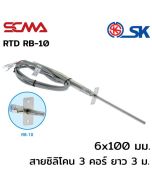
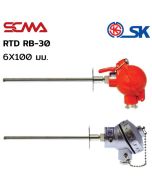
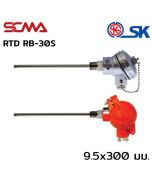
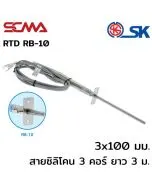
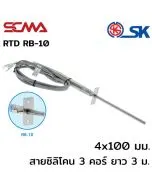
RTD is a highly accurate temperature measurement device that is popular in industries requiring precise temperature measurements. With outstanding stability and durability, RTDs are suitable for use across various industries such as food processing, chemical, petrochemical, or even in automatic control systems where accurate temperature data is needed to control production processes.
What is an RTD?

Resistance Temperature Detector (RTD) is a temperature measuring device that works on the principle of electrical resistance changing with temperature. It consists of pure metal wire or film, especially platinum which is most commonly used due to its high chemical inertness and linear relationship between temperature and resistance, providing excellent stability. RTDs can accurately measure temperatures over a wide range and are resistant to electrical interference, making them suitable for industrial environments.
How Does an RTD Work?
RTD (Resistance Temperature Detector) is a passive transducer that relies on the principle of electrical resistance changing with temperature. It requires an external power source to operate. The relationship between electrical resistance and temperature is linear, meaning as temperature increases, so does the metal's resistance. Materials with high resistivity coefficients are suitable for use in RTDs because they can detect even slight changes in temperature clearly.
The Importance of RTD

RTD (Resistance Temperature Detector) is crucial for temperature measurement in laboratory and industrial processes that require high accuracy. With its precision, stability, and excellent repeatability characteristics, it offers versatile applications except in extremely high-temperature conditions. Specifically, RTDs made from platinum are highly resistant to corrosion and oxidation, allowing them to maintain accuracy even through repeated heating and cooling cycles, resulting in reliable temperature data with low deviation for process control.
What are the differences between RTD and Thermocouple?
RTD (Resistance Temperature Detector) and Thermocouple are temperature sensors commonly used in industrial applications. However, what are their differences? From working principles to accuracy, measurement range, cost, and suitability for specific uses, the choice depends on the particular needs of each application.
RTD
- Suitable for measuring in low temperature ranges, with a measurement range from -200°C to 500°C.
- Offers high stability, providing reliable long-term measurements.
- More accurate than thermocouples.
- High sensitivity, capable of detecting minor temperature changes.
- Provides a linear output signal, making it easy to convert the signal into temperature readings.
- More expensive than thermocouples.
Thermocouple
- Can measure a wider temperature range, from -180°C to 2,320°C.
- Less stable, requiring frequent calibration.
- Less accurate than RTD.
- Lower sensitivity, unable to detect minor temperature changes as well as RTD.
- Faster response time than RTD.
- Provides a non-linear output signal, requiring compensation in temperature calculations.
- Cheaper than RTD.
What Should Be Considered When Selecting an RTD Temperature Sensor?

Choosing the right RTD sensor for a specific application is crucial to ensuring accurate and efficient temperature measurement. Users should consider various factors such as the range of temperatures they will be measuring, the required level of precision, environmental conditions, and installation constraints.
- RTD Type: Choose based on the temperature range and desired accuracy. Commonly used types include Pt100, while for higher precision requirements, Pt500 or Pt1000 may be selected.
- RTD Class: Select according to the required accuracy level. Various levels are available:
- Class AA: Accuracy ± (0.10 + 0.0017 * |t|) °C
- Class A: Accuracy ± (0.15 + 0.0020 * |t|) °C
- Class B: Accuracy ± (0.30 + 0.0050 * |t|) °C (most commonly used)
- Class C: Accuracy ± (0.60 + 0.0100 * |t|) °C
- Note: |t| is any temperature value that will always be positive.
- RTD Wiring Configuration: The three-wire configuration is the most popular in industrial applications due to its high accuracy and ability to compensate for wire resistance.
- Protection Tube Size: Consider material (Stainless or Ceramic), diameter, and length suitable for installation and environmental conditions.
- Screw Size and Wire Type: Choose a screw size that fits the mounting point and wire type (PVC, Teflon, Shield, Fiberglass) according to environmental conditions and required length.
- Accessories: Consider using a thermowell for protection in environments with hazardous chemicals.
Interested in RTD? You can now purchase from SCMA!
Accurate temperature measurement is crucial in manufacturing and quality control processes. To ensure efficient temperature measurement, you need both high-quality thermal sensors and precise measuring tools.
SCMA offers high-quality multimeters that support accurate resistance measurements, making them ideal for use with RTD to achieve precise temperature readings. Our multimeters feature special capabilities that make reading values from RTDs easy, offer high resolution, and automatically convert resistance values into temperatures.
Moreover, SCMA sells a variety of high-quality RTD models suitable for all usage requirements, whether it's Pt100, Pt1000 or other variants, along with accessories and installation services by expert teams.
Summary
RTD (Resistance Temperature Detector) is a temperature sensor that operates on the principle of electrical resistance changes in metal as temperature varies. Typically made from pure metals such as platinum, nickel, or copper, RTDs are distinguished by their high accuracy, good stability, and linear relationship between resistance and temperature, making them ideal for applications requiring precise temperature measurement.
Compared to Thermocouples, RTDs offer higher accuracy but have a narrower temperature range and are more expensive. Selecting the appropriate RTD requires considering several factors such as the required temperature range, desired accuracy, and environmental conditions for use.
At SCMA, we provide high-quality RTDs and multimeters that support accurate resistance measurements, along with consultation and installation services by expert teams to ensure you have an efficient and suitable temperature measurement system. Interested in our products or services? Contact SCMA right away!
Frequently Asked Questions
How does an RTD temperature sensor work?
An RTD (Resistance Temperature Detector) temperature sensor operates on the principle that the electrical resistance of a metal changes with temperature. As the temperature increases, so does the electrical resistance, and as the temperature decreases, the electrical resistance also decreases. By measuring this changing resistance, it can be calculated into a temperature value using an equation relating resistance to temperature.
What type of temperature measurement principle does an RTD sensor use?
An RTD temperature sensor uses the electrical resistance (Resistance Temperature Sensing) measurement principle, which relies on the relationship between the electrical resistance value of a metal and temperature. Within normal operating temperatures, this relationship is linear, allowing for accurate calculation of temperature from measured resistance values.
What does RTD stand for?
RTD stands for Resistance Temperature Detector or sometimes referred to as a Resistance Temperature Device. It is a temperature measuring device that relies on the change in electrical resistance of metal when temperature changes.
What type of circuit principle does RTD wiring use?
RTD wiring can be done in several ways, generally there are three main types:
- 2-Wire: This is the simplest connection method but has a drawback where the resistance of the wires adds to the RTD's resistance, leading to potential measurement errors. Suitable for close-range measurements that do not require extremely high accuracy.
- 3-Wire: This is the most commonly used method in industrial applications, capable of compensating for some of the effects of wire resistance using a Wheatstone Bridge circuit principle.
- 4-Wire: Provides the highest accuracy as it can eliminate almost all effects of wire resistance by using two wires to supply current to the RTD and another two wires to measure the voltage drop directly across the RTD.
The choice of wiring type depends on the required accuracy and distance between the RTD and measuring instrument. For high accuracy or long distances, a 3-wire or 4-wire connection should be selected.