Having trouble with product drop issues or inaccurate counting on the production conveyor belt? This problem can be solved by installing high-quality SCMA part counting sensors. As an expert in industrial measuring instruments, the company offers precise solutions. Reading this article will help entrepreneurs understand the working principles and correctly select equipment for use in automated systems.

What is a Conveyor Belt Part Counting Sensor?
A conveyor belt part counting sensor is an electronic device designed to detect the movement of objects without physically touching the actual part. The most popular device in the industrial market is the photoelectric sensor. This type of device stands out for its high-speed operation and excellent accuracy, perfectly meeting the needs of modern production line product counting.
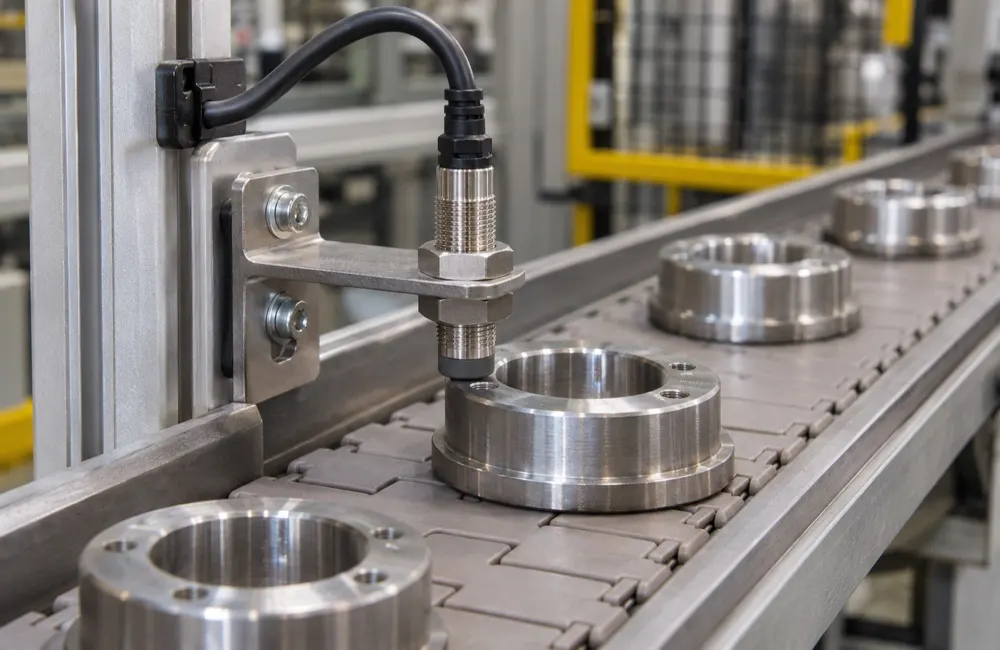
Working Principle of Conveyor Belt Part Counting Sensor
The working principle of the conveyor belt part counting sensor relies on non-contact object detection to quickly send an electrical signal to the control system. The Photoelectric Sensor type uses an infrared beam to pass through or reflect off the part. The inductive proximity sensor type creates an electromagnetic field to detect metal parts passing through the detection range.

How many types of conveyor part-counting sensors are there?
Conveyor part-counting sensors come in various forms depending on the type of object and the usage characteristics on the conveyor belt. Choosing the appropriate technology can effectively reduce work errors.
Photoelectric Sensors (Photoelectric Sensors)
This type of sensor uses light to detect objects. It is the most popular form because it can accommodate a variety of materials, covering all forms of light transmission, mirror reflection, and direct object reflection.
Inductive Proximity Sensors (Inductive Proximity Sensors)
This device generates an electromagnetic field to detect metal parts without contact. It is highly suitable for use on conveyor belts in heavy industries, and is durable in harsh environments. For more details, please visit the page Proximity Sensor.
Capacitive Sensors (Capacitive Sensors)
This technology uses electrical capacitance to detect parts, allowing it to detect both metal and non-metal materials, including plastics and liquids inside packaging containers. It is a good option for checking product integrity on the conveyor belt.
Ultrasonic Sensors (Ultrasonic Sensors)
This type of sensor uses high-frequency sound waves to strike objects and receive reflected signals to assess distance. It can detect transparent objects or objects with glossy surfaces that are difficult for light sensors to detect.
Fiber Optic Sensors (Fiber Optic Sensors)
Fiber optic cables are designed for installation in narrow or restricted areas on machines. This device is highly effective in detecting very small parts, responds quickly, and is highly resistant to electrical interference.
Maintenance of Conveyor Belt Counting Sensors
Regular maintenance of conveyor belt counting sensors is essential to maintain operational accuracy. Based on the experience of SCMA's engineering team, we recommend the following simple maintenance steps:
Clean the lens surface regularly
Dust or oil residue on the lens surface is the main cause of counting errors. Users should use a lint-free clean cloth to gently wipe the lens surface daily. This maintenance helps effectively prevent distorted reflections.
Inspect the wiring and connection points
The factory environment may cause humidity or vibrations that affect the signal cable. System administrators should regularly check for cable damage and ensure that the connectors are tightly secured. Preventing dirt from entering the device helps extend its lifespan significantly.
Calibrate sensitivity and test the range
Changes in lighting conditions or product characteristics may affect the detection range. Operators should regularly test the device with actual objects on the conveyor belt. If counting errors are detected, the sensitivity should be recalibrated to match the current working conditions.
Use of Conveyor Belt Counting Sensors in Industry
The industrial sector widely adopts conveyor belt counting sensors to improve production speed. These devices work in conjunction with automated measuring systems to inspect products in real time.
Heavy Industry and Metal Components
The automotive or electronic component industries commonly use inductive sensors for counting metal parts. These devices are highly impact-resistant and can accurately operate amidst oil stains or metal debris on the production line.
Packaging and Consumer Goods Industry
Conveyor belts in packaging factories require fast counting of product boxes. Choosing Reflective Sensor perfectly meets the demand for detecting opaque objects moving at high speed without any issues.
High-speed Conveyor Systems
For conveyor belts moving at very high speeds, using Through Beam Sensor installed on both sides of the conveyor belt to emit a continuous beam is the best option. It allows for quick and accurate counting of products without any loss.
Advantages of Conveyor Belt Counting Sensors
Investing in the installation of Conveyor Belt Counting Sensors provides long-term value. These technologies reduce reliance on human labor and eliminate errors caused by employee fatigue.
Detect and Count at High Speed
These devices can process the movement of items on the conveyor belt at the millisecond level. This speed meets the needs of the packaging industry, which must handle massive amounts of products every day.
Provide the Highest Level of Stability and Accuracy
Light reflection or electromagnetic field generation technologies enable highly accurate detection. Stable operation reduces the risk of miscounting products and prevents business damage caused by incomplete product delivery.
Protect Items with a Non-Contact System
The non-contact detection method reduces the chance of scratches or damage to items on the conveyor belt during counting. This method also reduces sensor wear, resulting in a clearly longer lifespan.
Connect and Control Automated Systems Immediately
The sensor can send digital signals to a counter or immediately stop the conveyor belt when the target product count is reached. Working with these systems elevates the factory to modern industry standards in a tangible way.
How to Choose a Conveyor Belt Item Counting Sensor
When purchasing a conveyor belt item counting sensor that offers good value, the main considerations should be the characteristics of the items and the working environment. The engineering team has the following recommendations to assist in decision-making:
Evaluate the type of item: Choose a through-beam sensor for general objects, or select a proximity sensor if you need to detect specific metal items on the conveyor belt
Check the conveyor belt speed: Evaluate the sensor's Response Time to match the movement speed of the conveyor belt to prevent missed counting intervals
Observe the surface and color of the object: Transparent or glossy-surfaced objects require special sensors such as ultrasonic sensors to reduce erroneous light reflection
Explore the installation environment: Evaluate the amount of dust, humidity, and temperature to select equipment with appropriate dust and water protection ratings for the area
Check compatibility with the existing system: It is recommended to study how to use item counting sensors with PLCs to ensure that the type of output signal can be connected to the existing control system immediately
Installation Precautions for Counting Sensors
Proper installation of counting sensors on the conveyor belt is a crucial factor that determines the accuracy of the entire system. Operators should be mindful of these precautions during the operation.
Avoid sources of interfering light: Do not install light sensors at points where direct sunlight or high-intensity light bulbs shine directly onto the lens.
Maintain appropriate installation distance: Check the Sensing Range from the manufacturer's manual and install the device within the most stable range.
Prevent damage from vibrations: Conveyor belts with high vibration may cause the mounting bracket to shift. It is recommended to use a strong bracket with a vibration-damping system.
Organize signal cables safely: Route signal cables separately from high-voltage power cables to prevent electrical interference that may cause counting errors.
Summary
Selecting a standardized counting sensor for the conveyor belt is a valuable investment to eliminate product drop issues and improve the smoothness of the production line. SCMA is pleased to be a partner in providing consultation and design solutions through our team of expert engineers. We have high-quality products that meet all industrial needs.
Interested in purchasing or consulting via LINE Official: @SCMA
If you want to buy a counting sensor for the conveyor belt, you can purchase it from SCMA today!
Quality control in production starts with having accurate numerical data. The counting sensor on the conveyor belt is a crucial component that helps enhance the reliability of factory operations. SCMA specializes in automation systems and offers design services that can assess the work site and install sensors to work seamlessly with your conveyor belt.
Frequently Asked Questions
Which type of part-counting sensor on the conveyor belt is most popular?
Optical sensors are the most popular because they are easy to install and can accommodate a variety of parts without considering the material of the product
Can the sensor count parts moving at very high speeds?
Yes, it can be done for sure. Current devices are designed to have a response rate at the millisecond level, allowing accurate detection of parts on high-speed conveyor belts
If the conveyor belt has a lot of dust, which type of sensor should be used?
If the object is metal, it is recommended to use an inductive proximity sensor. For other materials, it is advisable to choose a sensor with an IP67 rating or higher to protect against dust and water
What are the possible causes of missed part counting?
The main causes are a dirty lens surface, improper installation distance, and electrical interference from nearby machinery
Can the sensor be directly connected to a display screen?
Yes, it can be connected immediately by connecting the sensor's signal output cable to a digital counter to display real-time results