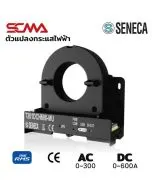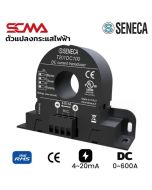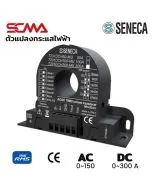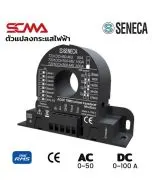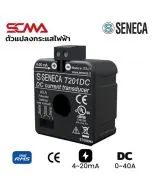

Electric current transformers, commonly known as Current Transformers (CT), are crucial components in industrial and building electrical systems that require accuracy and safety for measuring electric currents. SCMA understands the necessity of having devices to convert high current units into smaller, more manageable sizes suitable for use with smaller measurement tools. Therefore, SCMA's service focuses on consulting, designing, and providing custom-made current transformers tailored to each customer’s specific needs.
What is a Current Transformer?

A current transformer, or Current Transformer (CT), is a device that reduces high levels of electric current to smaller sizes so they can be safely measured by standard measuring tools in electrical systems. This type of transformer primarily converts large currents flowing through the main circuit (Primary) into small currents flowing through the secondary circuit (Secondary), which are used for measurement or system protection purposes. Generally, these current transformers are installed in power stations, production systems, and energy management systems.
How Does a Current Transformer Work?
The principle of operation of a current transformer is based on electromagnetic induction. The electric current flowing through the primary winding (Primary Winding) creates an electromagnetic field in the magnetic core. As this magnetic field varies according to the current, it induces an electromagnetically generated current in the secondary winding (Secondary Winding). This induced current has a lower proportion compared to the original current in the primary winding based on the specified ratio, allowing the current transformer to safely and accurately work with measuring devices.
Components of a Current Transformer

A current transformer consists of several important components, each playing a crucial role in working together to accurately and safely transform electrical currents. The main components of a current transformer include:
- Primary winding
- Secondary winding
- Core
- Enclosure and insulation
Benefits of a Current Transformer
A current transformer plays an important role in enabling the accurate and safe measurement of high currents in various systems without direct contact with high voltage, and also enhances system protection from abnormal events. The main benefits of a current transformer include:
- Enables safe measurement of high currents
- Works in conjunction with protection systems such as circuit breakers or relays
- Increases accuracy in maintenance and system inspection
- Aids in efficient energy management and control
Types of Current Transformers
Current transformers come in various types suitable for different applications. Each type has its own specific advantages tailored to particular uses, depending on the nature of use, location, and related electrical systems.
Wound Primary Current Transformer
This type of current transformer features a primary winding with clearly defined turns, commonly used for measuring currents that require high clarity and accuracy. It is ideal for applications requiring precise measurement such as control systems needing the most accurate monitoring of electrical current.
Bar-Type Current Transformer
This type uses bus bars instead of primary windings and is suitable for high-current circuits. It offers durability and suits systems with large-scale current flow, such as large industrial plants that continuously use high electrical currents.
Window-Type Current Transformer
This type of current transformer has a central opening through which wires or bus bars can easily pass. It offers ease of installation and great convenience in use, making it popular for electrical systems within buildings or power stations that require quick and safe installations.
Split-Core Current Transformer
This type of current transformer can separate its magnetic core, making it suitable for installation in electrical systems where circuit operation cannot be interrupted. This facilitates continuous maintenance and monitoring of the electrical system.
Usage of Current Transformers in Industrial Plants

Current transformers are crucial in various industrial sectors due to their ability to accurately measure and control electrical current, which aids in management and enhances production efficiency. Examples of usage include:
- Checking the electrical current in machinery
- Protecting the electrical system by working with relays
- Analyzing and improving electrical quality
- Checking the electrical system in buildings and various manufacturing plants
How to Choose the Right Current Transformer?
Choosing the right current transformer involves considering several factors to ensure that the selected equipment can operate efficiently, meet the specific usage requirements, and safely and accurately accommodate related electrical systems. The following are key considerations:
- Primary Current Rating
- Secondary Current Rating, such as 1A or 5A
- Current Ratio, such as 300/5
- Accuracy Class, such as Class 0.5, 1.0 or 3.0
- Burden (Power Loss) Capacity, such as 5VA
- Installation Type: Busbar, DIN Rail, Wall Mount, or Enclosure
- Electrical System Characteristics: Frequency, Voltage, and Load Profile
Interested in Buying a Current Transformer? SCMA is Ready to Serve You Today!
SCMA offers professional selection services for current transformers, focusing on operational accuracy, safety, and suitability for various industries. Customers can receive tailored consultations to select the most appropriate transformer within their budget and usage goals. Our engineering team is ready to support you throughout the process, from design and installation to after-sales service. Additionally, we provide training sessions to enhance your team's knowledge, along with demonstration centers and real-world testing facilities to ensure that our solutions truly meet your needs.
Summary
Electric current transformers are crucial for efficient measurement and control of industrial electrical systems. With the ability to convert large electric currents into appropriate levels for use in measuring circuits and protection systems, SCMA is a reliable partner with comprehensive services covering every step. If you are looking for high-quality solutions and close technical support, SCMA is the answer you should consider.
Frequently Asked Questions
What is the difference between a rectifier and an inverter?
Rectifiers and inverters are electrical devices that serve different functions in converting types of electric current, with details as follows:
- Rectifier: Used to convert alternating current (AC) into direct current (DC)
- Inverter: Used to convert direct current (DC) into alternating current (AC)
- Rectifiers are commonly used in battery charging devices and electronic systems
- Inverters are popularly used in solar energy systems or appliances that require AC power
What is the process of converting AC to DC called?
The conversion of alternating current into direct current is referred to as "Rectification" or commonly known as a Rectifier. The principle of operation involves changing the direction of the electric current in one continuous direction, which is widely used in power conversion systems for electronic devices, chargers, or automatic control systems in industrial plants.
What is an electrical converter or inverter?
In the context of Inverter, it refers to a device that converts DC power into AC while maintaining appropriate frequency and voltage levels for specific applications. Such equipment is commonly found in renewable energy systems like Solar Cells or backup power systems that convert battery power for use with electrical appliances.
What are some examples of inverters?
Inverter systems can be installed in various types of equipment, such as air conditioners with inverter technology, energy-efficient refrigerators, solar cell systems, UPS (Uninterruptible Power Supply), and motor control systems in factories. All these devices play a role in converting electrical power to enhance operational efficiency and save energy.
How many types of converters are there?
There are various types of converters based on their functions in transforming electric power from one form to another, primarily including:
- Rectifier: Converts AC into DC
- Inverter: Converts DC into AC
- Transformer: Changes the voltage level of AC without changing its type
- Converter: Converts DC voltages between different levels, such as DC-DC Converter