
Currently, the term "Smart Factory" is gaining popularity across all industries. Everyone has heard this term at some point. With the advancement of technology up to this era, Smart Factories play a significant role and greatly enhance the efficiency in industrial sectors, marking the Industry 4.0 era. SCMA would like to introduce everyone to what a Smart Factory is and explore how it relates to the Industry 4.0 era.
What is a Smart Factory?
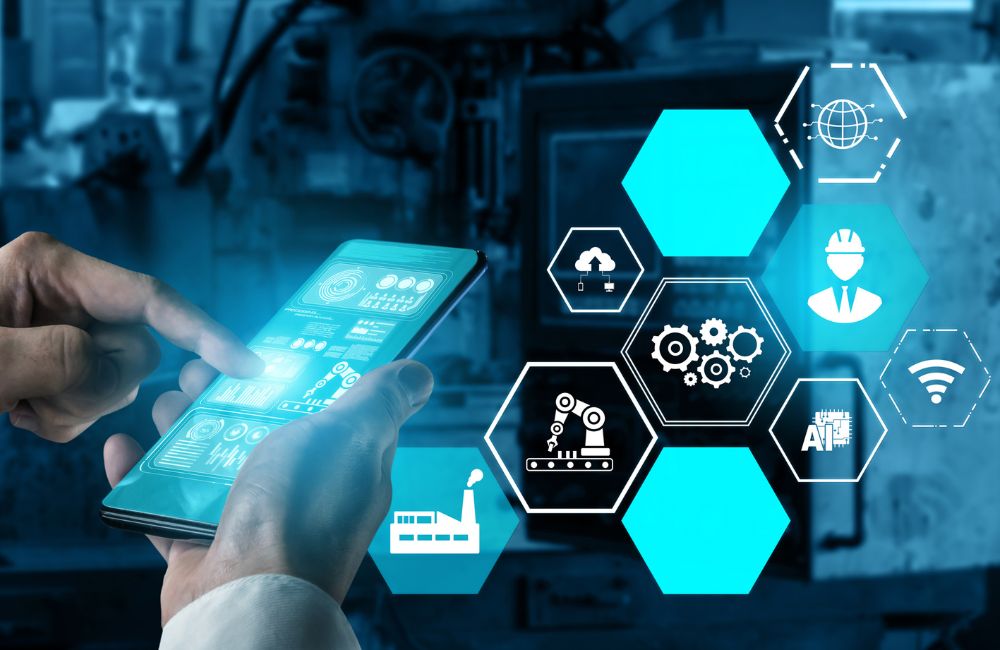
Let's start with understanding the meaning of a Smart Factory. A Smart Factory is an intelligent factory that integrates technology, machinery, artificial intelligence (AI), and IoT (Internet of Things) to manage operations within the factory efficiently. It enables precise data collection and reporting, leading to optimal performance in factory operations.
How Does a Smart Factory Work?
The main working principles of a Smart Factory include four aspects:
- Prediction, which involves analyzing and assessing production data based on customer orders coming into the factory.
- Planning & Scheduling, where timelines for work are set after production predictions have been made.
- Analytic, which involves analyzing the manufacturing process to determine how many people and what technologies are needed.
- Execution, where progress can be closely monitored and controlled from anywhere.
Advantages of a Smart Factory

Once you understand what a Smart Factory is and compare it to traditional factories, there are distinct differences or advantages. Why should we develop our factory into an intelligent one? Let's take a look.
Reduced Labor but Unchanged Production Volume
A Smart Factory focuses on machinery and artificial intelligence, which work together efficiently. This allows production to continue at the same volume or even increase despite reducing human labor.
Long-term Profitability
Although investing in machines may have high initial costs, they can generate long-term profits due to their durability and low maintenance rates. A single machine can operate for a long time, thus recovering the initial investment cost and ensuring future profitability.
Reduced Production Time
With machines handling production, there's no need to worry about time constraints as human bodies require rest. Machines can work longer hours compared to humans, even though they may occasionally need maintenance breaks.
Collect Detailed Data
This is one of the strengths of a Smart Factory because AI systems can collect and analyze data deeply, identify issues accurately, and further analyze the collected information for additional insights.
Reduce Workplace Accidents
The Smart Factory system collects data, analyzes it, and plans work automatically within the factory, significantly reducing errors that lead to accidents.
Monitor Operations Anywhere
Since production requires constant monitoring to ensure desired outcomes, a Smart Factory equipped with IoT technology allows real-time monitoring and oversight from anywhere.
Prepare Before Transitioning to a Smart Factory
When preparing for the transition of a conventional factory into a Smart Factory in order to fully step into Industry 4.0, there are several factors to consider. The considerations include setting goals for transitioning to a Smart Factory as follows:
Necessity
First and foremost is the necessity of transforming a conventional factory into a Smart Factory, including whether it's necessary to change only certain systems or the entire system.
Understanding Smart Factories
After assessing the necessity of your factory, you must thoroughly study Smart Factories. This includes understanding how they operate, related equipment, and overall costs, as well as companies capable of installing this system for your factory.
Evaluate Factory Capabilities
For the capabilities of the factory, including financial resources, personnel, space, and production plans, to get an overall picture before transforming into a Smart Factory. This ensures that all necessary costs are fully prepared.
Train Personnel
For proper understanding by the staff who will work in the factory transitioning to a Smart Factory, there must be announcements and training provided so that employees have accurate knowledge about the Smart Factory system.
Test System Before Installation
Smart Factories require system testing in specific areas to ensure they can work efficiently with your factory, identifying any improvements or fixes needed so that there are no issues when implemented.
Install Equipment Properly
Of course, after the system testing is completed, it's time to install the necessary equipment for creating a Smart Factory in the factory and conduct tests to see if everything works smoothly. This way, any issues can be resolved before actual use, and once this step is complete, it’s time for real-world application.
Usage and Monitoring
Once in use, don't relax just yet because problems often arise during the initial stages. Therefore, throughout the early usage period, closely monitor system performance and track results. When encountering issues, immediately contact the installation team.
With this, it's possible to elevate a regular factory into an intelligent or Smart Factory and fully step into the industrial era. If any factory wants to transform itself into a Smart Factory, they can contact SCMA directly.
SCMA Company Limited is a leader in selling and providing services for various industrial equipment. Equipped with specialized expert trainers, it aims to build skills and knowledge regarding Industry 4.0 to advance factory operations. It offers technologies such as IO-Link sensors and automation systems that will turn your factory into a true Smart Factory.
References: riverplus.com, mreport.co.th, proindsolutions.com, 1stcraft.com, dia.co.th, tot.co.th