Ever wondered which type of multimeter is best for your job site to ensure the highest accuracy and safety when measuring electrical values, team engineers from SCMA Experts inMeasuring and Testing InstrumentsAnd automated systems, along with recommendations for selecting the right equipment for your factory. Reading this article will help you understand the basic operating principles, how to make cost-effective purchases, as well as maintenance tips to extend the product lifespan.
What is a multimeter?
Multimeter (Multimeter) is a device that measures voltage, current, and resistance in one unit. The functions and specifications depend on the model. The measurement results are used to detect abnormalities in circuits. When choosing which multimeter is best, start with the type of work, the measurement range required, and the safety rating at the measurement point.

How a Multimeter Works
Understanding deep insights about multimeters will help users extract the maximum performance from the tool. This device works by using magnetic field coils or signal conversion circuits to display accurate values, divided into two main types as follows.
Analog Multimeter
Analog multimeters use a moving coil in a magnetic field to move the needle on the scale. Resistance measurement uses an internal power supply, and some models also use batteries for other functions. Refer to the manual for the model in use, such as KYORITSU Analog Multimeter Manual
Digital (Digital Multimeter - DMM)
Digital multimeters use an analog-to-digital signal conversion circuit (ADC) to process and display values on the screen. Accuracy and protection systems depend on the specifications of each model. Users must select the correct mode, measurement range, and probe jack.
Which Multimeter is Better?
The question of which multimeter is better depends on the user's preference, the level of precision required, and the budget. Beginners should consider digital models because they are easier to read, while professional electricians may need to carry both types to cover all situations.
Digital Multimeter (Digital Multimeter)
The digital display makes it easy to read values. Some models have automatic range adjustment (Auto-range). Users still need to select the correct mode and probe port for the measurement, as well as ensure that the device and probe are suitable for the measurement point.
Analog Multimeter (Analog Multimeter)
This type of device displays results using a needle on a scale. Users must have the skill to adjust the settings and read the scale themselves. A key advantage is that it clearly and naturally shows the trend of voltage signal changes, which is more intuitive than digital numbers. Specialist technicians still prefer this type of tool for inspecting certain electronic devices that require quick observation of changes.
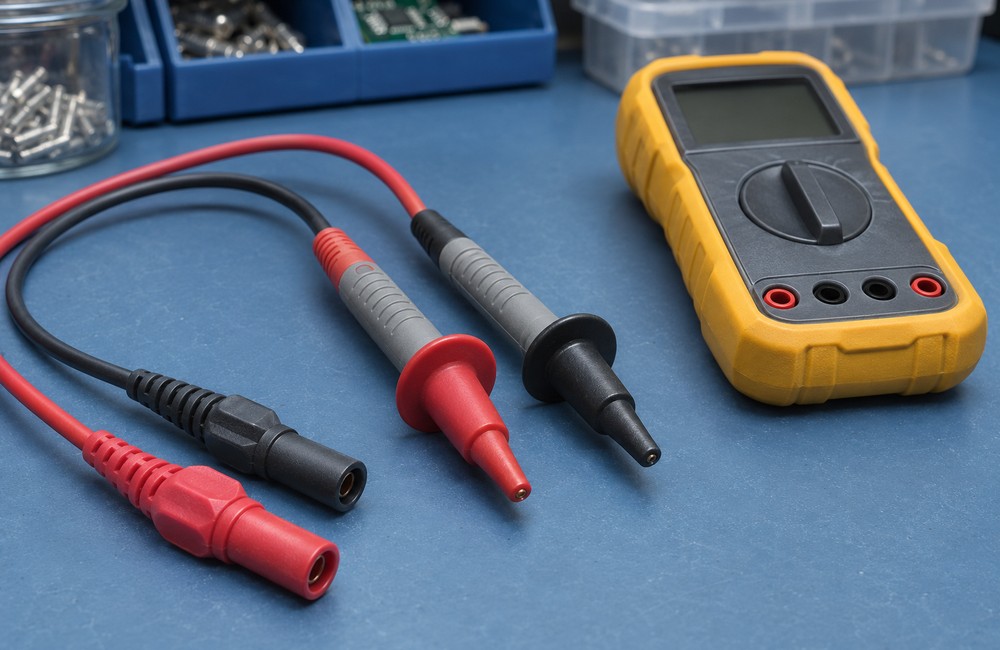
Multimeter Maintenance
Proper maintenance of electrical measuring instruments is important to extend their lifespan and maintain consistent accuracy. Based on the experience of SCMA's engineering team, we recommend some basic self-care methods to prevent damage.
Cleaning the Device
Turn off the device and disconnect the leads from the circuit before cleaning. Use a cloth according to the manufacturer's instructions and avoid solvents. For work areas with dust or moisture, check the appropriate IP rating for the environment and conditions specified in the manual.
Checking the Test Leads
Inspect the insulation, probe tips, and connectors before use. If any damage is found, stop using and replace the leads with those that have the appropriate CAT rating and voltage suitable for the measurement point, along with the related adapters and probe tip covers. See the requirements for probes according to IEC 61010-031
Replacing Batteries and Fuses
When the low battery symbol appears, replace the battery according to the manual. Turn off the device and disconnect the measuring leads from the circuit and the device before opening the cover. If the manufacturer allows fuse replacement, use screws or types specified according to the code or type indicated, ensuring they match in current rating, voltage, short-circuit interrupting capability, response characteristics, and size. See example specifications in Fluke 87V MAX Manual
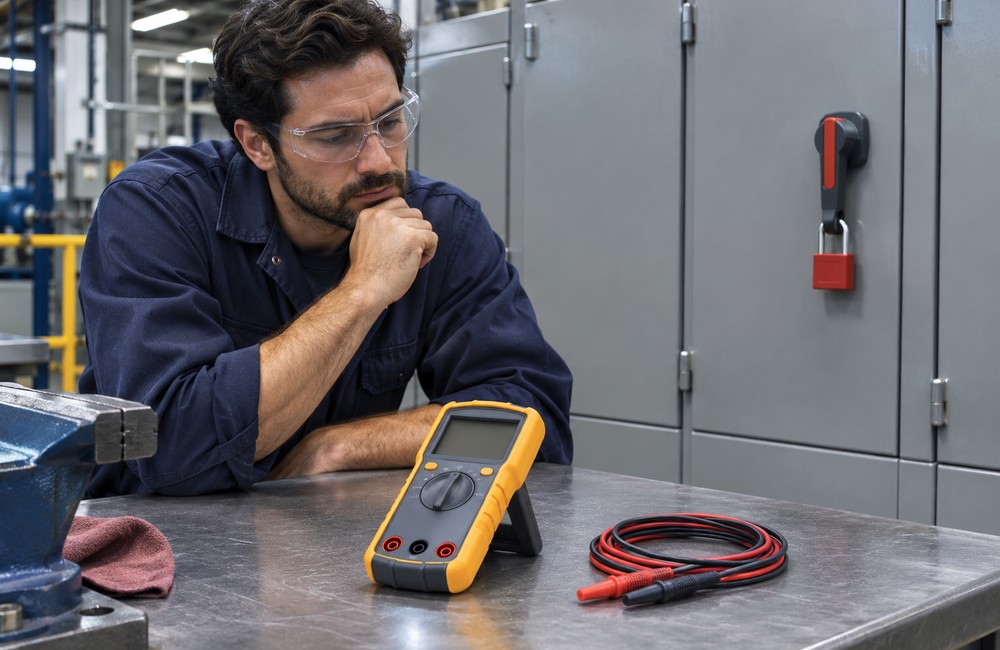
Multimeter Use in Industry
Multimeter Use in factories should select both the CAT category and the voltage rating of the meter, test leads, and accessories according to the measurement location, adhering to the limit of the item with the lowest rating. Qualified personnel should follow safety procedures and use tools suitable for the circuit risk.
Voltage Measurement
Voltage measurement is a measurement across two points. Qualified personnel must select AC or DC mode and use the COM terminal and voltage terminal according to the manual. Do not measure voltage while the test leads are inserted into the current terminal. Work involving live parts should be carried out according to the site safety procedures.
Current Measurement
Series current measurement is only applicable within the rating of the meter, terminal, and test leads. Qualified personnel should disconnect and isolate the power source before connecting or disconnecting the leads. Select the current terminal according to the manual, and do not use the leads in the current terminal to measure across the power source. For currents exceeding the rating or when measuring without opening the circuit, select a clamp meter suitable for the current type and measurement point.
Resistance Measurement
Before measuring resistance, disconnect and isolate the power source, confirm that there is no voltage, and discharge any residual charge according to the specified procedure. The meter will supply a test signal to calculate the ohm value. If there are parallel paths in the circuit, the measurement result may differ from the value of a single component. See Fluke Resistance Measurement Method
Continuity Test
Use the continuity mode after disconnecting the power source, check that there is no voltage, and discharge any residual charge according to the procedure. The alarm sound indicates that the resistance value is within the range specified by the meter model. The result may be affected by parallel paths in the circuit.
Advantages of a Multimeter
This tool is a must-have multifunctional device for every electrician and maintenance engineer who uses it regularly. If you're still hesitating about which multimeter to buy, understanding the main advantages of this device will help you make a decision much easier.
Can Measure a Variety of Values
With just one device, you can fully measure voltage (Volt), current (Ampere), and resistance (Ohm). Higher-priced digital multimeters can also measure capacitance (Capacitance), frequency (Frequency), and temperature (Temperature). Combining so many functions together helps make electrical problem analysis more comprehensive and allows you to solve problems with just one device.
Cost-Effective and Value for Money
Investing in a single centralized measuring device saves budget more than buying a voltmeter, ammeter, and ohmmeter separately. Industrial companies can reduce the cost of purchasing basic tools for distribution to maintenance staff. The durability of leading brand tools also helps reduce the cost of frequently replacing equipment, making it a cost-effective investment in the long run.
Easy to Carry and Convenient to Use
With a compact and lightweight design, technicians can easily carry the tool in a belt bag or tool box. Taking the electrical measuring device to work on-site, at heights, or in narrow spaces becomes a smooth and convenient task. Most new models come with a rubber anti-shock case that helps protect the device from falling during transportation on the job site.
High Accuracy
The resolution of the display indicates the changes the device can show, while accuracy should be checked according to the tolerance specified for that measurement range. Periodic calibration helps verify that the readings are still within acceptable limits. See Fluke's explanation on accuracy and resolution
Safety Features
Insulation, fuses, and protective circuits help reduce risks within the limits designed by the manufacturer. The fuse in the current measurement channel protects according to the rating of that channel. Users must check the mode, sockets, CAT rating, and voltage of the tool set before measuring, and stop using it when damage is found.
How to Choose a Multimeter
Deciding which multimeter is best depends mainly on the nature of the work to find the most suitable and safest equipment. Users can consider the selection method according to the checklist summarized by our engineers as follows:
For low-voltage equipment repair that is isolated from household electricity, choose a device with functions and measurement ranges that match the task. If measuring circuits connected to household electricity, use equipment and test leads with appropriate CAT ratings and voltage ratings suitable for the measurement point, and have qualified personnel perform the task.
For electrical work in buildings, choose equipment and test leads according to the rating of the measurement point. If NCV is available, use it for preliminary AC voltage screening. Confirming the absence of voltage must be done with an appropriate touch-type tester and follow safety procedures.
For factory work, check the CAT rating and voltage rating of each model. For example, KYORITSU equipment, internal distribution panels and building incoming power points may require different categories. All equipment, test leads, and accessories must support the same measurement position.
Select additional functions according to the task, such as capacitance measurement when capacitor testing is required, or temperature measurement with a compatible probe. Be sure to check the limitations of the function and accessories in the manual.
Warranty and After-sales Service: It is advisable to purchase from a reliable authorized dealer that provides technical consultation services and has spare parts available for peace of mind during use.
Standard of Multimeter Safety (CAT Rating)
CAT indicates the category of the measurement point in an electrical system, taking into account the conditions of voltage surge and energy at that location. Always read it together with the voltage rating, for example, CAT III 600 V, and check the rating of the device, test leads, and accessories together. The standard IEC 61010-2-033 specifies requirements for portable multimeters used for measuring voltage from power supply systems.
Circuits not directly connected to the power supply system, such as some types of electronic circuits, should check the device's rating and limitations for that circuit. Devices that do not specify the measurement category for the power supply system should not be used to measure circuits requiring CAT II, III, or IV ratings.
CAT II covers measurement points related to socket-outlet connected loads, such as household appliances or portable electric tools.
CAT III covers measurement points in permanently installed power supply systems within buildings, such as distribution boards and feeders, according to Fluke's measurement category guidelines.
CAT IV covers measurement points at the origin of the low-voltage electrical system of a building, such as the point of supply from the utility provider. Check both the measurement category and the voltage rating specified on the device and test leads.
Summary
When searching for the answer to which multimeter is best, the conclusion is that you should start by assessing the nature of the work and the safety standards required at the job site. Digital multimeters are the most versatile option, but good tools must come with regular maintenance. SCMA is happy to provide advice on selecting electrical measuring instruments and offers calibration services to ensure your instruments are accurate according to international standards.
Interested in purchasing or consulting via LINE Official: @SCMA
If you want to buy a multimeter, you can buy it from SCMA today!
If you are considering which multimeter would help improve the performance and reliability of your factory's production process, SCMA, the expert in automation systems and measurement-testing instruments, is ready to present high-quality equipment from leading global brands. You can come in to select buy a multimeter and receive technical advice from our engineering team to get the most accurate and cost-effective solution
Frequently Asked Questions
1. How is a digital multimeter different from an analog one?
The digital type displays numbers, while the analog type shows values on a scale and helps easily see the trend of changing values. Accuracy can be compared based on the specifications of each model and measurement range
2. What does the NCV symbol on the device mean?
NCV (Non-Contact Voltage) is used to screen for the presence of AC voltage without touching the conductor. The lack of an alert may depend on insulation, position, or limitations of the device, so it must be confirmed that there is no voltage using an appropriate contact-type tester according to the procedures on site. Read more from Fluke Safety Manual
3. When should a multimeter be sent for calibration?
Determine the calibration cycle according to the manufacturer's manual, quality control system, frequency of use, and site conditions. If the device has been dropped or shows abnormal readings, stop using it and inspect it before using it again
4. How do AC and DC voltage measurements differ?
AC voltage is alternating current used in home or factory electricity, while DC voltage is direct current from batteries or power supplies (Switching Power Supply) in control cabinets. Users must adjust the measurement range to match the type of electricity before use
5. Can a multimeter be used to measure temperature?
It can be used in models that support temperature measurement and with compatible probes. Check the temperature range and probe limitations. Avoid touching the probe to parts with electricity