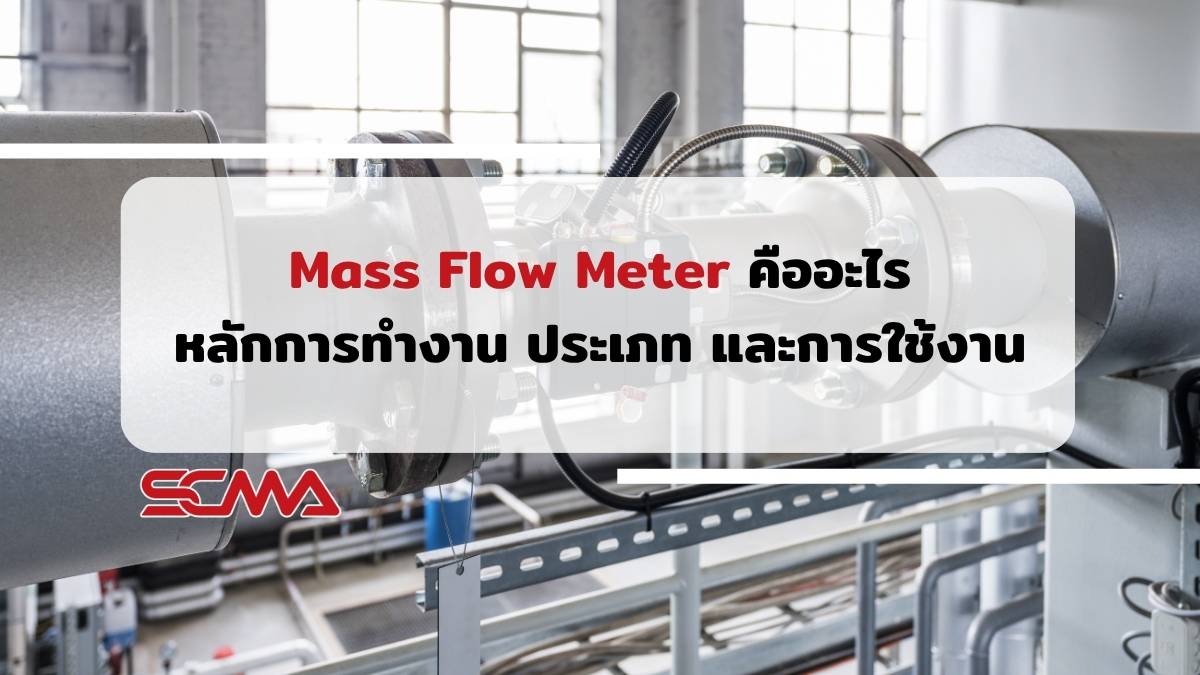
Have you ever wondered how we can be sure that various substances are mixed in the most accurate proportions during complex production processes? The answer lies in an instrument called a Mass Flow Meter (MFM), which is a crucial measuring tool in industry. This article will introduce you to this type of flow meter in detail, from what it is, how it works, its types, and its benefits for the industrial sector, so that you can confidently choose the right tools for your work. SCMA is ready to be your partner in providing precise end-to-end solutions for your business.
What is a Mass Flow Meter?

A Mass Flow Meter is a type of flow meter that measures the "mass flow rate" of fluids (liquids or gases) flowing through a pipe. Unlike general flow meters, which measure "volume flow rate," measuring in units of mass per unit time (such as kilograms per minute) is much more accurate because it is not affected by external factors such as temperature, pressure, or density of the substance. This makes MFM an essential tool for processes that require the highest accuracy.
How does a Mass Flow Meter work?
The main operating principles of a Mass Flow Meter come in two primary forms, each with different technologies but all aiming to measure the mass flow rate directly.
- Inertial Flow Meter Principle: Also known as Coriolis Mass Flow Meters, they utilize the "Coriolis Effect" for measurement. By causing the pipe through which fluid flows to vibrate, when the mass of the fluid moves through this vibrating pipe, it causes a twisting force that deviates from its original path. This deviation is directly proportional to the mass flow rate of the fluid.
- Thermal Flow Meter Principle: Utilizing heat transfer principles for measurement, there are two temperature sensors and a heating coil installed. As the fluid flows through, heat is carried away by the fluid, causing a difference in temperature between the two sensors. This temperature difference is then calculated to determine the mass flow rate.
What Types of Mass Flow Meter Are There?

Based on the experience of the SCMA engineering team, we can categorize mass flow meters commonly used in industry into two main types according to their working principles mentioned above. Each type has its own strengths and suitable applications.
1. Thermal Mass Flow Meter
The Thermal Mass Flow Meter operates on the principle of heat transfer and is particularly suited for measuring gas flow rates. Its standout feature is that it can accurately measure very low flow rates, and it tends to be more affordable compared to the other type.
2. Coriolis Mass Flow Meter
The Coriolis Mass Flow Meter is currently considered the most accurate flow meter available. It can measure both liquids and gases without being affected by physical properties of the fluid. In addition to measuring mass flow, it also measures density and temperature simultaneously, making it popular in industries requiring extremely high precision.
What Are the Benefits of Mass Flow Meter?
Investing in a quality mass flow meter provides significant benefits for manufacturing processes in industrial plants, helping to solve inaccurate measurement problems and reduce unexpected machine downtime.
- Highest accuracy: Provides precise and reliable flow rate data which is crucial for product quality control.
- Increased production efficiency: Helps accurately control various processes such as chemical mixing and ingredient addition, reducing waste and increasing output.
- Cost reduction: Accurate measurement helps reduce unnecessary raw material usage and waste in the manufacturing process.
- Reliability and durability: Not affected by temperature fluctuations, pressure changes, or density variations, ensuring stable measurements.
Applications of Mass Flow Meter in Industries

With accuracy and reliability, Mass Flow Meters are used in various industries that require strict control of processes involving mass.
- Chemical and Petrochemical Industries: Used to control chemical reactions where the ratio of reactants is crucial
- Food and Pharmaceutical Industries: Used for mixing ingredients accurately and consistently
- Automotive and Electronics Industries: Used in gas and liquid dispensing processes that are delicate
- Metering and Custody Transfer: Used in buying or selling gases or liquids where high accuracy is required for proper pricing
What are the advantages of Mass Flow Meter?
The most obvious advantage of a Mass Flow Meter is its ability to measure mass directly, which is a fundamental property of matter. This makes it superior to other types of flow meters in many aspects.
- Direct Mass Measurement: Provides the most accurate results as several manufacturing processes are based on mass rather than volume
- Independent of Flow Properties: The measurement is not affected by changes in viscosity, density, or state of the fluid
- High Accuracy: Has very low deviation and is suitable for tasks requiring utmost precision
- Low Maintenance: Many models are designed without moving parts, making them durable and reducing maintenance needs
Does Mass Flow Meter Contain Mercury?
According to current technical data and manufacturing standards, modern Mass Flow Meters do not contain mercury components. These measuring instruments are made from non-toxic materials resistant to corrosion such as stainless steel, aluminum, or engineering plastics in accordance with strict environmental and health safety standards. Therefore, users can be assured that these devices are safe and free of harmful substances.
Does a Mass Flow Meter Contain Hazardous Chemicals?
In general, the Mass Flow Meter itself does not contain any hazardous chemicals. However, for applications that require measuring the flow of corrosive or dangerous fluids, the meter may be designed with special materials or have surface coatings to withstand such substances. The most important thing is to select equipment according to the manufacturer's specifications and strictly follow installation and usage guidelines to ensure the highest safety for operators and the environment.
Why Is a Mass Flow Meter Important?
A Mass Flow Meter is crucial in modern industries as it is at the heart of high-precision production process control. Direct mass flow measurement helps maintain product quality consistently, increase production efficiency, reduce waste, and ensure safety in operational processes. Investing in reliable measuring tools is not just an expense but a long-term investment to enhance business competitiveness and reliability.
If You Are Looking for "High-Quality Mass Flow Meters," Think SCMA!
Selecting the right Mass Flow Meter goes beyond purchasing a product; it's about choosing a partner who truly understands your technical needs. At SCMA, we are not just distributors but providers of comprehensive measurement and automation solutions. With over 15 years of experience, our team of engineers is ready to consult on selecting high-quality Flow Sensors & Meters that meet your application requirements accurately. We also offer after-sales service and calibration work to ensure your production processes run smoothly and efficiently.
Summary
A Mass Flow Meter (MFM) is a highly accurate tool for measuring mass flow rates, which is crucial in controlling production processes across various industries. The main types are Thermal Mass Flow Meters suitable for gases and Coriolis Mass Flow Meters with the highest accuracy applicable to both liquids and gases. Choosing high-quality measurement tools not only enhances efficiency and reduces costs but also builds trust in your products. If you need more information or seek a knowledgeable partner for the best solutions, SCMA's team is always ready to advise.
Frequently Asked Questions
What is a Mass Flow Meter?
A Mass Flow Meter is a measuring instrument that determines the flow rate of liquids or gases in units of mass per time (such as kg/s), providing higher accuracy than volumetric measurements because it is not affected by changes in temperature, pressure, or density of the substance.
How does a Mass Flow Meter work?
The main operating principles are two types: 1) Thermal type which measures the change in temperature of the flowing fluid passing through a heated coil and 2) Coriolis type which measures the twist force that occurs when mass flows through a vibrating tube.
How many types of Mass Flow Meters are there?
The main types commonly used in industry include two categories: Thermal Mass Flow Meter, suitable for gas measurement, and Coriolis Mass Flow Meter, the highest accuracy type which can measure both liquids and gases. For more information, read our article on Flow Meters.