

In a beverage manufacturing plant, "water" is not just the main ingredient but also the heart of utility systems such as RO water, softened water, hot water, cold water, coolant water, CIP water, wastewater, steam, and compressed air. Installing an appropriate Flow Meter helps the factory control quality, reduce energy costs, detect leaks, and collect data for systematic process improvement.

When selecting a Flow Meter for drinking water and beverage applications, one must consider three dimensions simultaneously: measurement accuracy, suitability for food hygiene standards, and long-term reliability. Especially at points where the product or clean water systems are involved, hygienic design standards such as 3-A should be considered, which have specific standards for Flow Meters and accepted practices for installation and CIP of sanitary piping systems.
1. What does a Flow Meter measure in a beverage factory?
Main usage points in a beverage factory are typically divided into 5 groups
Production water systems such as raw water, filtered water, RO water, product mixing water, bottle washing water, and blending tank inlet water. These points often require high accuracy and totalizer data to control formulas, yields, and monitor water usage per unit of production.
CIP and hot water systems must measure flow appropriately for the cleaning speed. If the flow is too low, it may not clean effectively; if it's too high, it will waste water, chemicals, and energy.
Steam and Condensate Systems are typically used for boilers, pasteurizers, hot water sets, and heat exchangers. The Vortex Flow Meter is one of the technologies that can be applied to steam, gas, and liquids. In steam applications, temperature/pressure compensation should be provided if reliable mass flow is required.
Compressed Air and Gas Systems, such as compressed air, CO₂ or N₂, are used to track leaks, energy usage, and utility costs. Thermal mass flowmeter is suitable for measuring the mass of industrial gases and compressed air directly in various applications.
Wastewater and Effluent Systems are used to track effluent volume, system load, and water balance compared to the process feedwater.
2. Types of Flow Meters You Should Know About

Electromagnetic Flow Meter or Mag Meter
is suitable for water and conductive liquids such as raw water, softened water, CIP water, and wastewater. Its advantages include no moving parts, low pressure drop, and suitability for medium to large pipe sizes. In food and beverage applications, there are hygienic magnetic flowmeters designed specifically for sanitary processes. A caution is that the liquid must have sufficient conductivity and the pipe must be full at all times during measurement.
Coriolis Flow Meter
is suitable for applications requiring high accuracy, such as syrup, concentrate, dosing, blending, or points where mass flow and density are needed in a single unit. Its advantage is direct mass measurement, but it is more expensive and requires careful selection of size to match pressure drop.
Ultrasonic Flow Meter
Suitable for clean water, coolant water, or retrofit points where cutting pipes is undesirable, especially the clamp-on type. The standout feature is that it does not come into contact with liquids, but accuracy depends on pipe condition, pipe wall thickness, air bubbles, scale buildup, and installation position.
Turbine Flow Meter
Suitable for clean liquids and relatively constant flow rates. It offers high accuracy but has moving parts, so wear and tear, contaminants, and suitability for CIP/SIP must be considered if used in product contact points.
Vortex Flow Meter
Suitable for steam, hot water, chilled water in some applications, and utility gas. The standout feature is that it has no moving parts and works with steam, gas, and various liquids, but must be careful of vibration, low flow rates, and the need to follow straight run requirements as per manufacturer guidelines.
Thermal Mass Flow Meter
Suitable for compressed air and plant gas. Its strength lies in energy monitoring and leak detection because it directly measures mass flow.
3. Principles of Selecting Flow Meters for Water and Utility Systems
Before selecting a meter, it is essential to answer basic questions thoroughly: What is the liquid? What are the minimum and maximum flow rates? What is the pipe size? What are the temperature/pressure conditions? What level of accuracy is required? Is this a critical point in the formula or just for utility monitoring? Do you need 4–20 mA signals, pulse, HART, Modbus, or Ethernet/IP communication? And do you require totalizer logging in PLC/SCADA?
For potable water, one should distinguish between “meters for process control” and “meters for billing/legal reference” because standards such as ISO 4064-1:2024 specify metrological and technical requirements for water meters in closed pipes with full flow, covering mechanical, electrical/electronic meters, and accessories. OIML R 49-1:2024 is a specification for cold potable water and hot water meters, and the 2024 edition specifies that it is equivalent to the corresponding version of ISO 4064-1.
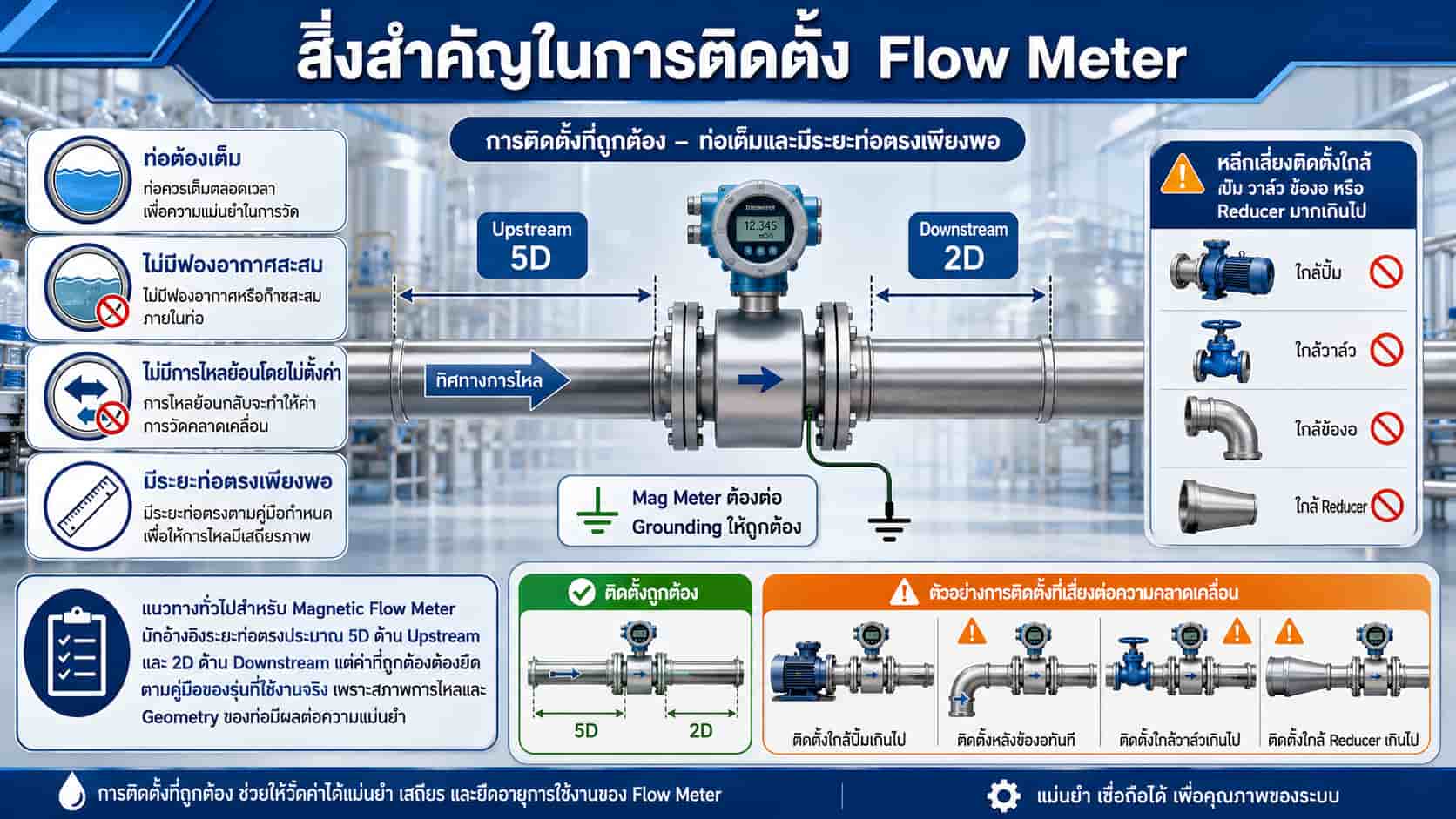
4. Key Installation Considerations
A good Flow Meter can give incorrect readings if installed improperly. Points to always check include ensuring the pipe is full, no air bubbles are accumulating, there's no reverse flow without setting it up, sufficient straight pipe length, avoiding installation too close to pumps, valves, elbows, or reducers, and proper grounding in case of mag meter.
For magnetic flow meters, general industry guidelines often refer to a straight pipe run of approximately 5D upstream and 2D downstream. However, the correct values must be based on the manual of the actual model used because conditions of flow and pipe geometry affect accuracy.
5. Calibration and Acceptance Testing
Flow Meters should have a calibration or verification plan according to the importance of the measurement point. Points related to production formulas, sales volume, wastewater discharge, or energy KPIs should be classified as critical instruments and have clear retest cycles.
In liquid calibration work, ISO 4185 standard describes the method of determining liquid flow rate by measuring the mass of fluid entering a weighing tank over a known period. It covers equipment, procedures, calculation methods, and measurement uncertainty. While factories may not need to perform this entirely themselves, they should understand the principles to evaluate calibration certificates and the reliability of service providers.
6. Common Issues
Common issues in beverage plants include fluctuating flow readings due to air bubbles, empty pipes, pump cavitation, excessive proximity to control valves, selecting an overly wide range, using a meter the same size as the pipe but with too low velocity, poor grounding, scale or CIP residue on the sensor, and not comparing totalizer values with tanks or batch records
Another issue is choosing the wrong technology, such as using a mag meter for water with very low conductivity, using a turbine meter for water with sediment, using an ultrasonic clamp-on meter on old pipes of unknown material or thickness, or using a vortex meter at flow rates too low to produce stable signals
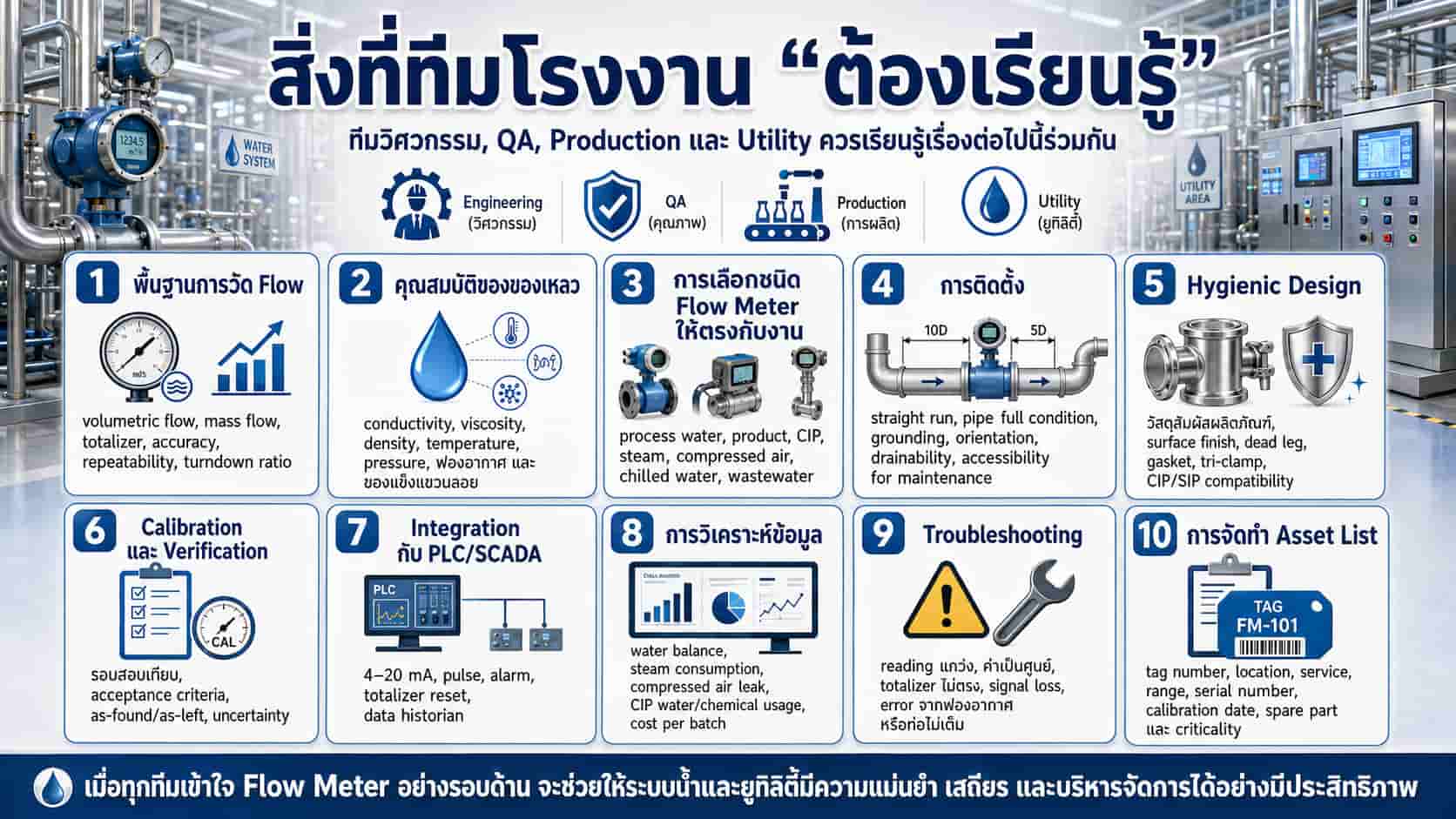
7. What the Plant Team “Needs to Learn”
The engineering, QA, Production, and Utility teams should learn the following together:
- Flow measurement basics: volumetric flow, mass flow, totalizer, accuracy, repeatability, turndown ratio
- Properties of liquids: conductivity, viscosity, density, temperature, pressure, air bubbles, and suspended solids
- Selecting the right type of Flow Meter for the job: process water, product, CIP (Clean-In-Place), steam, compressed air, chilled water, wastewater
- Installation considerations: straight run, pipe full condition, grounding, orientation, drainability, accessibility for maintenance
- Hygienic design: product contact materials, surface finish, dead leg, gasket, tri-clamp, CIP/SIP compatibility
- Calibration and verification: calibration cycles, acceptance criteria, as-found/as-left, uncertainty
- Integration with PLC/SCADA: 4–20 mA, pulse, alarm, totalizer reset, data historian
- Data analysis: water balance, steam consumption, compressed air leak, CIP water/chemical usage, cost per batch
- Troubleshooting: fluctuating readings, zero values, incorrect totalizer, signal loss, errors from air bubbles or pipe not full
- Creating an asset list: tag number, location, service, range, serial number, calibration date, spare parts and criticality
Summary
A Flow Meter in a beverage manufacturing plant is not just a device for measuring water volume, but also a tool for controlling quality, cost, energy, and the reliability of the production process. Selecting the appropriate type, installing correctly, calibrating systematically, and analyzing the data will help the factory reduce water loss, mitigate production issues, and enhance utility control standards clearly.




