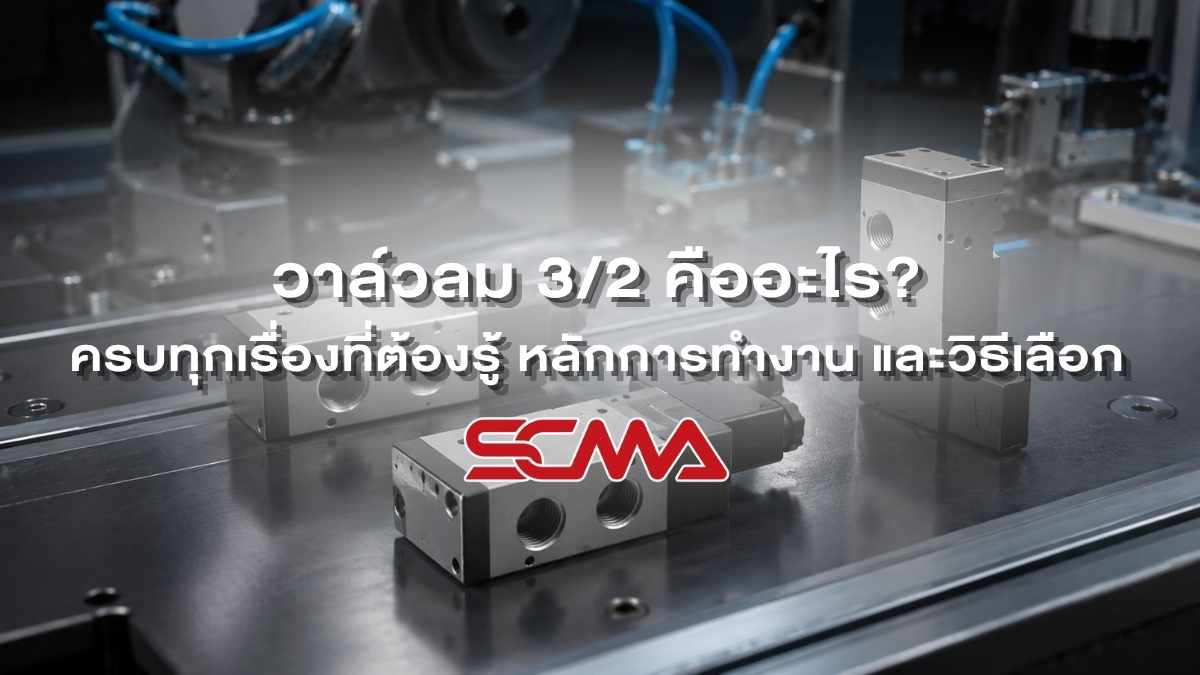
What is a 3/2 Pneumatic Valve? Why is it an important component in pneumatic circuits? This article will delve into the working principles of the 3/2 valve, including easy-to-understand explanations of pneumatic valve symbols, so you can correctly apply this knowledge to three-way valves on the job site. If you are looking for automation experts, check out SCMA's Services, which provide comprehensive industrial technology consultation.
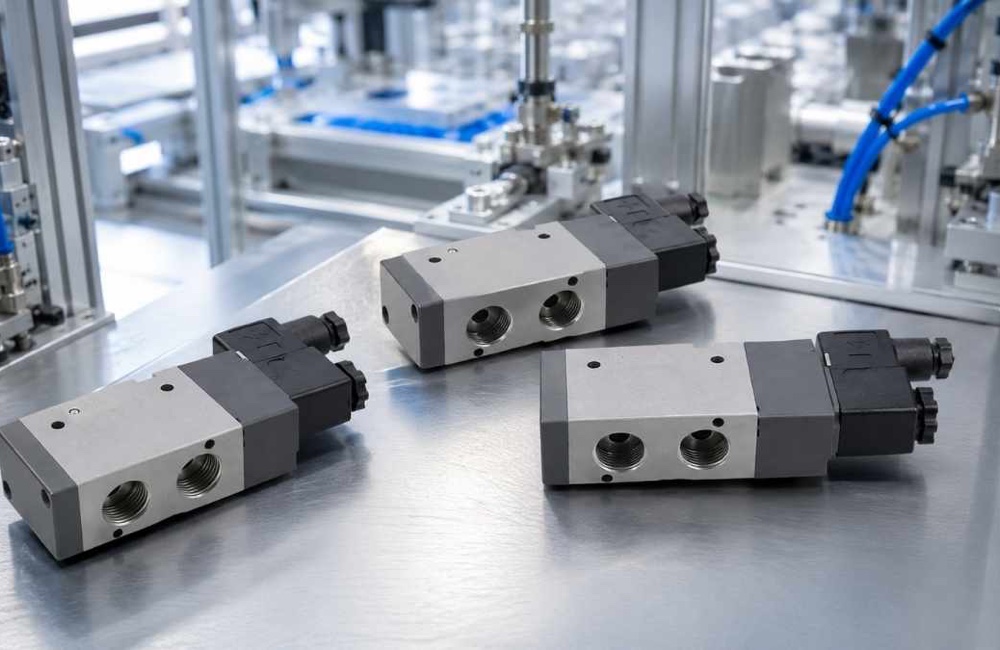
What is a 3/2 Pneumatic Valve? Get to know the components and functions
A 3/2 pneumatic valve is a control device that directs compressed air flow in pneumatic systems. The numbers 3/2 are easy to understand, meaning the valve has three ports for connecting air and two operating positions (2 Positions). Key internal components include the body (Body), valve spool (Spool or Poppet), rubber seals preventing air leaks. The primary function of a 3/2 valve is to switch airflow direction to command end devices to operate, such as supplying air to an air cylinder or venting air to reduce system pressure.
How does the 3/2 Valve Work?
Based on SCMA's engineering team experience, the operation of a 3/2 valve is clearly divided into two states. In the normal position before any command (Normal Position), an internal spring holds the spool in its resting position, which may be air shut-off (NC) or air passage (NO). When commanded through electrical or mechanical means, the spool moves to change positions, allowing compressed air from the source to flow to end devices. Upon deactivation of the command, the spring returns the spool to its original position, venting any remaining air in the system out via exhaust ports. This mechanism is crucial for designing safe pneumatic circuits.
How to Read Different 3/2 Valve Symbols?
Reading pneumatic valve symbols correctly is a fundamental skill that every engineer must have in order to assemble pneumatic circuits according to international engineering standards.
Basic Method for Reading Pneumatic Symbols
Pneumatic valve symbols are represented by squares. The number of square frames indicates the number of operating positions of the valve, while arrows within the frame indicate the direction of air flow. For a 3/2 valve, there will be two adjacent square frames with three points of symbol ports and arrows inside.
Symbol for Normally Closed (NC) 3/2 Valve
In the case of an NC (Normally Closed) 3/2 valve in its normal state before operation, port 1 (air input port) is blocked. Air cannot flow to the working port (port 2). The air in the system will be vented through exhaust port (port 3). When activated, air can then flow from port 1 to port 2.
Symbol for Normally Open (NO) 3/2 Valve
The pneumatic symbol of an NO (Normally Open) type works in reverse compared to the NC type. In its normal state, air from port 1 can immediately flow through to port 2. When the 3/2 valve is activated, the valve stem shifts to block port 1 and vent the system's air out through port 3. This configuration is used in circuits that require continuous air supply.
Actuation Mechanism Symbols (Solenoid, Push Button, Roller)
The side of the square frame will have actuation symbols added to indicate how the 3-way valve operates. A coil symbol with a crossbar line indicates a solenoid-operated 3/2 valve. A half-circle shape represents manual pressing (push button). A full circle represents a roller mechanism that is operated by machinery.
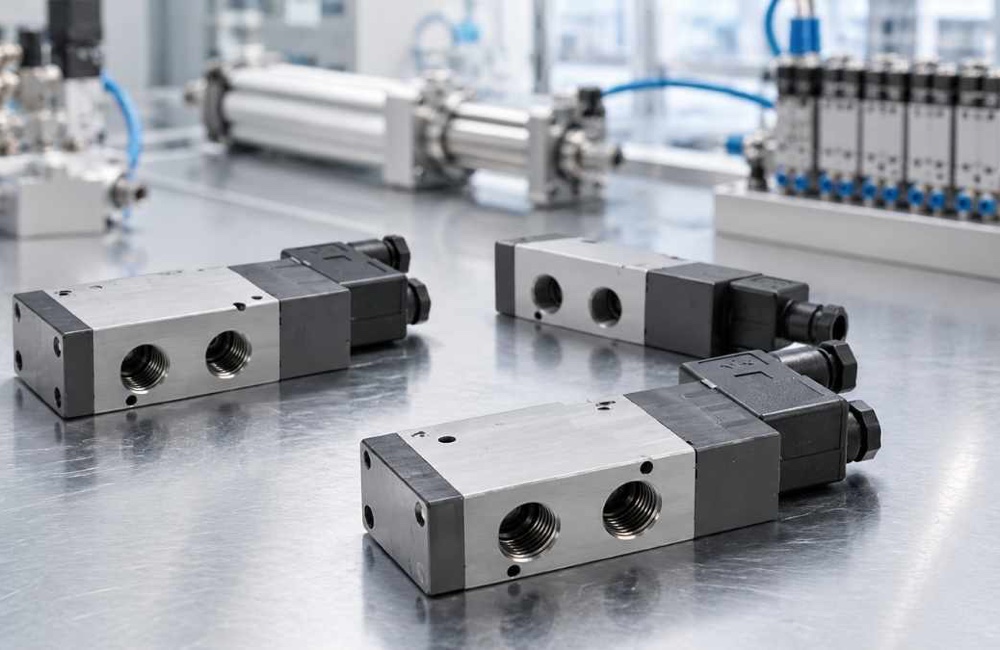
What are the popular types of 3/2 air valves?
In the market, three-way valve types are categorized based on their operating methods to enable engineers to apply them flexibly in machinery.
Electrically Operated Valves (Solenoid Valve)
The 3/2 solenoid valve is the most popular type in the era of automated industry. It uses electric current to create a magnetic field that pulls the valve stem, making it suitable for control through PLC systems. If you want to learn more, you can read about air solenoid valves here.
Mechanically Operated Valves (Mechanical Valve) such as Push Button, Lever Actuated
This type of 3/2 valve relies on mechanical force from the outside to change its position, such as turning a lever with your hand, pressing buttons on control panels, or using rollers to receive impacts from workpieces. It is commonly used in pneumatic circuits that do not require electrical systems for safety.
Pneumatically Operated Valves (Pneumatic Valve / Pilot Valve)
A 3-way valve operated by air uses small air pressure (pilot air) to push the main valve stem and change its position. It is suitable for hazardous areas sensitive to sparks, with advantages such as quick response and durability in harsh industrial environments.
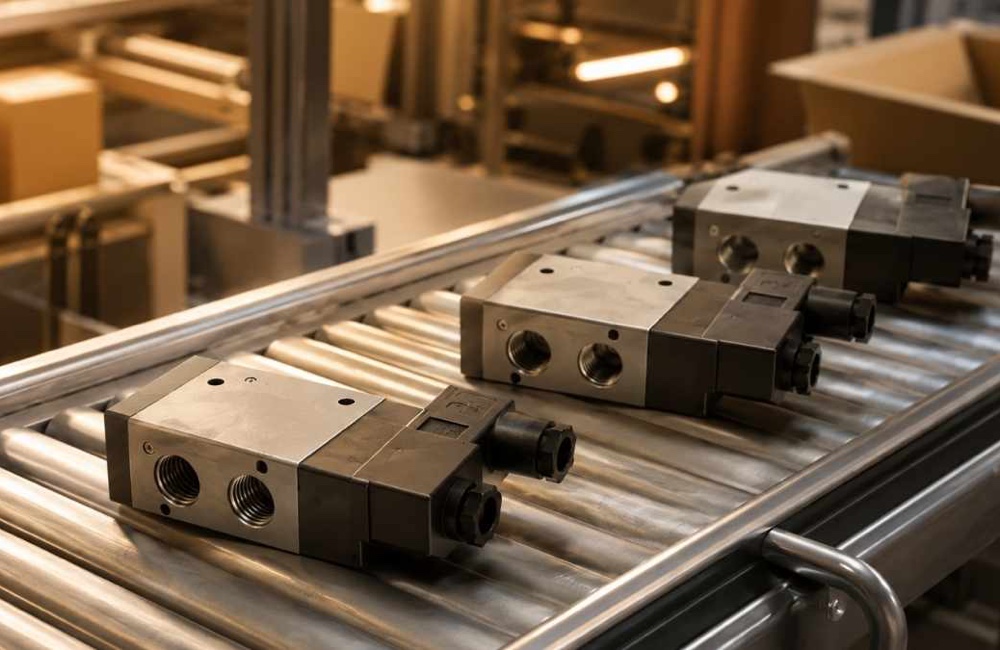
Examples of Using 3/2 Valves in Industry
The SCMA engineering team has been involved in designing systems for various factories. We found that the application of 3/2 valves is diverse and interesting, with main examples as follows:
- Controlling Air Cylinders Working in One Direction (Single-acting Cylinder): Use 3/2 solenoid valve to supply air to push the cylinder rod out, different from the 5/2 solenoid valve used for double-acting cylinders.
- Using as a Blow-off Valve: In production lines, 3-way valves are commonly used to open and close air flow precisely for cleaning workpieces.
- Application in Vacuum Systems (Vacuum Application): As pneumatic basics, using a 3/2 valve to control the suction and release of parts through vacuum grippers, referencing international standards from MecFluid2.
How to Choose the Right 3/2 Air Valve for Your Work
Selecting the correct 3/2 air valve can significantly reduce downtime in production lines. Considerations before purchasing include:
- Considering Working Air Pressure: You must check what your pneumatic circuit uses as air pressure; a 3/2 solenoid valve needs to safely support the maximum working pressure (Max Pressure).
- Size of Ports and Flow Rate: Select thread size (such as 1/8", 1/4", 1/2") that matches the volume of air the three-way valve must supply to end devices.
- Type of Substance to Control (Air, Water, Oil): Although called a 3/2 valve, some models are designed for liquids. Carefully review the datasheet.
- Environmental Conditions and Installation Temperature: If installed in wet or dusty areas, choose pneumatic valve symbols and valves with appropriate IP (Ingress Protection) ratings.
Summary
Air directional control valves, specifically the 3/2 valve, play a crucial role in pneumatic circuit design. Understanding their working principles and reading pneumatic valve symbols will help you use the 3-way valve correctly and safely. If you want to delve deeper into the working principle of solenoid valves for industrial applications, SCMA's team of expert engineers is ready to provide consultation, design systems, and offer comprehensive services to ensure the highest efficiency for your factory.
If you want to buy, you can purchase from SCMA today!
Misselecting a 3/2 valve could lead to unquantifiable machine downtime. SCMA Co., Ltd. (SCMA) offers high-quality solenoid valves 3/2 from leading global brands for sale. We do more than just sell equipment; we provide measurement tool solutions, automation systems, and fast after-sales service to ensure your pneumatic circuits operate at peak efficiency.
Frequently Asked Questions about the 3/2 Valve
How are the 2/2 valve and the 3/2 valve different?
The 2/2 valve has only two ports, functioning solely to open or close air flow. In contrast, the 3/2 air valve has three ports, allowing it to admit air, shut off air, and vent air out of the system.
Can a 5/2 valve be used instead of a 3/2 valve?
You can use it as an alternative by plugging one unused port. However, engineering advice suggests using a direct 3/2 valve for cost-effectiveness and to reduce the complexity of pneumatic circuits.
How long is the lifespan of a solenoid valve 3/2?
The lifespan depends on brand quality and air cleanliness; with good air filters, high-quality valves can operate millions of cycles (Cycles).
How does a normally closed (NC) 3/2 valve work?
In an unpowered or undepressed state, the air is blocked from entering the system. Upon activation, air can flow through from the inlet port to the working port.
What are some basic maintenance tips for a 3/2 valve?
Air filters (Air Filter) should be installed to capture dust and moisture that could damage internal rubber seals in the valve. Regularly check for leaks at connections.