
SPECIAL PROMOTION — Up to 40% off across many product groups, until 31 December 2026 · Click to see all promotion itemsIFM, Sensor, Automation SystemMeasuring / Testing InstrumentsTemp Indicator, Control, T/C, RTD, TimerHeater, SCR Control, Solid State, Power Supply, Control CabinetField Measuring Instruments, Pressure Gauge, Level Control, Flow MeasurementEMC, Pneumatic, Solenoid ValveInspection Test Lamp, Head Light, Automotive Measuring InstrumentWeighing Scales, Marking Machine, PrintersEducational Training SystemsHot Line Tools & Equipment SPECIAL PROMOTION — Up to 40% off across many product groups, until 31 December 2026 · Click to see all promotion itemsIFM, Sensor, Automation SystemMeasuring / Testing InstrumentsTemp Indicator, Control, T/C, RTD, TimerHeater, SCR Control, Solid State, Power Supply, Control CabinetField Measuring Instruments, Pressure Gauge, Level Control, Flow MeasurementEMC, Pneumatic, Solenoid ValveInspection Test Lamp, Head Light, Automotive Measuring InstrumentWeighing Scales, Marking Machine, PrintersEducational Training SystemsHot Line Tools & Equipment View promotion items View all
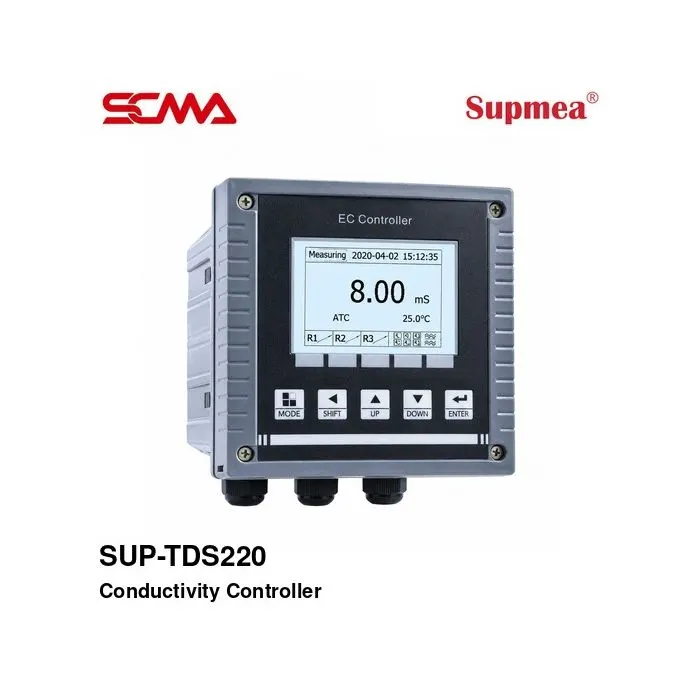
SUP-TDS220 CONDUCTIVITY CONTROLLER SUPMEA
Price on request – please contact us
Out of stock
SKU
050984
Out of stock

SUP-TDS220, SUPMEA, Conductivity Controller, EC Controller, TDS Controller, Online Conductivity Meter, Industrial Conductivity Meter, Conductivity Analyzer, Electrical Conductivity Meter, EC TDS Resistivity Salinity Controller, Water Quality Controller, Online Water Quality Monitoring, EC Measurement, TDS Measurement, Resistivity Measurement, Salinity Measurement, Temperature Measurement, Conductivity Range 0.00uS/cm to 2000mS/cm, TDS Range 0-133000ppm, Resistivity Range 0-20MOhm.cm, Salinity Range 0-78g/kg, Accuracy ±1%FS, 4.3 Inch LCD, Temperature Compensation, PT1000, NTC30K, Dual 4-20mA Output, RS485, Modbus RTU, Three Relay Outputs, 500000 Data Records, Automatic Electrode Cleaning Control, IP65, 90-260VAC, Panel Mount Controller, Water Treatment Conductivity Measurement, Industrial Process Water Monitoring, Electrical Conductivity Meter, EC Meter, TDS Meter, Resistivity Meter, Salinity Meter, Online Water Quality Monitor, Wall-Mounted EC Meter with RS485, TDS Meter with 4-20mA Output, SUPMEA Conductivity Meter, SUP-TDS220 Conductivity Meter, Water Quality Controller, Wastewater Treatment Measurement Device, Industrial Water Quality Monitoring Tool
*Price does not include VAT
SUPMEA SUP-TDS220 Conductivity Controller
SUPMEA SUP-TDS220 Conductivity Controller is an online conductivity measuring and controlling device for water quality and production process monitoring in industries. It supports the measurement of Conductivity (EC), Total Dissolved Solids (TDS), Resistivity, Salinity, and Temperature. The measured data can be used for monitoring and controlling water treatment systems, pure water production systems, and production processes that require continuous water quality tracking.
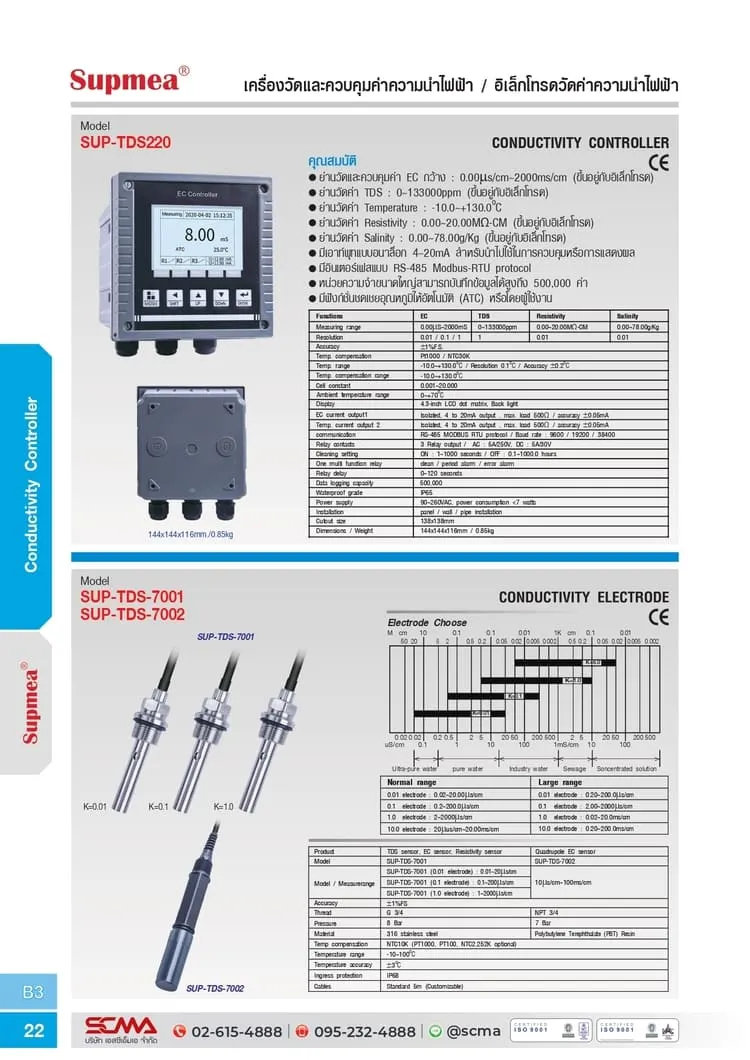
The device supports a conductivity measurement range from 0.00 µS/cm to 2,000 mS/cm as specified in the catalog. The actual measurement range depends on the type of electrode and the selected cell constant. It also supports TDS measurement up to 133,000 ppm, Resistivity up to 20.00 MΩ·cm, and Salinity up to 78.00 g/kg.
SUP-TDS220 has a 4.3-inch LCD screen with backlight and supports automatic or custom temperature compensation to help reduce the impact of temperature changes on conductivity measurements.
The device has two separate analog output channels of 4-20 mA for EC and temperature, and communication via RS485 using the Modbus RTU protocol. It can be connected to PLC, HMI, SCADA systems, and data logging systems that support it.
Additionally, it has three relay outputs that support functions such as electrode cleaning control, alarms, and data logging up to 500,000 entries, suitable for water quality monitoring in industrial systems that require continuous data.
General Specifications
- Brand: SUPMEA
- Product Model: SUP-TDS220
- Product Type: Conductivity Controller
- Supports measurement of EC, TDS, Resistivity, Salinity, and Temperature
- EC measurement range as specified in the catalog from 0.00 µS/cm to 2,000 mS/cm, depending on the electrode
- TDS measurement range 0-133,000 ppm according to electrode and settings
- Resistivity measurement range 0.00-20.00 MΩ·cm
- Salinity measurement range 0.00-78.00 g/kg
- Accuracy of EC, TDS, Resistivity, and Salinity measurements ±1% F.S.
- Supports temperature measurement from -10.0 to +130.0°C
- Temperature measurement resolution 0.1°C
- Temperature measurement accuracy ±0.2°C according to the catalog
- Supports Pt1000 / NTC30K temperature sensors
Technical Specifications
| Specifications | Details |
|---|---|
| Brand | SUPMEA |
| Model | SUP-TDS220 |
| Product Type | Conductivity Controller |
| Measured Parameters | EC / TDS / Resistivity / Salinity / Temperature |
| EC Measuring Range | 0.00 µS/cm to 2000 mS/cm (Depending on Electrode) |
| TDS Measuring Range | 0-133000 ppm (Depending on Electrode) |
| Resistivity Measuring Range | 0.00-20.00 MΩ·cm (Depending on Electrode) |
| Salinity Measuring Range | 0.00-78.00 g/kg (Depending on Electrode) |
| EC Resolution | 0.01 / 0.1 / 1 (Depending on Selected Range) |
| TDS Resolution | 1 ppm |
| Resistivity Resolution | 0.01 MΩ·cm |
| Salinity Resolution | 0.01 g/kg |
| Measurement Accuracy | ±1% F.S. |
| Temperature Range | -10.0 to +130.0°C |
| Temperature Resolution | 0.1°C |
| Temperature Accuracy | ±0.2°C |
| Temperature Sensor | Pt1000 / NTC30K |
| Temperature Compensation | Manual / Automatic |
| Temperature Compensation Range | -10.0 to +130.0°C |
| Cell Constant | 0.001-20.000 |
| Display | 4.3-inch LCD Dot Matrix with Backlight |
| EC Analog Output | Isolated 4-20 mA, 1 Channel |
| Temperature Analog Output | Isolated 4-20 mA, 1 Channel |
| Analog Output Maximum Load | 500 Ω per Channel |
| Analog Output Accuracy | ±0.05 mA |
| Communication Interface | RS485 |
| Communication Protocol | Modbus RTU |
| Baud Rate | 9600 / 19200 / 38400 |
| Relay Output | 3 Channels |
| AC Relay Contact Rating | 5A / 250VAC |
| DC Relay Contact Rating | 5A / 30VDC |
| Relay Delay | 0-120 Seconds |
| Cleaning ON Time | 1-1000 Seconds |
| Cleaning OFF Interval | 0.1-1000.0 Hours |
| Multi-Function Relay | Cleaning / Period Alarm / Error Alarm |
| Data Logging Capacity | 500000 Records |
| Ambient Operating Temperature | 0 to +70°C |
| Power Supply | 90-260VAC |
| Power Consumption | <7W |
| Ingress Protection | IP65 |
| Installation | Panel / Wall / Pipe |
| Overall Dimensions | 144 x 144 x 116 mm |
| Panel Cutout | 138 x 138 mm |
| Weight | Approximately 0.85 kg |
Principle of Conductivity Meter Operation
The measurement of Electrical Conductivity (EC) relies on the ability of a solution to conduct electric current through ions dissolved in water. The device receives signals from the measuring electrodes and calculates the conductivity according to the predefined Cell Constant.
The conductivity of a solution depends on the type and quantity of ions, as well as the temperature of the sample. Therefore, it is necessary to select the appropriate probe and set the temperature compensation according to the nature of the work.
TDS is an approximate value of the dissolved solids related to conductivity. The conversion result depends on the coefficient and composition of the solution. Resistivity is the specific resistance inversely related to conductivity.
The measurement of Salinity relies on the relationship between conductivity and salt concentration according to the principle or settings of the device. Therefore, the obtained values may vary depending on the composition of the sample and the measurement conditions.
Measurement Function Details
1. Electrical Conductivity (EC)
Measures the conductivity of a solution in units of µS/cm or mS/cm for water quality inspection and process condition monitoring. The measurement range depends on the electrode and the selected Cell Constant.
2. Total Dissolved Solids (TDS)
Displays an approximate value of dissolved solids in units of ppm based on the conversion from conductivity and the supported settings. Suitable for water quality monitoring in water production systems and water filtration systems.
3. Resistivity
Measures the specific resistance of water in units of MΩ·cm. Suitable for application in pure water systems and systems requiring monitoring of the water's conductivity capability.
4. Salinity
Displays the salinity of the solution in units of g/kg. Suitable for salinity monitoring of water according to the range and measurement conditions supported by the device and probe.
5. Temperature
Supports temperature measurement and compensates for the effect of temperature on conductivity. Uses Pt1000 or NTC30K probes depending on the installation type.
4-20 mA Output System
SUP-TDS220 has two isolated analog 4-20 mA output channels. The catalog specifies one channel for EC and one channel for temperature. It can be connected to PLC, Data Logger, or control systems that support current input.
Each channel supports a maximum load of 500 Ω and has an output accuracy of ±0.05 mA. It is necessary to check the terminal diagram, signal scaling, and circuit connection mode from the manual before actual use.
RS485 Modbus RTU Communication System
The device supports RS485 communication with the Modbus RTU protocol for connecting to PLC, HMI, SCADA, or compatible control systems. Baud Rate can be selected as 9600, 19200, and 38400 according to the catalog data.
It is necessary to check the settings for Slave Address, Baud Rate, Parity, Register Address, and signal wiring according to the specific model manual before actual system connection.
Relay Control and Probe Cleaning System
SUP-TDS220 has 3 relay outputs, which can be used for alarm systems and external device control according to the set functions.
The device can set the electrode cleaning cycle, with the working time (ON) ranging from 1-1000 seconds and the rest time (OFF) ranging from 0.1-1000.0 hours, and supports Relay Delay settings from 0-120 seconds.
Automatic electrode cleaning requires appropriate external equipment, such as a valve set or cleaning device. It is necessary to check the circuit connection and the actual ordered equipment list.
Data Logging System
The device supports memory for logging up to 500,000 data entries, suitable for continuous measurement data storage and water quality trend tracking. The method for viewing or exporting data should be checked from the SUP-TDS220 model manual.
Selection of Conductivity Electrodes
Selecting the electrode is important for using SUP-TDS220, as the measurement range depends on the Cell Constant and the probe characteristics.
| Cell Constant | Typical Application |
|---|---|
| K = 0.01 | Pure water and water with low conductivity |
| K = 0.1 | Drinking water and water with relatively low conductivity |
| K = 1.0 | General water, raw water, and water quality monitoring systems |
| K = 10.0 | Wastewater or solutions with high conductivity |
Note: The table is a general guideline for selecting the probe only. The actual measurement range of the electrode, Cell Constant value, probe material, temperature, and compatibility with the device must be checked before ordering.
Installation and Setup
- Check the product model and electrode compatibility before installation
- Select a probe suitable for the Conductivity range and the condition of the solution
- Install the Panel, Wall, or Pipe type device according to the appropriate mounting kit
- For front panel installation, prepare an installation opening of size 138 x 138 mm
- Check that the power voltage is within the range of 90-260VAC
- Connect the Conductivity probe and temperature probe according to the manufacturer's terminal diagram
- Set the Cell Constant to match the actual probe in use
- Set the temperature compensation to Manual or Automatic according to the installed equipment
- Calibrate the device with an appropriate standard Conductivity solution
- Set the 4-20 mA output scale to match the PLC or end system
- Configure the RS485 Modbus RTU communication according to the manual
- Check the operation of the relay and alarm system before actual use
- Set the inspection, calibration, and cleaning schedule of the probe according to the process conditions
Examples and Application Guidelines
- Check water quality in wastewater treatment systems
- EC monitoring system in the production process
- Pure water production system and Reverse Osmosis (RO) system
- Measure the conductivity of water in industrial plants
- Monitor TDS in water production and water filtration systems
- Resistivity monitoring system for low conductivity water
- Check the salinity of water within the range supported by the probe
- Water quality monitoring system connected to PLC and SCADA
- Online measurement and data recording of water quality
Considerations
- The measurement range of EC, TDS, Resistivity, and Salinity depends on the type of electrode and Cell Constant value
- The Controller and electrode may be separate items; check the delivered set before ordering
- The Cell Constant must be set to match the probe to obtain appropriate measurement results
- The TDS value is calculated or estimated from Conductivity according to the conversion factor, not a direct analysis of the solution composition
Write Your Own Review
This website uses cookies
We use cookies to make the site work properly, to understand how it is used, and to show content that is relevant to you. You choose which types to allow; strictly necessary cookies are always on. Privacy Policy
🤖 AI Assistant
Ask about products, specs and replacement models
Hello 👋 Ask us anything — find products, compare specs, or troubleshoot.
🗑 Clear history