
SPECIAL PROMOTION — Up to 40% off across many product groups, until 31 December 2026 · Click to see all promotion itemsIFM, Sensor, Automation SystemMeasuring / Testing InstrumentsTemp Indicator, Control, T/C, RTD, TimerHeater, SCR Control, Solid State, Power Supply, Control CabinetField Measuring Instruments, Pressure Gauge, Level Control, Flow MeasurementEMC, Pneumatic, Solenoid ValveInspection Test Lamp, Head Light, Automotive Measuring InstrumentWeighing Scales, Marking Machine, PrintersEducational Training SystemsHot Line Tools & Equipment SPECIAL PROMOTION — Up to 40% off across many product groups, until 31 December 2026 · Click to see all promotion itemsIFM, Sensor, Automation SystemMeasuring / Testing InstrumentsTemp Indicator, Control, T/C, RTD, TimerHeater, SCR Control, Solid State, Power Supply, Control CabinetField Measuring Instruments, Pressure Gauge, Level Control, Flow MeasurementEMC, Pneumatic, Solenoid ValveInspection Test Lamp, Head Light, Automotive Measuring InstrumentWeighing Scales, Marking Machine, PrintersEducational Training SystemsHot Line Tools & Equipment View promotion items View all
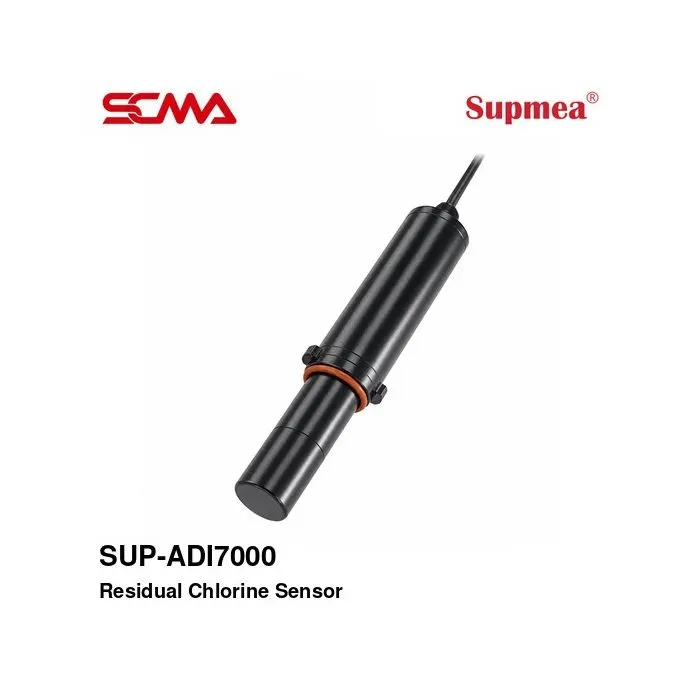
SUP-ADI7000 RESIDUAL CHLORINE SENSOR SUPMEA
Price on request – please contact us
Out of stock
SKU
050985
Out of stock

SUP-ADI7000, SUPMEA, Residual Chlorine Sensor, Digital Chlorine Sensor, Free Residual Chlorine Sensor, Online Chlorine Sensor, Chlorine Analyzer Sensor, Residual Chlorine Electrode, Digital Disinfectant Sensor, Three-Electrode Sensor, Three-Electrode Amperometric Sensor, Constant Potential Sensor, Membrane-Less Chlorine Sensor, Electrochemical Chlorine Sensor, Chlorine Dioxide Sensor, Ozone Sensor, 0-5 mg/L Chlorine Sensor, 0-20 mg/L Chlorine Sensor, 0.001 mg/L Sensitivity, RS485, Modbus RTU, NTC10K Temperature Compensation, 9-24VDC, 0.5W, ARM Processor, Water Quality Monitoring, Water Treatment Sensor, Drinking Water Chlorine Monitoring, Swimming Pool Chlorine Sensor, Water Disinfection Monitoring, Residual Chlorine Meter, Chlorine Sensor, Free Chlorine Sensor, Online Chlorine Measurement Device, Three-Electrode Chlorine Sensor, RS485 Chlorine Sensor, Modbus RTU Chlorine Sensor, Chlorine Dioxide Sensor, Ozone Sensor, Water Quality Monitor, SUPMEA Chlorine Sensor, SUP-ADI7000 Chlorine Sensor, Swimming Pool Chlorine Meter, Drinking Water Chlorine Monitoring Device, Disinfection System Chlorine Sensor
*Price does not include VAT
SUPMEA SUP-ADI7000 Residual Chlorine Sensor
SUPMEA SUP-ADI7000 Residual Chlorine Sensor is a sensor for continuously measuring the residual chlorine concentration in water (Online Monitoring). It uses a three-electrode constant potential amperometric measurement method. Suitable for water quality monitoring, potable water production systems, water distribution systems, and industrial disinfection control.
The sensor supports standard measurement range of 0-5 mg/L and an optional range of 0-20 mg/L with a detection sensitivity of 0.001 mg/L and accuracy according to the manufacturer's data ±5%. Additional specifications are provided for comparison using DPD method.
SUP-ADI7000 features an internal ARM processor, high precision measurement circuitry, and signal filtering system to enhance measurement stability. It supports digital communication via RS485 protocol (Modbus RTU) for connecting with PLCs, HMIs, SCADA systems, and online water quality monitoring systems.
The sensor uses a membrane-less design, eliminating the need to replace membrane caps or replenish electrolyte solutions as per manufacturer's operational guidelines. This reduces maintenance steps compared to some chlorine sensors that use membranes.
General Features
- Brand: SUPMEA
- Model: SUP-ADI7000
- Type: Residual Chlorine Sensor
- Continuous measurement of residual chlorine in water
- Suitable for use with high purity chlorine dioxide and ozone under manufacturer's measurement conditions
- Uses a three-electrode sensor technology (Three-Electrode System)
- Metering principle: Constant Potential Amperometric
- Membrane-less design
- No need to replenish electrolyte solution for routine maintenance of this type of sensor
- Standard measurement range 0-5 mg/L
- Optional measurement range 0-20 mg/L
- Detection sensitivity 0.001 mg/L
- Included with NTC 10K temperature compensation system
- Fitted with ARM processor and signal filtering system
- Supports RS485 Modbus RTU communication
- Powered by 9-24VDC
- Powere consumption not exceeding 0.5W
- Suitable for online water quality monitoring and control systems
Technical Specifications (Technical Specifications)
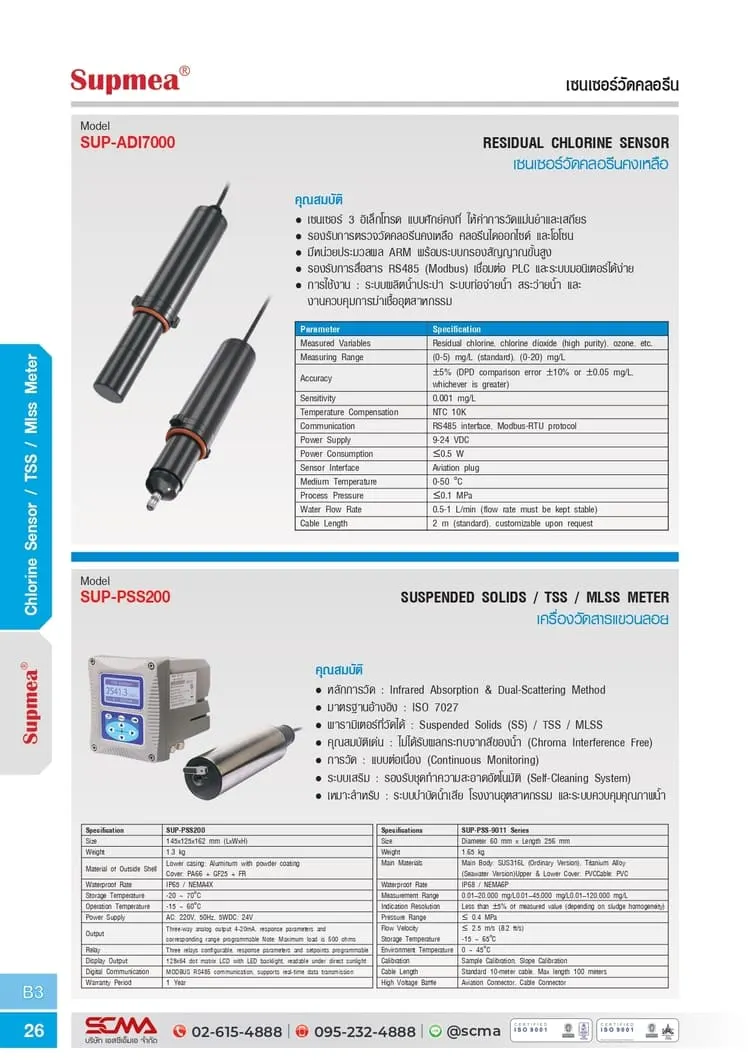
| Specifications | Details |
|---|---|
| Brand | SUPMEA |
| Model | SUP-ADI7000 |
| Product Type | Residual Chlorine Sensor |
| Measurement Principle | Three-Electrode Constant Potential Amperometric |
| Measured Variables | Residual Chlorine / High-Purity Chlorine Dioxide / Ozone (Depending on Application) |
| Standard Measuring Range | 0-5 mg/L |
| Optional Measuring Range | 0-20 mg/L |
| Accuracy | ±5% |
| DPD Comparison Error | ±10% or ±0.05 mg/L, Whichever Is Greater |
| Sensitivity | 0.001 mg/L |
| Temperature Compensation | NTC 10K |
| Signal Processing | Built-in ARM Processor and Digital Filtering |
| Communication Interface | RS485 |
| Communication Protocol | Modbus RTU |
| Power Supply | 9-24VDC |
| Power Consumption | ≤0.5W |
| Sensor Electrical Interface | Aviation Plug |
| Medium Temperature | 0-50°C |
| Process Pressure | ≤0.1 MPa |
| Required Water Flow Rate | 0.5-1 L/min (Stable Flow Required) |
| Standard Cable Length | 2 m |
| Custom Cable Length | Available on Request |
| Sensor Design | Membrane-Less Electrochemical Sensor |
| Application | Online Water Quality Monitoring |
Operation Principle of Residual Chlorine Sensor
The SUP-ADI7000 uses a three-electrode system, consisting of two platinum electrodes and one silver chloride electrode, working in conjunction with an electrochemical potential control circuit (Potentiostat) to maintain the working electrode's potential at a set value.
When the disinfectant being measured comes into contact with the electrode surface, it triggers an electrochemical reaction that generates an electric current proportional to the concentration of the substance. The internal circuitry within the sensor then processes the signal and transmits data via RS485 Modbus RTU communication system.
The sensor employs a membrane-free design which reduces maintenance related to membranes and electrolytes, but it still requires cleaning, electrode condition checking, and calibration according to manufacturer specifications.
Measurement of Residual Chlorine in Water
Residual chlorine is the chlorine remaining in water after the chlorination process and its reaction with various substances within the water. It serves as one of the parameters for monitoring the effectiveness of disinfection processes.
The measurement values obtained from an electrochemical sensor depend on the type of disinfectant, the chemical state of the water, pH level, temperature, and sample flow rate. Therefore, installation conditions should be checked and calibrated with appropriate reference methods.
For use in measuring chlorine dioxide or ozone, it is necessary to verify the sensor model, measurement range, calibration method, and suitability for target substances. It should not be assumed that residual chlorine specifications can be directly applied to all types of substances.
RS485 Modbus RTU Communication
The SUP-ADI7000 supports RS485 communication with the Modbus RTU protocol for transmitting measurement data to compatible control or monitoring devices such as PLC, HMI, Data Logger, and SCADA systems.
To establish a connection, communication device settings must be correctly configured according to the sensor manual, including parameters like Modbus Address, Baud Rate, Parity, and Register Address. Additionally, a DC power supply of 9-24V as specified is required.
The standard specification does not indicate that the sensor has an analog output of 4-20 mA if such connectivity to an analog system is needed, additional signal conversion equipment or controllers must be checked.
Flow Rate Conditions and Installation
The manufacturer specifies a sample water flow rate of 0.5-1 L/min, which needs to be maintained at a constant level to ensure stable measurements, with process pressure not exceeding 0.1 MPa.
The installation should use a Flow Cell kit or an installation set compatible with the sensor, along with a flow rate control system according to the manufacturer's specifications. Before using, check the delivered equipment list and the suitability of materials that come into contact with water.
Installation and Setup
- Check the product model and measurement range ordered as either 0-5 mg/L or 0-20 mg/L
- Ensure that the type of disinfectant to be measured matches the sensor's calibration settings
- Install the sensor in a Flow Cell kit or an installation set supported by the manufacturer
- Control the sample water flow rate within the range of 0.5-1 L/min and ensure consistency
- Check that the sample water temperature is within the range of 0-50°C
- Ensure that the process pressure does not exceed 0.1 MPa
- Connect the power supply at 9-24VDC according to the manufacturer's terminal and wiring diagram
- Connect the RS485 signal with a PLC or monitoring system supporting Modbus RTU
- Configure the Modbus Address and communication parameters as per the manual
- Calibrate or verify readings against reference methods such as DPD according to manufacturer's steps
- Inspect and clean the sensor head periodically based on water conditions
Examples and Usage Guidelines
- A residual chlorine monitoring system for a water treatment plant
- A chlorine monitoring system in a water distribution network
- A quality control system for building and backup water supply systems
- A residual chlorine measurement system for swimming pools
- A process control system for adding disinfectants to water
- An efficiency monitoring system for disinfection processes in industries
- Online water quality tracking with PLC and SCADA systems
- Data logging of chlorine concentration levels for water quality management systems
Considerations
- The standard measurement range of 0-5 mg/L and the 0-20 mg/L range must be selected to match the application requirements
- The sensor requires a consistent sample water flow rate, so the Flow Cell system should be designed appropriately
- Check the response to pH values and water composition before using in actual processes
- A comparison of measurement results with DPD method according to appropriate steps and frequency is recommended
- Sensitivity of 0.001 mg/L does not mean that the accuracy of the instrument equals 0.001 mg/L
- Support for RS485 Modbus RTU does not imply direct 4-20 mA output from the sensor
- Check compatibility of PLC, Controller and power supply equipment before connecting
Write Your Own Review
This website uses cookies
We use cookies to make the site work properly, to understand how it is used, and to show content that is relevant to you. You choose which types to allow; strictly necessary cookies are always on. Privacy Policy
🤖 AI Assistant
Ask about products, specs and replacement models
Hello 👋 Ask us anything — find products, compare specs, or troubleshoot.
🗑 Clear history