
SPECIAL PROMOTION — Up to 40% off across many product groups, until 31 December 2026 · Click to see all promotion itemsIFM, Sensor, Automation SystemMeasuring / Testing InstrumentsTemp Indicator, Control, T/C, RTD, TimerHeater, SCR Control, Solid State, Power Supply, Control CabinetField Measuring Instruments, Pressure Gauge, Level Control, Flow MeasurementEMC, Pneumatic, Solenoid ValveInspection Test Lamp, Head Light, Automotive Measuring InstrumentWeighing Scales, Marking Machine, PrintersEducational Training SystemsHot Line Tools & Equipment SPECIAL PROMOTION — Up to 40% off across many product groups, until 31 December 2026 · Click to see all promotion itemsIFM, Sensor, Automation SystemMeasuring / Testing InstrumentsTemp Indicator, Control, T/C, RTD, TimerHeater, SCR Control, Solid State, Power Supply, Control CabinetField Measuring Instruments, Pressure Gauge, Level Control, Flow MeasurementEMC, Pneumatic, Solenoid ValveInspection Test Lamp, Head Light, Automotive Measuring InstrumentWeighing Scales, Marking Machine, PrintersEducational Training SystemsHot Line Tools & Equipment View promotion items View all
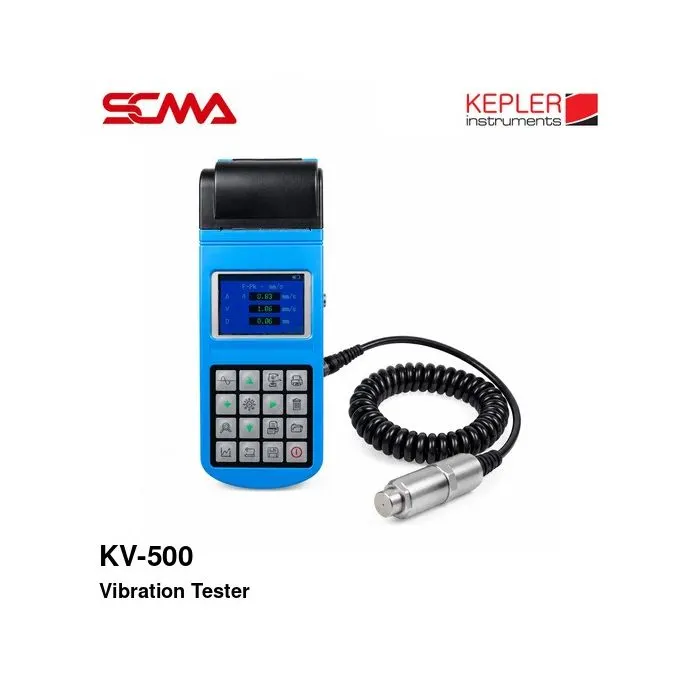
KV-500 VIBRATION TESTER KEPLER
Price on request – please contact us
Out of stock
SKU
050989
Out of stock

KV-500, KEPLER, Vibration Tester, Portable Vibration Tester, Digital Vibration Meter, Vibration Analyzer, Handheld Vibration Meter, Industrial Vibration Tester, Machinery Vibration Analyzer, Acceleration Meter, Vibration Velocity Meter, Vibration Displacement Meter, Peak Acceleration, RMS Velocity, Peak-to-Peak Displacement, Acceleration Range 0.1-205.6m/s², Velocity Range 0.1-400mm/s, Displacement Range 0.001-9.0mm, Vibration Frequency Analysis, Spectrum Analysis, Rotational Speed Measurement, 30-300000 RPM, 100 Spectrum Memory, Data Logging, TFT Color Display, USB Interface, Integrated Thermal Printer, Rechargeable Lithium Battery, Predictive Maintenance, Machine Condition Monitoring, Motor Vibration Testing, Pump Vibration Testing, Fan Vibration Testing, Rotating Machinery Monitoring, Vibration Meter, Vibration Tester, Portable Vibration Tester, Digital Vibration Analyzer, Handheld Acceleration Meter, Industrial Vibration Meter, Machinery Vibration Analyzer, Peak-to-Peak Displacement Meter, KEPLER Vibration Meter, KV-500 Vibration Meter, Predictive Maintenance Tool
*Price does not include VAT
KEPLER KV-500 Vibration Tester (Portable Vibration Tester)
KEPLER KV-500 Vibration Tester is a portable vibration measurement and analysis device for checking the operational condition of machinery, motors, pumps, fans, and rotating equipment in industrial settings. It is suitable for machine inspection work, predictive maintenance (Predictive Maintenance), and machine condition monitoring (Machine Condition Monitoring).
The unit can measure three parameters: acceleration, velocity, and displacement of vibration, displaying results as Peak Acceleration, RMS Velocity, and Peak-to-Peak Displacement to allow users to assess the condition of machinery based on inspection objectives.
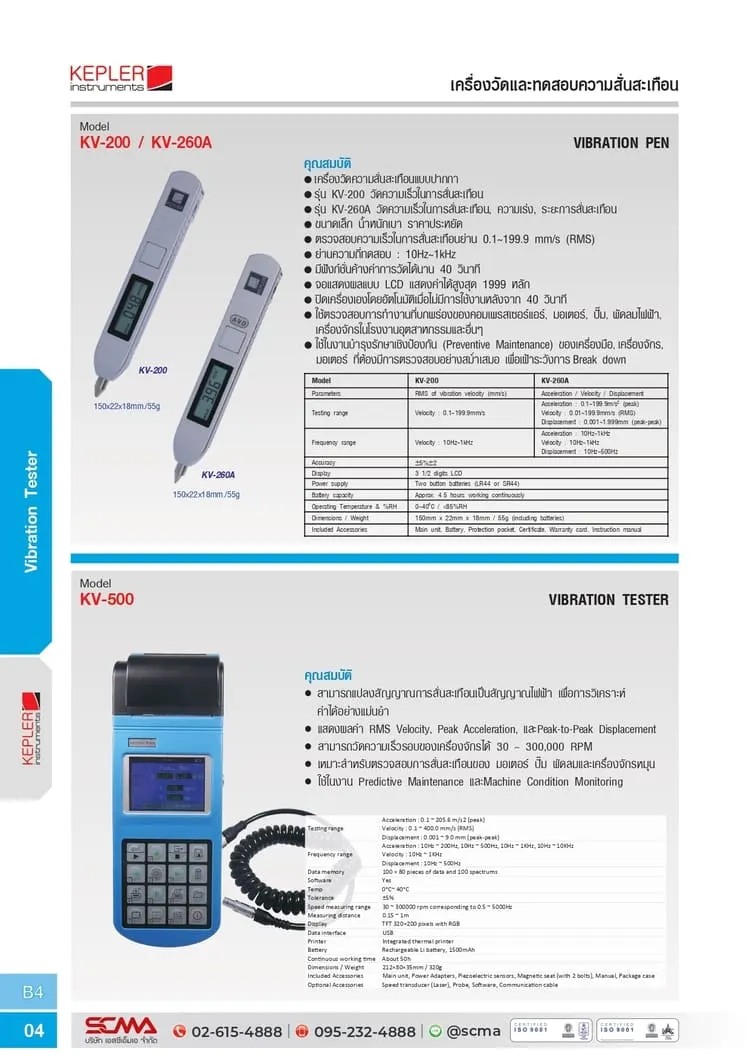
KV-500 supports measuring acceleration in a range of 0.1-205.6 m/s² (Peak), velocity vibration from 0.1-400.0 mm/s (RMS), and displacement vibration from 0.001-9.0 mm (Peak-to-Peak). The catalog data indicates an accuracy of ±5%.
The device features a color TFT screen with a resolution of 320 x 200 pixels, supporting spectrum analysis and data logging. It connects via USB interface and includes an integrated thermal printer for printing supported function data.
Furthermore, KV-500 supports measuring machine speed in the range of 30-300,000 RPM using a suitable tachometer; the catalog specifies Laser Speed Transducer as an accessory.
General Features
- Brand: KEPLER
- Model: KV-500
- Type: Portable Vibration Tester
- Makes measurements of acceleration, velocity, and displacement
- Displays Peak Acceleration, RMS Velocity, and Peak-to-Peak Displacement
- Measuring range for acceleration 0.1-205.6 m/s² (Peak)
- Measuring range for velocity 0.1-400.0 mm/s (RMS)
- Measuring range for displacement 0.001-9.0 mm (Peak-to-Peak)
- Supports multiple frequency bands for acceleration measurement, up to 10 kHz
- Supports measuring machine speed in the range of 30-300,000 RPM when using a suitable tachometer
- Includes Spectrum Analysis function for analyzing vibration frequency components
- Saves measured data and spectrum graphs
Technical Specifications
| Specifications | Details |
|---|---|
| Brand | KEPLER |
| Model | KV-500 |
| Product Type | Portable Vibration Tester |
| Measurement Parameters | Acceleration / Velocity / Displacement |
| Acceleration Measuring Range | 0.1-205.6 m/s2 (Peak) |
| Velocity Measuring Range | 0.1-400.0 mm/s (RMS) |
| Displacement Measuring Range | 0.001-9.0 mm (Peak-to-Peak) |
| Acceleration Frequency Range 1 | 10-200 Hz |
| Acceleration Frequency Range 2 | 10-500 Hz |
| Acceleration Frequency Range 3 | 10 Hz-1 kHz |
| Acceleration Frequency Range 4 | 10 Hz-10 kHz |
| Velocity Frequency Range | 10 Hz-1 kHz |
| Displacement Frequency Range | 10-500 Hz |
| Measurement Tolerance | ±5% |
| Rotational Speed Measuring Range | 30-300000 RPM (With Suitable Speed Transducer) |
| Rotational Frequency Range | 0.5-5000 Hz |
| Rotational Speed Measuring Distance | 0.15-1 m (With Applicable Speed Transducer) |
| Data Memory | 100 x 80 Data Records (Catalog Description) |
| Spectrum Memory | 100 Spectrums |
| Spectrum Analysis | Supported |
| Display | TFT Color Display |
| Display Resolution | 320 x 200 Pixels |
| Data Interface | USB |
| Printer | Integrated Thermal Printer |
| Battery | Rechargeable Lithium Battery |
| Battery Capacity | 1500 mAh |
| Continuous Working Time | Approximately 50 Hours (Catalog Rating) |
| Operating Temperature | 0-40°C |
| Dimensions | 212 x 80 x 35 mm |
| Weight | Approximately 320 g |
Vibration Measurement Functions
1. Acceleration Measurement
Mechanical vibration acceleration measurement in units of m/s², displaying peak acceleration with a measuring range of 0.1-205.6 m/s², supporting frequency band selection of 10-200 Hz, 10-500 Hz, 10 Hz-1 kHz, and 10 Hz-10 kHz.
The vibration acceleration value is suitable for assessing changes in machine condition and high-frequency vibration component inspection within the measurement range.
2. Velocity Measurement
Mechanical vibration velocity measurement in units of mm/s, displaying RMS velocity with a measuring range of 0.1-400.0 mm/s and frequency band of 10 Hz-1 kHz, suitable for assessing the overall vibration level of rotating machinery.
Consistent tracking of RMS velocity allows comparison of machine trend changes under similar operating conditions.
3. Displacement Measurement
Vibration displacement measurement in units of mm, displaying peak-to-peak displacement with a measuring range of 0.001-9.0 mm and frequency band of 10-500 Hz, used for evaluating the movement characteristics of machinery or structures caused by vibration.
Spectrum Analysis System (Vibration Spectrum Analysis)
The KV-500 supports frequency spectrum analysis of vibration signals to help inspectors study the distribution of vibration energy across frequencies supported by the device.
Spectrum analysis can be used in conjunction with machine diagnostics, such as identifying unbalanced rotating parts (Unbalance), misaligned drive systems (Misalignment), and other mechanical abnormalities. However, diagnosing causes requires additional information like rotational speed, installation conditions, and machinery operation history.
Vibration Measurement Speed Function
The device supports measuring rotational speeds in the range of 30-300,000 RPM or frequencies from 0.5 to 5,000 Hz. The catalog specifies a measurement distance of 0.15-1 meters for suitable speed detection systems.
Measuring RPM requires using compatible Speed Transducers as specified by the manufacturer. A Laser Speed Transducer is listed in the accessory catalog.
Data Logging and Printing System
The device has memory to store measurement data and Spectrum graphs, with the catalog specifying a capacity of 100 x 80 entries and 100 Spectrums to support logging machine inspection data and tracking vibration trends.
An integrated Thermal Printer is included, along with a USB port for data connection. Compatibility must be verified when using external software and communication devices, including accessory kits shipped with the product set.
Usage for Machinery Maintenance
- Inspect electrical motor vibrations
- Measure pump and drive system vibrations
- Check industrial fan vibrations
- Measure air compressor vibrations
- Use to monitor rotating machinery condition
- Record vibration values for trend comparison over time
- Analyze Spectrum to support machine fault detection
- Used in Preventive Maintenance and Predictive Maintenance tasks
Preparation Guidelines and Measurement Procedures
- Check the device, sensor head, and cable condition before use
- Verify battery level and display system readiness
- Select Acceleration, Velocity or Displacement mode according to inspection objectives
- Select an appropriate frequency range based on machinery characteristics
Standard Accessories (Included Accessories)
- Vibration Measurement & Testing Device KEPLER KV-500
- Power Adapter
- Piezoelectric Sensor
- Magnetic Seat with two screws
- User Manual
- Accessory Package Case
Optional Accessories (Optional Accessories)
- Laser Speed Transducer
- Probe
- Software
- Communication Cable
Prior Considerations Before Use
- Select measurement parameters and frequency range appropriately for the type of abnormality to be checked
- Vibration speed measurements require checking the Speed Transducer set and compatible accessories
- The presence of Spectrum Analysis function does not mean that the device can automatically diagnose all machine damage cases
- Use consistent sensor mounting positions and measurement directions for trend comparisons
- Magnetic base use must consider safety and surface adhesion strength on machinery surfaces
- Avoid bringing hands or probes near rotating parts without protective devices
- Vibration values should be evaluated in conjunction with operating conditions and appropriate machine standards
- Check calibration and readiness of equipment before using it for important inspections
- Software and communication cables may be sold separately as optional accessories
- Verify the actual accessory list and warranty details before ordering
Write Your Own Review
This website uses cookies
We use cookies to make the site work properly, to understand how it is used, and to show content that is relevant to you. You choose which types to allow; strictly necessary cookies are always on. Privacy Policy
🤖 AI Assistant
Ask about products, specs and replacement models
Hello 👋 Ask us anything — find products, compare specs, or troubleshoot.
🗑 Clear history