
SPECIAL PROMOTION — Up to 40% off across many product groups, until 31 December 2026 · Click to see all promotion itemsIFM, Sensor, Automation SystemMeasuring / Testing InstrumentsTemp Indicator, Control, T/C, RTD, TimerHeater, SCR Control, Solid State, Power Supply, Control CabinetField Measuring Instruments, Pressure Gauge, Level Control, Flow MeasurementEMC, Pneumatic, Solenoid ValveInspection Test Lamp, Head Light, Automotive Measuring InstrumentWeighing Scales, Marking Machine, PrintersEducational Training SystemsHot Line Tools & Equipment SPECIAL PROMOTION — Up to 40% off across many product groups, until 31 December 2026 · Click to see all promotion itemsIFM, Sensor, Automation SystemMeasuring / Testing InstrumentsTemp Indicator, Control, T/C, RTD, TimerHeater, SCR Control, Solid State, Power Supply, Control CabinetField Measuring Instruments, Pressure Gauge, Level Control, Flow MeasurementEMC, Pneumatic, Solenoid ValveInspection Test Lamp, Head Light, Automotive Measuring InstrumentWeighing Scales, Marking Machine, PrintersEducational Training SystemsHot Line Tools & Equipment View promotion items View all
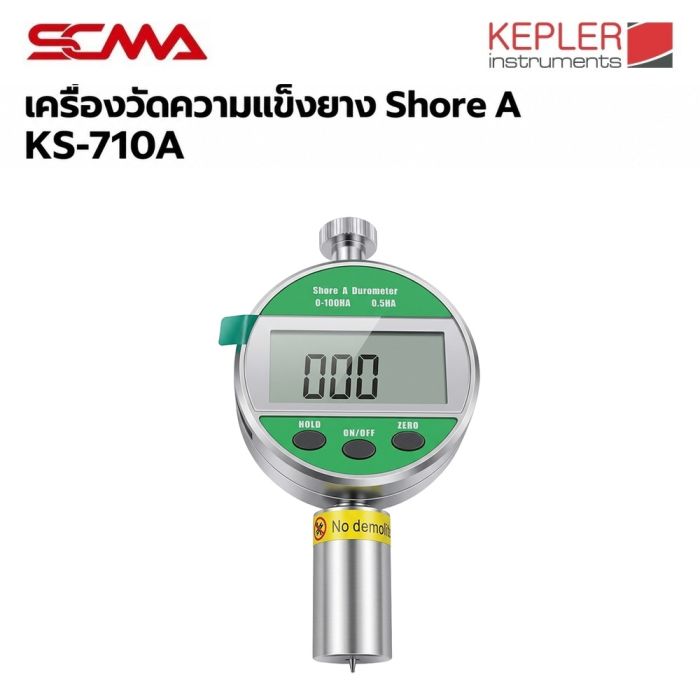
KS-710A SHORE A HARDNESS TESTER KEPLER
Special Price THB 2,025.00 Regular Price THB 2,700.00
In stock
SKU
041501
In stock: 4 pcs
Delivery within: 29/11/2026
🚚 Free delivery on orders of THB 2,500 or more! (standard delivery fee THB 100)

KS-710A, KEPLER, SHORE A HARDNESS TESTER, Rubber Hardness Tester, Shore A Durometer Test Instrument, Shore A Durometer, Soft Rubber Hardness Tester, Synthetic Rubber, O-Ring Rubber, Data Hold
*Price does not include VAT
KS-710A KEPLER Shore A Hardness Tester for Rubber
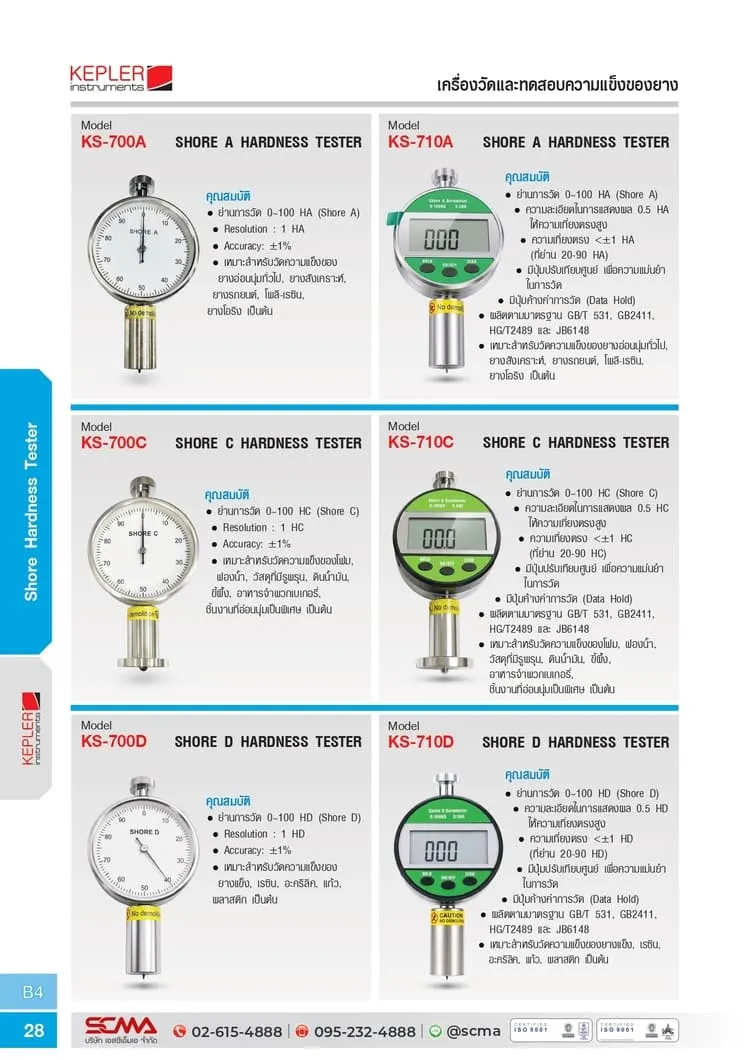
The KS-710A from KEPLER is a Shore A hardness tester designed for general soft rubber, synthetic rubber, automotive tires, polyresin, and O-rings. It supports measurement ranges of 0–100 HA with an accuracy of 0.5 HA. The device features zero adjustment buttons and Data Hold function to hold the measured value. Ideal for quality control and inspection work on rubber products.
Features
- Measures hardness according to Shore A scale from 0–100 HA
- Accuracy of 0.5 HA
- Catalog accuracy <±1 HA in the range of 20–90 HA
- Zero adjustment button included
- Data Hold function for holding measured values
- Made according to standards GB/T 531, GB2411, HG/T2489 and JB6148 as specified in the catalog
Technical Data
- Model: KS-710A
- Brand: KEPLER
- Type of Instrument: Shore A Hardness Tester
- Scales: Shore A (HA)
- Measurement Range: 0–100 HA
- Accuracy: 0.5 HA
- Precision: <±1 HA in the range of 20–90 HA
- Functions: Zero adjustment and Data Hold for holding measured values
Usage
- Measures hardness of general soft rubber and synthetic rubber
- Checks hardness of automotive tires and O-rings
- Meters polyresin suitable for Shore A scale testing
- Used in quality control and inspection work on rubber products
Write Your Own Review
This website uses cookies
We use cookies to make the site work properly, to understand how it is used, and to show content that is relevant to you. You choose which types to allow; strictly necessary cookies are always on. Privacy Policy
🤖 AI Assistant
Ask about products, specs and replacement models
Hello 👋 Ask us anything — find products, compare specs, or troubleshoot.
🗑 Clear history