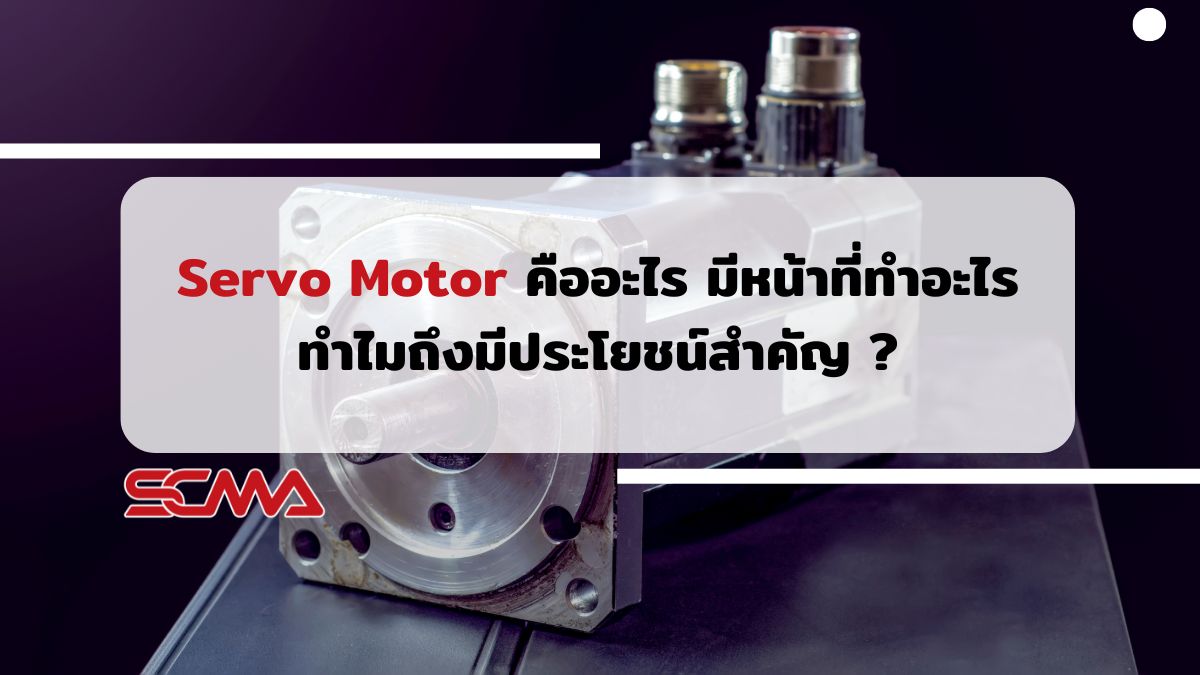
Currently, the Servo Motor has become a crucial component in the automation industry. It can precisely control the operation of machinery and systems, quickly responding to commands for speed, torque, or rotational position.SCMA, experts in Servo Motor systems, are ready to provide knowledge and recommend suitable solutions for your industrial needs.
What is a Servo Motor?

A Servo Motor, or servo motor, is an electric actuator that can precisely control movement using a feedback control system. This allows for detailed and rapid control of the motor's speed, torque, and rotational position. Therefore, Servo Motors are ideal for high-precision applications such as industrial robots, automated machinery, and various control systems.
How Does a Servo Motor Work?
The operation of a servo motor is similar to that of a synchronous motor. When electrical current is supplied to the stator windings, it generates a rotating magnetic field which pulls the permanent magnet rotor along with it. However, the standout feature of Servo Motors is the installation of an encoder or position sensor, which continuously sends feedback signals to the Servo Driver to adjust the motor's operation for precise control as required.
What is the Function of a Servo Motor?

The primary function of a Servo Motor is to drive equipment or machinery according to received commands, capable of precisely controlling speed, torque, and position. It works in conjunction with a Servo Drive that issues commands and adjusts various parameters of the motor, including receiving feedback signals from an internal encoder to ensure precise movement as required.
Applications of Servo Motors
Due to their ability to control motion with precision, Servo Motors are widely used in various industries such as:
- Manufacturing Industry - Used in CNC machines, robots, conveyor systems for accurate and fast production
- Automotive Industry - Used in drive systems, steering wheels, suspension systems to enhance driving performance
- Printing Industry - Used in digital printers, paper feed systems for printing accuracy
- Packaging Industry - Used in packaging machines, sealing machines, labeling machines to increase packaging efficiency
- Medical Industry - Used in surgical robots, dental equipment, medical tools for treatment accuracy
Types of Servo Motor
Servo Motors come in two main types:
1. Brushed DC Servo Motor
This is a Direct Current (DC) motor that uses brushes to switch the polarity of the armature magnets, allowing the motor to rotate continuously. It is commonly used in applications where high speed is not required but high torque is needed. However, this type of motor has drawbacks such as brush wear, requiring frequent maintenance and potentially causing sparks from the brushes, making it unsuitable for use in environments with flammable substances.
2. Brushless Servo Motor
This is a servo motor that does not use brushes and thus has greater durability and longer lifespan. It can be divided into three types:
- Synchronous AC Servo Motors which use permanent magnets as the rotor, offering high efficiency across a wide range of speeds but are more expensive compared to Induction.
- Induction Servo Motors which use the principle of induction through coils in the rotor.
- Stepping Servo Motor Drives which use pulse timing to supply power to the coils, creating a rotating magnetic field.
Why You Should Use a Servo Motor

Using a Servo Motor has several advantages, including:
- Ability to control speed, torque, and position accurately and quickly
- Smooth and continuous movement suitable for high-precision work such as CNC part cutting, electronic component assembly, automatic material handling systems, etc.
- High power and torque with immediate response to signals
- High efficiency and low energy loss, saving electricity costs in the long term
- Long service life, especially brushless models that have no wear parts
Therefore, it is suitable for high-efficiency and precision work in industries.
If you are interested in Servo Motors, you can purchase them from SCMA today!
SCMA is a service provider of leading servo motor system solutions. We offer various models from quality brands, along with a team of expert engineers ready to consult and recommend the best approach for your business, including full automation system design and installation services. Additionally, we provide training and after-sales support to ensure that your Servo Motors Drives operate at peak efficiency throughout their service life.
Summary
A servo motor is a critical driving device in today's automation industry, capable of precise and rapid control over movement. It meets the needs of high-precision work. If you are looking for a servo motor system solution or want to know what a servo motor is, SCMA is ready to provide consultation to design a system that meets your requirements. Contact us today for more information.
Frequently Asked Questions
What are the differences between DC Motor and Servo Motor?
A DC Motor is a standard motor that uses direct current, while a Servo Motor adds sensors to detect position and speed, making it more precise for high-precision work.
What is the role of a servo motor?
The main function of Servo Motor is to drive machinery or equipment according to commands, working with a servo driver to control speed, torque, and rotation position accurately.
How many degrees can a servo motor rotate?
Most Servo Motors can rotate up to 360 degrees or continuously without limit. They have encoders that detect the rotation position and send feedback signals, allowing for precise control over rotation.
How does a servo motor control its position?
A servo motor includes an encoder installed on the motor shaft to detect the rotation position and sends feedback signals to the Servo Drive, which compares this data with commands received from the controller. The drive then adjusts the motor's operation to rotate accurately to the desired position using techniques such as PID (Proportional-Integral-Derivative) tuning for system responsiveness, making servo motors/drives capable of rapid and accurate positioning control.