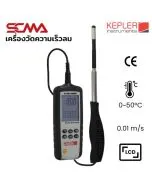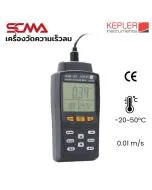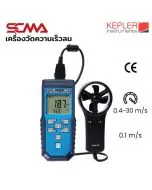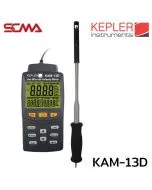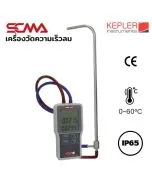

Anemometers are essential tools in various industries such as maritime, HVAC systems, wind energy, and construction. We need accurate data about the speed and direction of wind.SCMA recognizes the necessity for using Anemometers, thus offering high-quality and diverse products along with expert consultation to ensure maximum benefit for customers.
Anemometers (Anemometer) are what?

Anemometers or Anemometer are devices used to measure wind speed and air flow. They are crucial in various industries. Anemometers provide quantitative data on wind speed, air flow rate, and some models can also specify wind direction. This tool is useful for measuring wind conditions both indoors and outdoors.
How Anemometers Work (Anemometer)
The working principle of Digital Anemometers depends on the type of device, but generally relies on detecting air movement and converting it into wind speed values. Most anemometers consist of moving parts such as blades, rotating shafts, or hot wires. When wind blows through them, these components move, and this movement is converted into wind speed.
Benefits of Anemometers

Anemometers have numerous benefits, including structural safety checks, wind impact studies, weather forecasting, engineering work, and HVAC systems. Wind speed, flow rate, and direction data measured by an Anemometer are crucial factors in decision-making and planning for these tasks. Additionally, Anemometers are used in the wind energy industry to assess wind turbine potential.
Types of Anemometers
The term "Anemometer" refers to different types based on their operational characteristics, which can be broadly categorized as follows:
1. Cup Type Anemometer
This type of anemometer consists of half-circle cups attached to a rotating shaft. When wind blows through, it causes the cups and shaft to rotate; the rotational speed of the shaft is proportional to the wind speed. This is one of the most common types, offering durability and sufficient accuracy for general use.
2. Propeller Type Anemometer
Unlike the cup type, this uses propeller-like blades attached to a freely rotating shaft. When wind blows through, the blades rotate and align with the direction of the wind; the rate of rotation indicates wind speed while the position of the blade shows wind direction. Propeller anemometers are commonly used in meteorology, sailing, and aviation.
3. Hotwire Anemometer
Hotwire anemometers work on the principle of heat transfer; they have a thin wire heated by electricity in the air stream. As wind flows through, it carries away heat from the wire, causing the wire to cool and its electrical resistance to change. The device calculates wind speed based on this change. Its advantages include quick response, wide measurement range, and high accuracy, making it suitable for research requiring precision.
The Importance and Applications of Anemometers

Digital anemometers are crucial in various fields, including weather forecasting which relies on wind speed and direction data for analysis and prediction of weather conditions; assessing wind energy potential to plan turbine installations and electricity generation; monitoring air quality by tracking pollution through airflow patterns; and designing buildings and structures that require wind speed data for force calculations. Anemometers are also used in checking and improving the efficiency of HVAC systems.
If you are interested in Anemometers, SCMA is now available for purchase!
SCMA Company is the distributor of high-quality Anemometers from leading brands. We offer a variety of Anemometer models and types, ranging from basic to high-end multifunctional units. Our team of expert engineers is available for advice and consultation. We also provide after-sales service, including calibration to maintain accuracy. If you needhigh-quality wind speed and air flow measurement tools, think of SCMA first.
Summary
Anemometers are important measuring instruments for wind speed and air flow. They provide accurate data that is useful in various industries and applications, whether it's safety, efficiency, or even comfort. Therefore, Anemometers are essential and highly beneficial equipment. If you are looking for high-quality Anemometers, SCMA is ready to provide advice and supply products that meet your needs.
Frequently Asked Questions
What is the function of a wind speed meter?
Wind speed meters, or Anemometers are used to measure wind speed and air flow rate, as well as wind direction. This data is useful for weather forecasting, assessing wind force for safety purposes, studying air flow patterns for ventilation system planning, locating wind turbine installation sites, etc.
What units do wind speed meters use?
The standard unit for wind speed is meters per second (m/s), which is a metric system (SI) unit. Other units used include kilometers per hour (km/h), miles per hour (mph), knots, and feet per minute (ft/min). One m/s equals 3.6 km/h or 196.85 ft/min.
What is a wind speed meter?
"Wind speed meter" is another name for an Anemometer, which is a tool used to measure wind speed. The word "Anemometer" comes from the Greek word "anemos," meaning wind, and "meter," meaning measuring instrument. Combined, it literally translates to "wind measurer" or simply "wind meter."
What does an Anemometer measure?
An Anemometer measures wind speed, typically in units of m/s. Some models also measure air flow rate in CFM (cubic feet per minute) or CMM (cubic meters per minute). Additionally, certain types of Anemometers, such as vane anemometers, can indicate the direction of the wind.