Vacuum pumps are crucial for driving automation systems. Low pressure issues can cause gripping devices to malfunction. Choosing a vacuum pump that is durable and provides stable suction helps prevent errors. SCMA has an engineering team that checks the specifications of vacuum ovens before ordering them online at SCMA's website. This prevents mistakes and ensures quick delivery to your factory.
What is a vacuum pump? Why do plant engineers need to pay attention?
Many engineers ask, "What is a vacuum pump?" This equipment functions by removing air from a closed system to create negative pressure. Vacuum pumps meet the high-precision requirements of automation tasks. The primary role of a vacuum pump is to provide suction for pick-and-place units, remove air bubbles from resin, and maintain the stability of vacuum pumps. Ensuring the reliability of vacuum pumps clearly reduces waste in production lines.
In-depth look at vacuum pumps: Engineering principles of operation
Understanding the engineering principles of vacuum pump operation starts with the volume displacement mechanism. The rotor inside continuously sweeps air out of the pump chamber to reduce pressure. Engineers must analyze the relationship between flow rate (liters per minute) and ultimate vacuum. Correctly calculating the specifications of vacuum pumps helps match them accurately with cylinder sizes. A vacuum suction device that has a flow rate proportional to its suction pad prevents workpieces from falling during operation.
Types of Vacuum Pumps and Selecting the Right Specifications
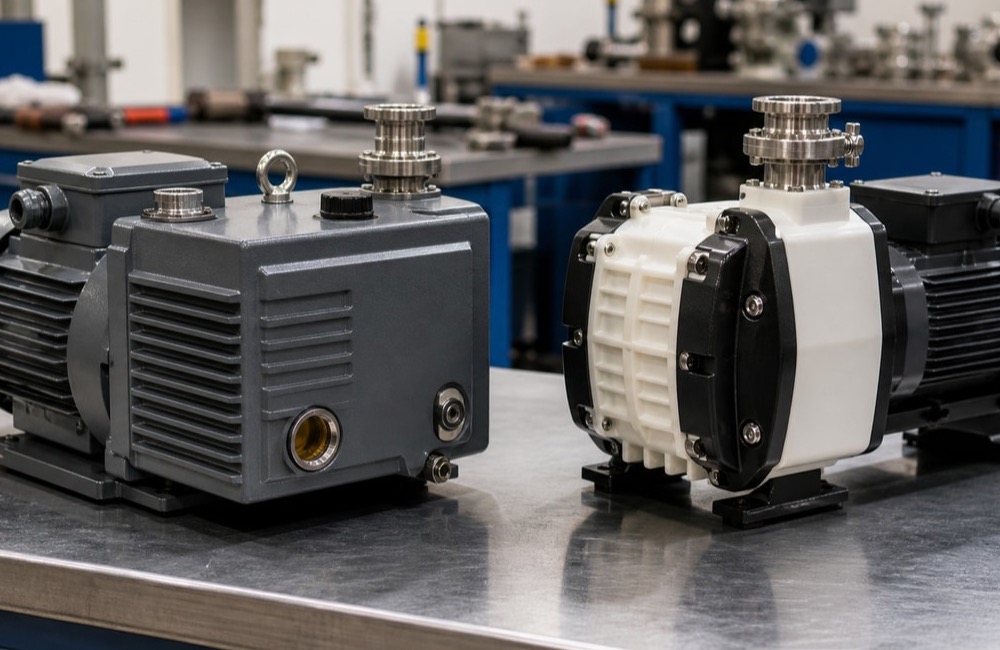
Incorrect selection of vacuum pumps can result in machinery not operating at full efficiency. Engineers can categorize based on the working structure to select specifications that complete tasks as follows:
Oil-lubricated Rotary Vane Pump
This pump type relies on lubricating oil to seal gaps between the rotor and housing vacuum pumps. Oil-lubricated vacuum pumps can achieve very deep pressure, meeting the needs of heavy-duty work that requires continuous operation for 24 hours. Maintenance staff must regularly check oil levels to prevent blade wear.
Dry Pump / Oil-free Vacuum Pump
The internal mechanism is designed to operate without lubricating oil. Oil-free vacuum pumps help reduce contamination issues with vapor in the production line. The unit is suitable for use in cleanrooms, food industry, and high-precision electronic assembly work.
Protective Accessories: Vacuum Filters and Suction Cups
A complete circuit must have protective equipment installed alongside vacuum pumps. Terminal components such as suction cups also need proper care.
- The vacuum filter serves to capture dust and debris before they are sucked into the pump chamber.
- Installing a dust filter helps prevent bearing failure or motor burnout due to blade friction.
- The terminal side must select materials for suction cups that suit the working conditions.
- NBR rubber suction pads resistant to oil, silicone suction pads resistant to high heat, help maintain consistent suction levels.
Application of Vacuum Pumps with Vacuum Ovens
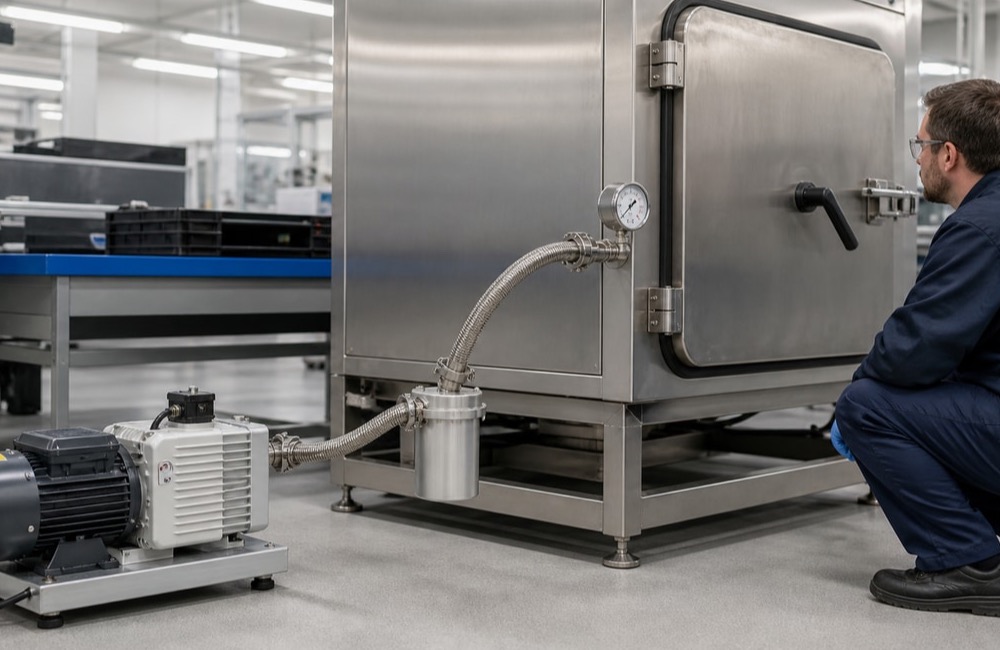
The semiconductor industry is extremely strict about high humidity levels. Connecting a vacuum pump with an oven helps address this issue directly.
- A vacuum oven requires tremendous suction power to create a vacuum inside the chamber.
- The system will draw out moisture and air from electronic components at specified temperatures.
- This process allows resin adhesives to cure better without trapped air bubbles.
- Reduces the risk of moisture accumulation on circuit boards, which is one of the main causes of short circuits.
Main Causes for Vacuum Pump Weakness and Solutions
Falling suction power is a classic problem that can halt production lines. On-site technicians should check vacuum pumps at various risk points as follows:
Leakage at Fitting Connections (Fittings Leakage)
Vibration from machinery operation loosens the screw connections, causing rubber seals to deteriorate and allowing outside air to seep in. Technicians must check all connection points of vacuum pumps to tighten them securely.
Clogged Filters Causing Reduced Flow Rate
A dusty environment will cause the vacuum filter to clog faster than usual, making it difficult for air to flow through and reducing suction capacity. Cleaning filters according to maintenance schedules helps restore system efficiency immediately.
Deteriorated Lubricating Oil with Contaminants
Moisture drawn in will condense and mix with the lubricating oil inside the pump, turning it cloudy white and losing its sealing properties. Engineers must drain vacuum pump oil and refill it with specific grade oil to restore suction power.
Preventive Maintenance Standards Reduce Downtime Issues
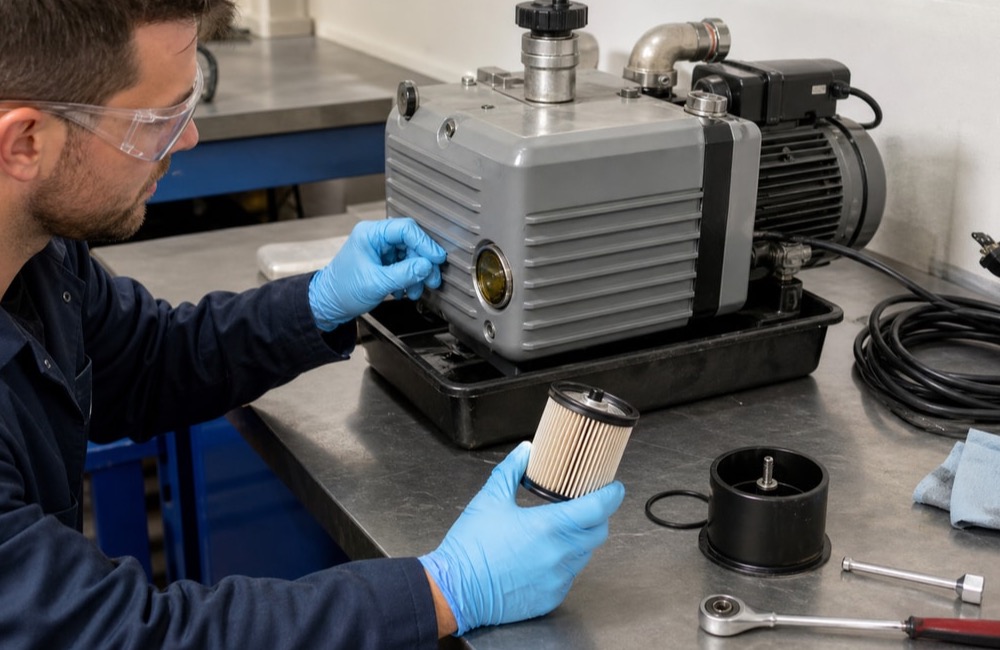
A preventive maintenance plan helps reduce emergency repair costs for vacuum pumps. The maintenance department must clearly define work schedules.
- Check the level and condition of lubricating oil in the vacuum pump weekly.
- Clean dust filters, replace worn parts according to hours of operation.
- Measure blade clearance (Clearance) to assess internal wear.
- Record motor current values to monitor abnormalities before equipment failure occurs.
Summary
Selecting the right vacuum pump specifications enhances system accuracy in Automation. Understanding the vacuum pump working principles helps maintenance teams address suction drop issues precisely. SCMA is ready to provide free online consultation for spare part comparisons and quick delivery of vacuum pumps.
If you want to buy, SCMA is available today!
SCMA offers a strong point in100% online service. Customers only need to send photos of the Drawing or Nameplate of their existing equipment via Line OA. Our engineering team will calculate specifications for vacuum pumps and compare models immediately, eliminating the wait time for technicians to visit on-site. Order a vacuum pump, and it will be delivered quickly nationwide.
Frequently Asked Questions (FAQ) About Vacuum Systems
Q1: What is a vacuum pump? How does it differ from an air compressor?
An air compressor works to compress air to have higher pressure than atmospheric pressure. A vacuum pump is what? It's a device that sucks out air to create negative pressure (Low Pressure). Technicians use it for picking up workpieces in closed systems.
Q2: What symptoms indicate the need to urgently change a vacuum filter?
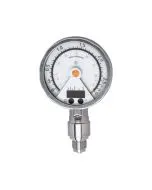
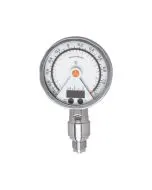
Note from the pressure gauge of a vacuum pump, if the vacuum value drops below standard, the motor works harder, and there's a whistling sound around the filter housing. You must remove the vacuum filter for cleaning or replacement immediately.
Q3: How to address vapor coming out while operating an oil-lubricated vacuum pump?
Vapor occurs when running a vacuum pump at atmospheric pressure levels for too long. You need to install an oil mist separator on the exhaust pipe, filtering out oil droplets from dispersing in the area of the vacuum cleaner.
Q4: Which type of vacuum pump should be used with a vacuum oven?
You need to evaluate based on chamber volume and Ultimate Vacuum level. Send specifications of your vacuum oven to the SCMA engineering team for evaluation through our online system, we calculate the most suitable model of vacuum pump free of charge.
Q5: How can I be confident about specifications when buying a vacuum pump online from SCMA without an on-site team?
We have dedicated engineering teams for our online channels. Customers just need to take pictures of the nameplate, and our staff will cross-check technical specifications of vacuum pumps accurately 100%, ready to deliver vacuum pumps nationwide quickly.