
In the modern industrial world, efficiently controlling the operation of electric motors is crucial. Soft Start Motor plays a vital role in enhancing the smoothness of motor startup, reducing wear and tear on components, and extending the lifespan of equipment. This technology has revolutionized the industry entirely. SCMA Company, an expert in motor control systems, wishes to provide in-depth information about Soft Start to help everyone understand its benefits and importance before deciding to use it in your system.
What is a Soft Start Motor?
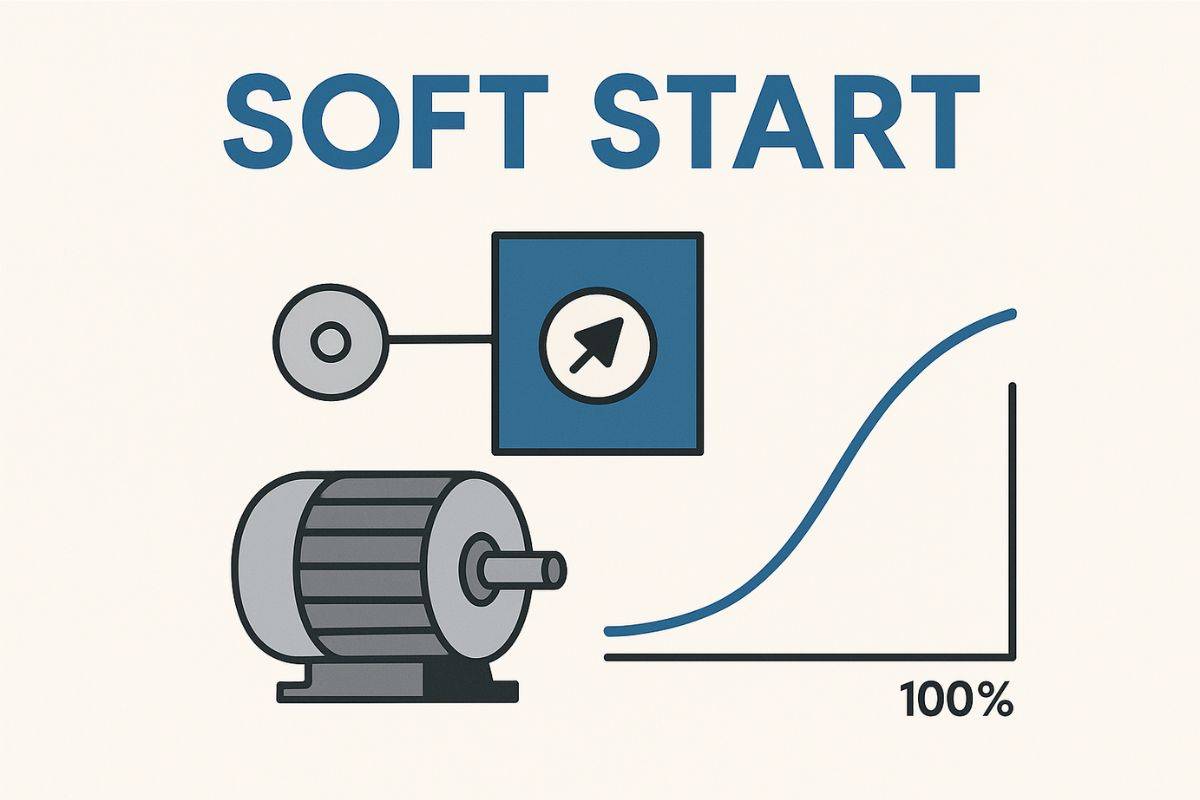
A Soft Start Motor is an equipment that controls the startup of electric motors by gradually increasing voltage to the stator windings, allowing the motor to smoothly accelerate from zero speed to rated speed. Unlike Direct Online (DOL) starting which immediately applies full voltage causing a sudden torque surge, using a Soft Start reduces mechanical wear and tear, minimizes inrush current, prevents power dips, and effectively extends motor life.
How Does a Soft Start Motor Work?
The principle of operation for a Soft Start Motor involves controlling the voltage supplied to the stator windings using an SCR or thyristor phase-controlled circuit. This adjusts the firing angle in each cycle of the current, resulting in an output voltage that gradually increases over time from zero volts to full rated voltage. Users can set Initial Voltage, Ramp-Up Time, and Current Limit according to load requirements. Once the motor reaches full speed, a parallel bypass circuit is engaged to reduce losses through the thyristor.
Benefits of Soft Start for Motor Systems
Using a Soft Start in motor control systems provides numerous benefits for both the motor itself and the overall electrical system, including extending lifespan, reducing maintenance costs, improving efficiency, and enhancing system stability.
-
Adjusts initial torque to match the load, preventing mechanical damage such as belt wear, gear failure, and shaft breakage.
-
Reduces starting current surge by up to 30-75%, avoiding voltage drops in the system.
-
Includes built-in protection systems such as Overload, Phase Loss, Underload, and Stall.
-
Easy to set various parameters to suit specific usage conditions.
-
Saves energy, reduces heat loss, and increases motor efficiency.
What are the Advantages of Soft Start Motors?
In addition to reducing mechanical and electrical starting surges, Soft Start Motors offer several advantages that make them a top choice for modern motor control systems, especially when compared to traditional starting methods.
The benefits of Soft Start include:
-
Reduces long-term costs including electricity bills, maintenance expenses, and spare parts.
-
Easy to install, less complicated than Star Delta Starters, and requires less space.
-
Includes status monitoring and alert systems through Communication Port.
-
Built-in bypass relay, no losses when operating at maximum speed.
-
Independent parameter tuning according to load conditions, increasing operational flexibility.
Why Install a Soft Start Motor?
In the past, starting motors with DOL (Direct On Line) or Star Delta methods might have been sufficient for general use. However, in today's highly competitive industrial sector, every organization needs to increase production efficiency while reducing long-term costs. A Soft Start Motor is a necessary device that helps achieve these goals comprehensively.
The main reasons to use a Soft Start are:
-
Reduce the impact on the electrical system, preventing voltage drops or flickering when starting motors
-
Prevent mechanical system damage, extending the lifespan of machinery and components
-
Easy to adjust parameters to suit load characteristics and environmental conditions
-
Increase motor performance efficiency, save energy, and reduce heat losses
-
Maintain product quality in production lines due to smooth starting and stopping
What is a Star Delta Soft Start Motor?
In addition to using Solid State Soft Start Motors, some systems may prefer the Star Delta motor start method by changing the stator winding connection from Star (which provides 1/√3 of line voltage) to Delta (which provides full line voltage) through a set of contactors. However, this Star Delta method has several limitations such as being applicable only to certain types of motors, the change from Star to Delta is relatively abrupt, and new wiring at the motor is required. Therefore, it is not commonly used nowadays, with most opting for Soft Start instead.
What are the Differences Between an Inverter and a Soft Start Motor?
Often, there is a comparison made between the use of an inverter and a soft start motor for controlling motors. Both devices have features to reduce surge current and increase smoothness during startup; however, their actual working principles and usage characteristics are quite different.
Inverter
An Inverter or VFD (Variable Frequency Drive) is a device that controls the speed of an AC motor by continuously adjusting the frequency and voltage supplied to the stator windings, allowing the motor to operate at various speeds as required. It is suitable for applications requiring precise speed control such as pumps, fans, conveyor belts; however, it is more expensive than a Soft Start.
Soft Start Motor
A Soft Start Motor controls voltage specifically during the motor startup phase to reduce surge and initial current draw. Once the motor reaches its rated speed, the soft start has no further effect on operation. It is suitable for applications that do not require speed adjustment such as water pumps, compressors, or jobs with frequent startups; it is cheaper than an Inverter.
How to Choose the Right Soft Start Motor?
Choosing a Soft Start Motor that suits your system requires considering several factors together, including motor rating size, load characteristics, installation environment, and desired functionality. This ensures you get equipment that truly meets your needs and is cost-effective in the long run.
Key factors to consider include:
-
The type of load being driven, whether it's constant torque or variable torque
-
Motor power and voltage size to select a Soft Start with the appropriate rating
-
Environmental conditions such as temperature, humidity, chemicals, and vibration to choose an appropriate model
-
Number of starts per hour; if more than 10, a larger size is recommended
-
Communication capability with the main control system such as PLC via Modbus, Profibus
-
Protection systems and required functions such as Overload, Stall, Undervoltage, Phase Loss
Looking to Buy a Soft Start Motor? SCMA is Ready to Serve You Today!
If you're looking for high-quality Soft Start Motors along with consultation services from our expert engineering team at SCMA, we have over 10 years of experience in the motor control and automation industry. SCMA is ready to advise you every step of the way, from analyzing your needs, selecting appropriate equipment, installation, to maintenance, ensuring that your system operates efficiently and reliably in the long term.
Summary
Soft Start Motor is a crucial component in enhancing the efficiency of modern motor control systems, helping to increase smoothness during motor startup and shutdown, reduce mechanical and electrical damage, and extend the lifespan of various equipment within the system. In addition to numerous benefits, choosing Soft Start is also a worthwhile investment for every industry. If you are interested in applying Soft Start Motor circuits, you can contact SCMA's professional team for consultation today, simply by clicking or calling us. We are ready to be part of your business success and growth sustainably.
Frequently Asked Questions
What is a Soft Start Motor?
A Soft Start Motor is an AC motor that comes with a built-in Soft Start device from the factory, allowing it to start smoothly without requiring any additional external equipment. It is typically used for smaller motors and specific applications such as certain types of electrical appliances.
What are the differences between VSD and Soft Start?
VSD (Variable Speed Drive) and Soft Start are motor control devices with different purposes. VSD focuses on continuously adjusting the motor speed according to load requirements, while Soft Start controls voltage only during startup to reduce inrush current and torque.
The main differences include:
-
VSD: Controls speed throughout all stages, higher cost, suitable for loads requiring variable speeds
-
Soft Start: Controls only during startup, lower cost, suitable for loads not requiring variable speeds
How does a Soft Start work?
A Soft Start works by controlling the voltage supplied to the motor's stator windings through the switching of semiconductor devices such as SCRs or thyristors at specific angles over time. This gradually increases the voltage from zero to the set value smoothly, reducing inrush current and torque during startup.
How many types of Motor Start are there?
Starting an AC motor can be categorized into three main types based on how voltage is supplied:
-
Soft Start: Gradually increases startup voltage smoothly using SCRs or thyristors
-
Star Delta (Y-Δ): Reduces startup voltage by 1/√3 and then supplies full voltage afterward
-
Direct Online (DOL): Starts with immediate full voltage supply, suitable for small motors