
SPECIAL PROMOTION — Up to 40% off across many product groups, until 31 December 2026 · Click to see all promotion itemsIFM, Sensor, Automation SystemMeasuring / Testing InstrumentsTemp Indicator, Control, T/C, RTD, TimerHeater, SCR Control, Solid State, Power Supply, Control CabinetField Measuring Instruments, Pressure Gauge, Level Control, Flow MeasurementEMC, Pneumatic, Solenoid ValveInspection Test Lamp, Head Light, Automotive Measuring InstrumentWeighing Scales, Marking Machine, PrintersEducational Training SystemsHot Line Tools & Equipment SPECIAL PROMOTION — Up to 40% off across many product groups, until 31 December 2026 · Click to see all promotion itemsIFM, Sensor, Automation SystemMeasuring / Testing InstrumentsTemp Indicator, Control, T/C, RTD, TimerHeater, SCR Control, Solid State, Power Supply, Control CabinetField Measuring Instruments, Pressure Gauge, Level Control, Flow MeasurementEMC, Pneumatic, Solenoid ValveInspection Test Lamp, Head Light, Automotive Measuring InstrumentWeighing Scales, Marking Machine, PrintersEducational Training SystemsHot Line Tools & Equipment View promotion items View all
Ultrasonic Flow Meter
What is an Ultrasonic Flow Meter?
A complete guide to selecting and using ultrasonic flow meters. Have you ever wondered if it's possible to measure flow rates without interrupting production lines? In industries where time is money, having to cut pipes to install a meter could mean significant downtime that causes substantial damage. This article introduces you to the ultrasonic flow meter—a technology that meets modern maintenance needs. We will delve into what an ultrasonic flow meter is, its working principles in detail, and techniques for selecting and using it effectively. If you are looking for accurate industrial measurement solutions services that reduce installation hassle, this guide is a must-read.
Benefits of Ultrasonic Flow Meters
- High accuracy in flow measurement due to being unaffected by mechanical factors.
- No moving parts, making it durable and long-lasting.
- Since there are no components installed inside the fluid, flow is not obstructed and pressure loss is minimized.
- Suitable for fluids of varying viscosity, including clean water, oil, wastewater, or liquids with chemical contaminants.
- Can be installed without cutting or modifying existing pipes.
Ultrasonic Flow Meters in Industrial Applications
- Water and Wastewater Industry for measuring the flow of clean water, wastewater, and drinking water.
- Oil and Gas Industry for measuring the flow of crude oil, refined oil, and natural gas.
- Chemical Industry for measuring the flow of various chemicals with high acidity or alkalinity.
- Food and Beverage Industry for measuring fluid flow in production processes such as syrup, fruit juice, and beverages.
- Energy Industry for measuring water flow in power plant cooling systems and fuel flow in electricity generation processes.
View the Ultrasonic Flow Meter Catalog click here
 SG-FUMD-25 Clamp-On Ultrasonic Flow Transmitter SANGISpecial Price THB 52,575.00 Regular Price THB 70,100.00
- SG-FUMD-20 Clamp-On Ultrasonic Flow Transmitter SANGISpecial Price THB 47,850.00 Regular Price THB 63,800.00
Delivery: 30 ต.ค. 2569
- SG-QTDS-100F Handheld Ultrasonic Clamp On Flow Meter SANGISpecial Price THB 31,650.00 Regular Price THB 42,200.00
- SG-QTDS-100H Handheld Ultrasonic Clamp On Flow Meter SANGISpecial Price THB 22,125.00 Regular Price THB 29,500.00
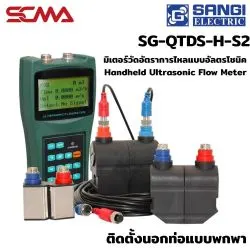 SG-QTDS-H-S2,M2-5 /DN15(1/2")-DN700(28") / Clamp on type / Handheld Ultrasonic Flow Meter SANGISpecial Price THB 25,500.00 Regular Price THB 34,000.00
Delivery: 30 ต.ค. 2569
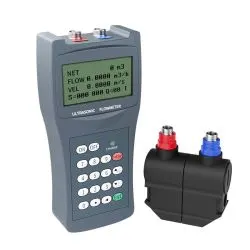 SUPMEA SUP-2100H Handheld Ultrasonic Flow MeterSpecial Price THB 28,160.00 Regular Price THB 35,200.00
Delivery: 30 ต.ค. 2569
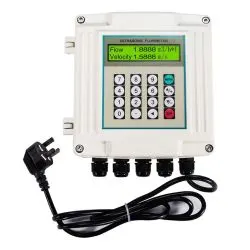 SUPMEA SUP-1158S Wall mounted Ultrasonic Flow MeterSpecial Price THB 31,680.00 Regular Price THB 39,600.00
Delivery: 30 ต.ค. 2569
What is an Ultrasonic Flow Meter and Why Is It Popular?
Ultrasonic Flow Meter is a tool for measuring the flow rate of liquids and gases using high-frequency sound waves (Ultrasonic) without direct contact with the fluid. The key feature that makes ultrasonic flow meters widely popular today is their "Clamp-on" installation method, which reduces the hassle of pipe cutting and minimizes leakage risks, making them the most cost-effective long-term flow measurement devices.
Simplified Definition
In simple terms, an ultrasonic flow meter is a digital scale for water pipes. It uses sound to "listen" to the flow of water instead of using blades to obstruct it, which means there are no wear-prone parts and accurate measurements can be taken even in large diameter pipes.
Main Advantage: Non-Intrusive Measurement
The standout feature of clamp-on flow meters is that you can install sensors outside the pipe without interrupting production lines, draining water out, or worrying about pressure drop (Pressure Drop), unlike older flow meters which require cutting into the pipe for installation.
Importance in Modern Industries
In the era of Industry 4.0, data is crucial. Ultrasonic flow meters can connect to SCADA systems to send real-time data, helping engineers analyze energy efficiency and detect leaks immediately.
How Does an Ultrasonic Flow Meter Work?
The core principle of ultrasonic flow meter operation involves sending sound waves through the pipe wall into the liquid, then measuring time or frequency changes to calculate speed and volume. This is divided into two main technologies based on fluid characteristics as follows [Infographic comparing Transit-Time vs Doppler]
Transit-Time Technology (Time-of-Flight)
This method measures the "time" it takes for sound waves to travel with or against the flow of water. If the water flows fast, the wave sent in the direction of the flow will arrive earlier than the one sent against it. This time difference is used to calculate the flow rate, suitable for clean water or oil without air bubbles. Learn more about this principle at Bronkhorst.
Doppler Effect Technology (Frequency Shift)
This method works similarly to how we hear a change in pitch as an ambulance passes by. Doppler sends sound waves that bounce off air bubbles or particles in the water, then measures the "frequency" of the reflected signal, suitable for wastewater or liquids with suspended solids.
Differences You Need to Know Before Choosing
In summary, if you are measuring drinking water or clean water, choose Transit-Time. But if you are measuring wastewater or sludge, choose Doppler. Incorrect selection may render your expensive ultrasonic flow meter useless.
Types of Ultrasonic Flow Meters You Should Know About
The market offers various types of ultrasonic flow meters to suit different applications. Knowing the types will help you select the most cost-effective flow meter for your needs.
Clamp-on Flow Meter: Advantages and Installation
Clamp-on flow meters are the stars because they are easiest to install, requiring only gel application followed by sensor attachment to the pipe. Ideal for temporary inspections or work that doesn't require system downtime.
Insertion Flow Meter: Suitable for Large Pipes
If old pipes have thick rust preventing sound wave transmission, insertion type is the solution. It involves drilling a small hole and inserting the measuring head directly into the liquid, providing higher accuracy than clamp-on in older pipes.
In-line / Spool Piece Flow Meter: For Maximum Accuracy
This comes as a pipe section with flanges, requiring cutting to install but offering the highest accuracy (up to 0.5% or better). Popular for oil trading (Custody Transfer) where high precision is required.
Portable Flow Meter: For Temporary Inspections
Portable ultrasonic flow meters are designed to be carried in a bag with built-in batteries, ideal for service teams inspecting various locations or calibrating other flow meters.
How to Choose the Right Ultrasonic Flow Meter for Your Needs
Mis-specification can lead to wasted money. Factors to consider aren't just ultrasonic flow meter price but also engineering aspects such as fluid characteristics, pipe specifications, and desired accuracy.
Fluid Characteristics (Type, Temperature, Viscosity)
You need to know what the liquid is, whether it's clean or has particles. If corrosive chemicals are involved, special material sensors must be chosen, and if temperature exceeds 100°C, high-temperature sensor models should be used.
Pipe Characteristics (Material, Size, Thickness)
Pipe material affects sound wave travel; PVC, steel, or stainless steel require different settings. Knowing the pipe size (DN) is crucial for selecting matching sensor sizes. If unsure about pipe size, consult SCMA All Products.
Required Accuracy (Accuracy & Repeatability)
If used to monitor general trends, clamp-on with 1-2% accuracy suffices. But if used for billing purposes, inline models with 0.5% or better accuracy are necessary.
Installation Environment (Temperature, Vibration)
The installation point must have sufficient straight pipe run (typically recommended as 10D before and 5D after) to ensure stable flow patterns. Nearby pumps or valves may cause fluctuations in readings.
Applications in Various Industries
Ultrasonic flow meters are used across industries for their non-intrusive nature, ease of installation, and wide range of applications.
Water Treatment Industry
Used to measure raw water intake into plants and wastewater before discharge, aiding compliance with regulatory requirements. Doppler or hybrid models are preferred.
Food & Beverage Industry
Due to being non-contact, they're ideal for food applications without harboring bacteria in crevices (Hygiene). Used to measure syrup, milk, or fruit juice in production lines. Learn more about other meter types at What is Electrical Meter.
Chemical & Petrochemical Industry
Safely measures hazardous chemicals or concentrated acids without pipe cutting risks and withstands harsh refinery environments.
HVAC Systems and Building Energy Management
Used with temperature sensors to calculate cooling energy (BTU Meter) in building chillers, aiding efficiency analysis.
Advantages and Limitations to Consider
Every coin has two sides; good engineers know limitations before choosing to avoid future problems.
Advantages: No Downtime, Low Maintenance, Versatile Fluids
No downtime is key. Installation takes hours without hiring welders or redoing hydro tests. Low maintenance due to no moving parts (No moving parts) that wear out like paddle wheel types and wide measurement range.
Limitations: Air Bubble Impact, Pipe Material Constraints
If fluid has too many air bubbles for transit-time models, signal loss occurs. Additionally, pipes with internal liners or thick concrete may hinder sound wave transmission; always check specifications with experts.
Consider SCMA When Looking for an Ultrasonic Flow Meter!
Selecting the right ultrasonic flow meter requires expertise. SCMA not only sells but also offers a team of engineers to survey sites, recommend suitable models, and provide installation/calibration services ensuring your investment yields maximum returns. For more information on Flow Meter Types and Principles, click here.
Summary
An ultrasonic flow meter is a technology that meets the needs of modern factories requiring accuracy and ease of installation, whether clamp-on, inline or portable. Choosing the right type is key; if you need more information or quotes, don't hesitate to contact SCMA. We're ready to partner with you for your measurement control system.
Frequently Asked Questions
How Accurate Are Ultrasonic Flow Meters?
Accuracy varies by type and installation; generally, clamp-on models are within +1% to +3%, while inline can achieve ±0.5%, sufficient for most process control applications.
Do You Need to Shut Down Production Lines for Installation?
No, this is the standout feature of clamp-on models where sensors can be attached to pipes without interrupting production lines.
Can Old Rusty Pipes Be Used?
Yes, but exterior rust must be sanded smooth before applying coupling gel. If internal buildup is severe, special high-power transmission or insertion types may be needed.
This website uses cookies
We use cookies to make the site work properly, to understand how it is used, and to show content that is relevant to you. You choose which types to allow; strictly necessary cookies are always on. Privacy Policy
🤖 AI Assistant
Ask about products, specs and replacement models
Hello 👋 Ask us anything — find products, compare specs, or troubleshoot.
🗑 Clear history